

Written By: Apoorv Agarwal, Preyoshi Bhattacharjee
INTRODUCTION
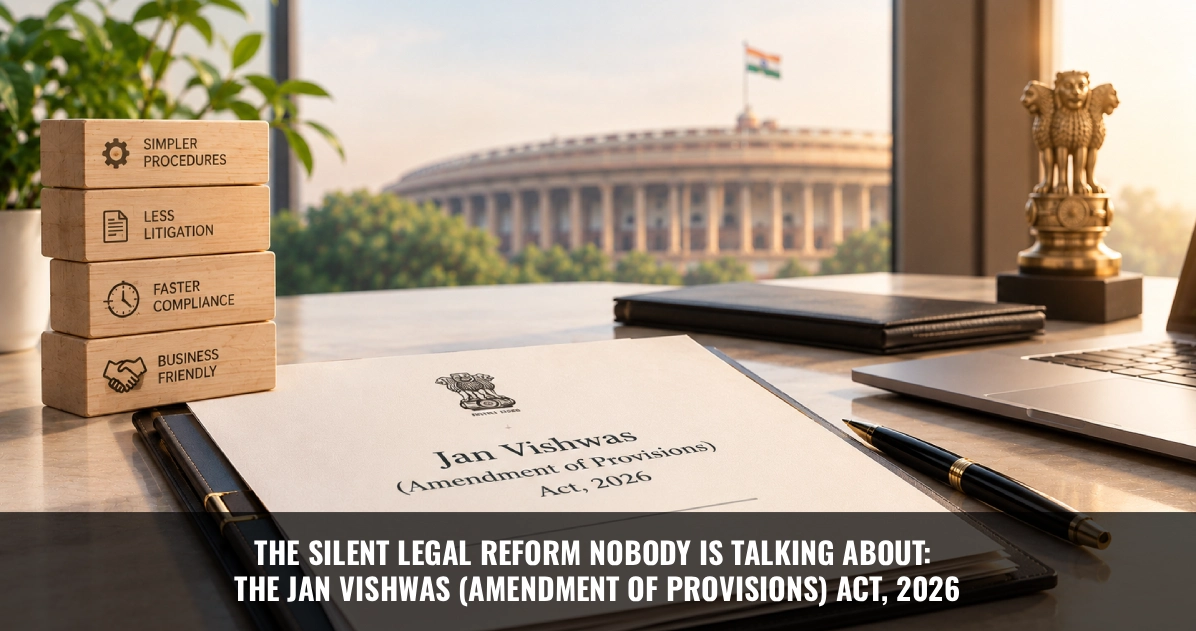
The Jan Vishwas (Amendment of Provisions) Act, 2023 (hereinafter referred to as the “Act”) has been hailed as one of the most significant legal reforms undertaken by the Government of India in recent years. Introduced with the objective of fostering trust-based governance and improving the ease of doing business, the Act seeks to reduce the criminalisation of minor regulatory and procedural violations by replacing criminal sanctions with civil penalties and administrative measures. Through amendments to 79 Central Acts covering 784 provisions, the legislation attempts to rationalise the regulatory framework and shift the focus of enforcement from punishment to compliance.[1]
At first glance, the reform appears to be a progressive step towards dismantling an over-criminalised legal system that had, for decades, treated numerous technical and procedural defaults as criminal offences. The Act acknowledges that imprisonment and criminal prosecution are often disproportionate responses to minor regulatory violations and that excessive criminalisation can impede entrepreneurship, discourage investment, and burden the judicial system. By decriminalising a substantial number of provisions, the legislature has sought to create a more business-friendly and citizen-centric regulatory environment.
However, beneath the celebratory narrative surrounding the legislation lies a more fundamental and uncomfortable question. If over 780 provisions required decriminalisation, does this not amount to an admission that a significant portion of India’s regulatory framework was unnecessarily criminal in the first place? More importantly, who bears responsibility for the consequences of such over-criminalisation? For years, individuals and businesses faced the threat of prosecution, criminal proceedings, and social stigma for conduct that is now considered insufficiently serious to warrant criminal sanctions. The Act remains conspicuously silent on the fate of those who may have suffered because of these provisions and offers no mechanism for addressing the historical consequences of such regulatory excess.
The legislation also raises concerns regarding its practical implementation. While the replacement of criminal penalties with monetary penalties undoubtedly reduces the severity of legal consequences, it does not necessarily simplify compliance obligations or reduce regulatory intervention. The success of the Act will therefore depend not merely on the text of the amendments but on the willingness of regulatory authorities to embrace the underlying philosophy of trust-based governance. In the absence of meaningful administrative reform, there remains a risk that the legislation may merely substitute one form of regulatory burden with another.
Against this backdrop, a critical examination of the Jan Vishwas Act becomes essential. Is the legislation a genuine attempt to correct decades of legislative overreach and transform the relationship between citizens and the State, or does it merely create the appearance of reform without addressing the structural issues that gave rise to over-criminalisation in the first place? In other words, will the Act bring about tangible change at the ground level, or is it simply constructing a palace of illusions built upon promises of deregulation and trust?
CRITICAL ANALYSIS OF THE ACT
At a time when India is seeking to attract investment and promote entrepreneurship, such reforms are both timely and necessary. The shift from criminal sanctions to monetary penalties in appropriate cases demonstrates an attempt to strike a balance between effective regulation and economic growth.
The replacement of criminal sanctions with monetary penalties raises questions about deterrence. Large corporations with significant financial resources may view penalties as manageable costs rather than serious consequences. If penalties are not substantial enough, the objective of ensuring compliance may not be fully achieved. Effective implementation and monitoring will therefore be essential for the success of the Act.
The Act increases the role of administrative authorities in adjudicating offences. While this can improve efficiency, it may also lead to concerns regarding excessive discretion and inconsistent decision-making. Without adequate safeguards and transparent procedures, there is a risk that administrative powers could be exercised arbitrarily. Therefore, accountability mechanisms must accompany the expanded role of regulatory authorities.
Another area of criticism relates to environmental and public welfare regulations. Excessive decriminalization could weaken accountability in sectors where violations may have serious social and environmental consequences.[2] While procedural lapses may not warrant criminal prosecution, offences causing significant harm should continue to attract stringent penalties. Maintaining this balance remains a critical challenge.
Although the Act reduces criminal liability, it does not substantially simplify India’s regulatory framework. Businesses may still face complex licensing procedures, multiple approvals, and extensive compliance requirements. Consequently, decriminalization alone may not fully address the broader issues associated with regulatory burdens. Further structural reforms will be necessary to achieve meaningful simplification.
The shift from imprisonment to monetary penalties is generally viewed as a progressive measure. However, financial penalties may have different effects on different categories of offenders. Large corporations may be able to absorb penalties without significant difficulty, whereas small businesses and individual entrepreneurs may face considerable financial strain.
CONCLUSION
The Jan Vishwas (Amendment of Provisions) Act, 2023 marks an important milestone in India’s ongoing efforts to reform its regulatory framework and create a more balanced approach towards compliance and enforcement. By decriminalising a large number of procedural and technical offences, the Act seeks to reduce the burden on businesses and individuals while ensuring that regulatory objectives continue to be met through civil and administrative mechanisms. In doing so, it reflects a growing recognition that criminal law should be reserved for serious wrongdoing rather than routine instances of non-compliance.
At present, it would be premature to conclude that the Jan Vishwas Act is merely a symbolic reform. The legislation has already brought about a substantial shift in India’s regulatory framework by decriminalising hundreds of provisions and signalling a move away from the routine use of criminal law for minor procedural and technical violations. In that sense, the Act has the potential to create tangible benefits, including reducing the fear of prosecution, lowering compliance costs, easing the burden on courts, and fostering a more business-friendly regulatory environment.
However, the true impact of the Act cannot be assessed solely by the number of provisions amended. Regulatory reform is ultimately tested through implementation. While the law has removed imprisonment and criminal liability in several instances, the underlying compliance obligations continue to exist, often backed by monetary penalties. If regulatory authorities continue to adopt an overly rigid or punitive approach, the practical experience of businesses and citizens may not change as significantly as the legislation intends.
That said, the Act should not be dismissed as a mere exercise in legislative optics. It represents an important acknowledgement by the legislature that excessive criminalisation can be counterproductive and that compliance is often better achieved through administrative and civil mechanisms rather than criminal prosecution. The reform may not resolve every issue within India’s regulatory ecosystem, but it establishes a framework upon which further rationalisation can be built.
Therefore, the Jan Vishwas Act is best viewed as a meaningful first step rather than a complete solution. Whether it ultimately delivers on its promise of trust-based governance will depend on the consistency of its implementation and the willingness of regulators to embrace the spirit of the reform. If that occurs, the Act could prove to be a significant turning point in India’s approach to regulatory enforcement; if not, its impact may remain confined largely to the statute book.
[1] Jan Vishwas (Amendment of Provisions) Bill, 2026: Simplifying Laws, Strengthening Trust, PIB Delhi, April 4th 2026, https://www.pib.gov.in/PressReleasePage.aspx?PRID=2248925®=3&lang=2
[2] Jan Vishwas Act: transition from punitive regime to trust based regime.