
Written By- Apoorv Agarwal, Gaurav Singh (Senior Associate)
Case Details- Ahra Syed v. SSP Traffic Police City Srinagar, File No. 4172/Misc./2025
Court- Special Mobile Magistrate (Traffic), Kashmir at Srinagar
Date of Decision– 05.05.2026
In an era where almost every aspect of governance has become digital, traffic enforcement has also undergone a technological transformation. Thereby, E-challans, surveillance cameras, automatic number plate recognition systems and mobile enforcement units are now common features on Indian roads. While these mechanisms are intended to improve transparency and road discipline, a recent judgment delivered by the Special Mobile Magistrate (Traffic), Srinagar, reminds authorities that technology cannot operate outside the boundaries of law.
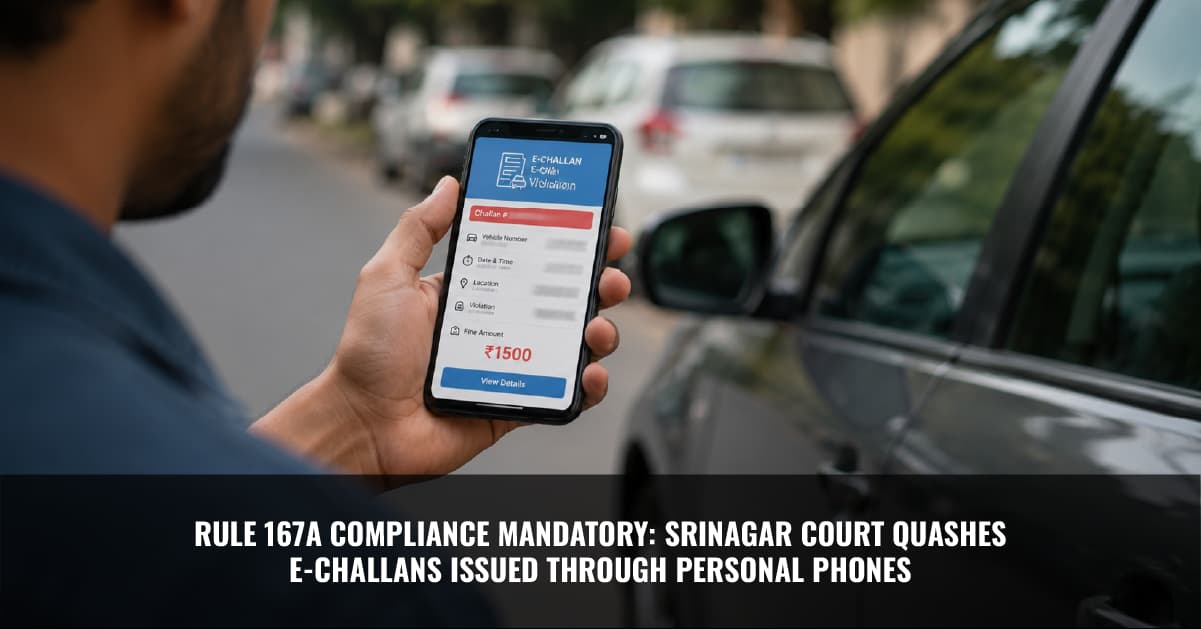
In Ahra Syed v. SSP Traffic Police City Srinagar, the Court quashed multiple e-challans issued against a vehicle owner after finding that they had allegedly been generated through personal mobile phones of police officers rather than officially authenticated electronic enforcement devices.
The judgment is significant not merely because the challans were set aside, but because it raises a larger question: can convenience override procedural safeguards in digital policing?
The applicant, a practising advocate, challenged several e-challans issued against her vehicle for offences such as disobedience of traffic signals, driving on footpaths and disobeying lawful directions. She argued that the challans were vague, unsupported by proper evidence and issued mechanically without compliance with Rule 167A of the Central Motor Vehicles Rules, 1989.
One of the most striking observations made by the Court was that some challans alleged “disobedience of traffic signals” at locations where, according to the applicant, no functional traffic signal even existed. The Court noted that the photographs attached to the challans did not clearly depict any signal post, stop line, or actual act of violation. Merely capturing a photograph of a vehicle, the Court observed, cannot automatically establish the commission of an offence.
The backbone of the judgment is Rule 167A of the Central Motor Vehicles Rules, introduced in 2021 to regulate electronic traffic enforcement. The Rule specifically contemplates the use of approved electronic enforcement devices such as CCTV cameras, speed cameras, ANPR systems, body cameras and dashboard cameras. These devices must be authenticated, certified and integrated with the official traffic enforcement system.
The Court drew an important distinction between an authorised electronic enforcement device and a personal smartphone. According to the Court, a privately owned mobile phone lacks official authentication, audit trails, system integration and accountability safeguards required under Rule 167A. Therefore, a challan generated through such a device becomes “procedurally defective and legally infirm.”
This reasoning carries broader constitutional and administrative significance. Digital governance may increase efficiency, but procedural fairness remains the foundation of lawful enforcement. The Court rightly expressed concern that permitting officers to issue challans through personal devices could open the door to fake challans, manipulation of evidence, lack of accountability and harassment of citizens.
Another important aspect of the ruling is the Court’s reliance on the Supreme Court judgment in S. Rajaseekaran v. Union of India. The Supreme Court had earlier directed States and Union Territories to implement Rule 167A strictly and ensure that challans are issued on the basis of footage obtained from approved electronic enforcement devices. The Srinagar Court effectively reinforced that mandate at the ground level.
Equally noteworthy is the Court’s observation that e-challans cannot be issued for every traffic offence. Rule 167A(3) specifically enumerates the categories of offences for which electronic enforcement may be used, such as speeding, helmet violations, red-light jumping and lane discipline violations. Authorities cannot mechanically expand the scope of e-challan enforcement beyond what the Rules permit.
At a practical level, the judgment serves as a reminder to traffic authorities that digital enforcement systems must be transparent, evidence-based and legally compliant. For citizens, it reinforces the principle that even in traffic regulation, the State must act within the framework of law and procedure.
The case does not undermine the importance of e-challans. On the contrary, it strengthens their legitimacy by insisting that technology-backed enforcement must also be accountable enforcement. Efficient governance and procedural fairness are not opposing goals; they must coexist.
As India moves toward increasingly automated systems of policing and surveillance, this judgment may well become an important precedent in defining the limits of digital enforcement powers. Technology may assist the law, but it cannot replace legality itself.