

Written By: Apoorv Agarwal, Bhanukaran Singh Jodha
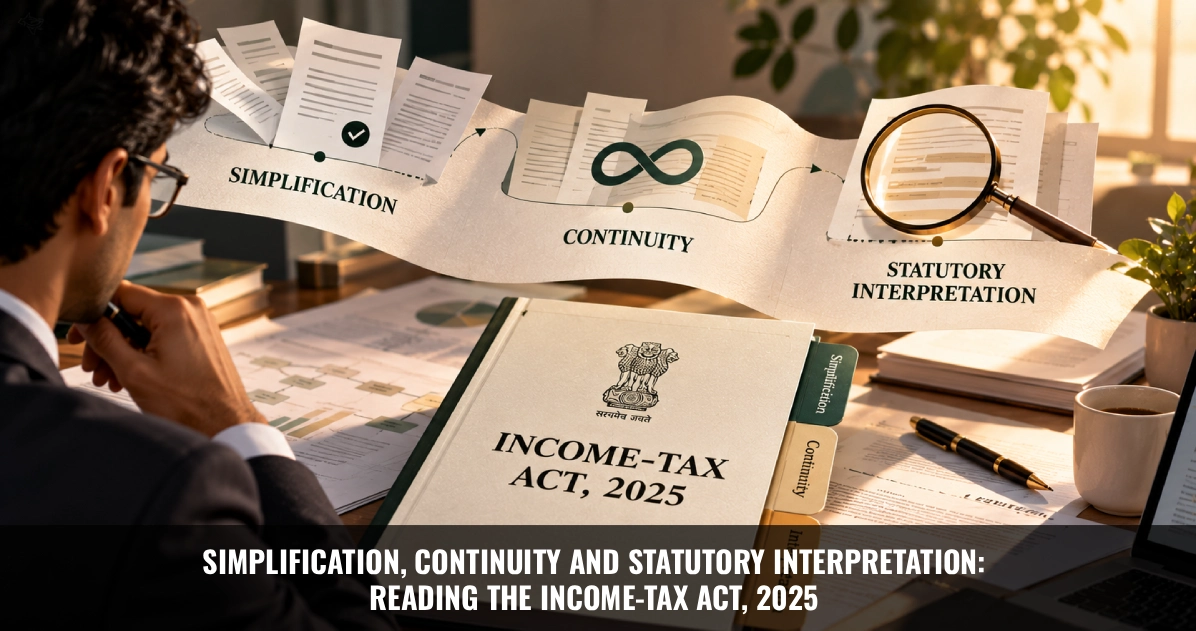
The enactment of the Income-tax Act, 2025 presents an unusual exercise in legislative drafting. It replaces a statute that governed India’s direct tax framework for more than six decades, while being introduced not as a fundamental policy overhaul, but as an exercise in simplification, continuity and avoidance of major policy change.
That creates an interpretive challenge.
A statute may be simplified only by changing the form in which the law is expressed. Provisions may be rearranged, explanations may be incorporated into substantive clauses, provisos may be recast, and language may be modernised. Yet tax law attaches consequences to the precise words enacted by Parliament.
The question, therefore, is inevitable: when the language of the 2025 Act differs from the corresponding provision of the Income-tax Act, 1961, how should courts determine whether the change is merely structural or whether Parliament intended to alter the law?
The answer cannot lie in either extreme. Every change in wording cannot automatically be treated as a substantive amendment. Equally, the objective of simplification cannot become a presumption that the legal effect of every provision remains unchanged.
The novelty of the 2025 Act does not require a new theory of statutory interpretation. Existing principles provide the necessary framework. The challenge lies in applying those principles to a rewritten statute.
Text, context and legal effect
In a taxing statute, the starting point remains the enacted text. In A.V. Fernandez v. State of Kerala, the Supreme Court reiterated the strict approach applicable to taxing statutes: tax liability must flow from the clear words of the statute, not from inference, equity or presumed intention.1 Similarly, in B. Premanand v. Mohan Koikal, the Court emphasised that where statutory language is clear, courts must give effect to the words actually used. Legislative intention is primarily gathered from the statute itself.2
This principle assumes particular significance for the 2025 Act. Even if the broader legislative exercise was intended to simplify the law, courts cannot restore words that Parliament has removed or ignore words that Parliament has introduced. Continuity must ultimately be found in the enacted provision.
At the same time, statutory interpretation does not require provisions to be read in isolation. In Reserve Bank of India v. Peerless General Finance and Investment Co. Ltd., the Supreme Court explained that interpretation depends on both text and context.3 This is particularly relevant in a legislative rewrite. A provision may look different because the drafting style has changed. An explanation may become a sub-section. A proviso may become a clause. A lengthy provision may become a table. The interpretive inquiry cannot end with identifying a textual difference; the court must examine whether that difference changes the legal operation of the provision.
The Constitution Bench decision in CIT v. Vatika Township (P) Ltd. reinforces this approach. Whether a legislative change is clarificatory, procedural or substantive depends not merely on its description, but on its nature and effect. The consequences produced by the change remain central.4 Therefore, simplification is relevant background, but it is not itself an interpretive rule.
Where genuine ambiguity remains, legislative history may assist. In K.P. Varghese v. Income Tax Officer, the Supreme Court recognised that the speech of the mover of a Bill may be referred to for understanding the object of legislation and the mischief sought to be addressed.5 Applied to the 2025 Act, the legislative material surrounding simplification may assist courts in understanding the purpose of the rewrite. But it remains an aid to interpretation. It cannot override the statutory text.
Applying the framework to the Income-tax Act, 2025
The practical importance of this framework can be seen from three categories of changes reflected in the new Act.
The first category is where judicially interpreted language has been retained. Section 37(1) of the 1961 Act permitted deduction of expenditure laid out or expended “wholly and exclusively for the purposes of the business or profession”. Over several decades, courts have interpreted this expression and developed principles around business purpose and commercial expediency. The corresponding provision in Section 34 of the 2025 Act retains this familiar expression, while restructuring certain exclusionary provisions that previously appeared separately.6
The retention of such settled terminology is significant. Where Parliament reenacts language that has acquired judicial meaning, there is a strong argument for continuity of interpretation. At the same time, courts must still examine whether surrounding structural changes alter the operation of the provision.
In such cases, continuity does not arise merely from the general objective of simplification; it arises from Parliament’s decision to retain language that already carries an established legal meaning. The interpretive significance lies not only in what has changed, but also in what has consciously been preserved.
The second category involves restructuring. Section 14A of the 1961 Act dealt with expenditure incurred in relation to income not forming part of total income. The Explanation inserted by the Finance Act, 2022 itself arose in the backdrop of controversy over the scope of the provision. Under the 2025 Act, the corresponding provision in Section 14 incorporates the subject matter in a revised structure.7
This raises a different interpretive question: when material previously contained in an explanation is incorporated into the body of a rewritten provision, does that merely improve drafting or does it affect how the provision should be understood? The answer cannot be assumed. Courts must examine the purpose of the earlier explanation, the reason for restructuring, and whether the legal effect has changed.
The movement of statutory language from one legislative form to another may therefore be relevant, but it is not determinative. A change in structure must ultimately be tested against whether it changes the rights, liabilities or consequences created by the provision.
The third category is where familiar expressions themselves are altered. An illustration arises from the provisions relating to unexplained assets. Section 69A of the 1961 Act applied where an assessee was found to be the owner of money, bullion, jewellery or other valuable articles not recorded in the books of account and for which no satisfactory explanation was offered. The corresponding provision in Section 104 of the 2025 Act uses the expression “owned by or belonging to” the assessee.8
The addition of “belonging to” alongside “owned by” may not necessarily be dismissed as merely stylistic. It may invite argument on whether the deeming provision now travels beyond strict ownership. The court’s task would not be to presume expansion or continuity, but to test the changed expression against the text, statutory context and legal consequences of the provision.
These illustrations demonstrate that the 2025 Act cannot be interpreted through a single assumption. The same legislative exercise may produce different interpretive answers depending on the provision. A rewritten statute therefore requires comparison at the level of legal effect, not merely comparison at the level of drafting form.
A court faced with such a dispute may usefully ask four questions. First, what does the text of the 2025 Act provide? Second, has the statutory context changed, or has the provision merely been reorganised? Third, does the alteration affect rights, liabilities, deductions, exemptions, limitation periods, procedural safeguards or burdens? Fourth, if uncertainty remains, does the legislative background assist in identifying whether continuity or change was intended?
The Income-tax Act, 2025 is likely to create a new category of interpretive disputes, not because Parliament has necessarily altered substantive law, but because a rewritten statute requires courts to determine where continuity lies, in the words used, the legal effect produced, or the purpose underlying the enactment.
Existing principles of statutory interpretation are equipped to answer that question. The discipline lies in resisting both extremes: assuming that every change in language changes the law, and assuming that simplification means nothing has changed.
The interpretive balance is therefore important. Simplification may explain the rewrite; it cannot control the meaning of the rewritten law. The text must govern, context must inform, legal effect must be tested, and legislative history may assist only where the statute leaves room for interpretation.
References
1. A.V. Fernandez v. State of Kerala, (1957) 1 SCC 560, para 29.
2. B. Premanand v. Mohan Koikal, (2011) 4 SCC 266, paras 18, 24 and 27-29.
3. Reserve Bank of India v. Peerless General Finance and Investment Co. Ltd., (1987) 1 SCC 424, para 33.
4. CIT v. Vatika Township (P) Ltd., (2015) 1 SCC 1, paras 27-36.
5. K.P. Varghese v. Income Tax Officer, (1981) 4 SCC 173, para 8.
6. Income-tax Act, 1961, Section 37(1); Income-tax Act, 2025, Section 34.
7. Income-tax Act, 1961, Section 14A; Income-tax Act, 2025, Section 14.
8. Income-tax Act, 1961, Section 69A; Income-tax Act, 2025, Section 104.