

Written By: Apoorv Agarwal, Divya Verma (Senior Associate)
Introduction:
The rapid pace of technological development has led to an unprecedented growth in the use of artificial intelligence across various sectors. AI is increasingly being adopted for tasks such as data analysis, content creation, and decision-support functions,[1] even in domains that were once considered heavily dependent on human involvement, owing largely to the convenience, accuracy, and time efficiency it provides.
However, the legal industry has not fully embraced AI’s impact yet, despite AI being used for managing cases, drafting contracts, utilizing smart contracts, and conducting e-research.[2]
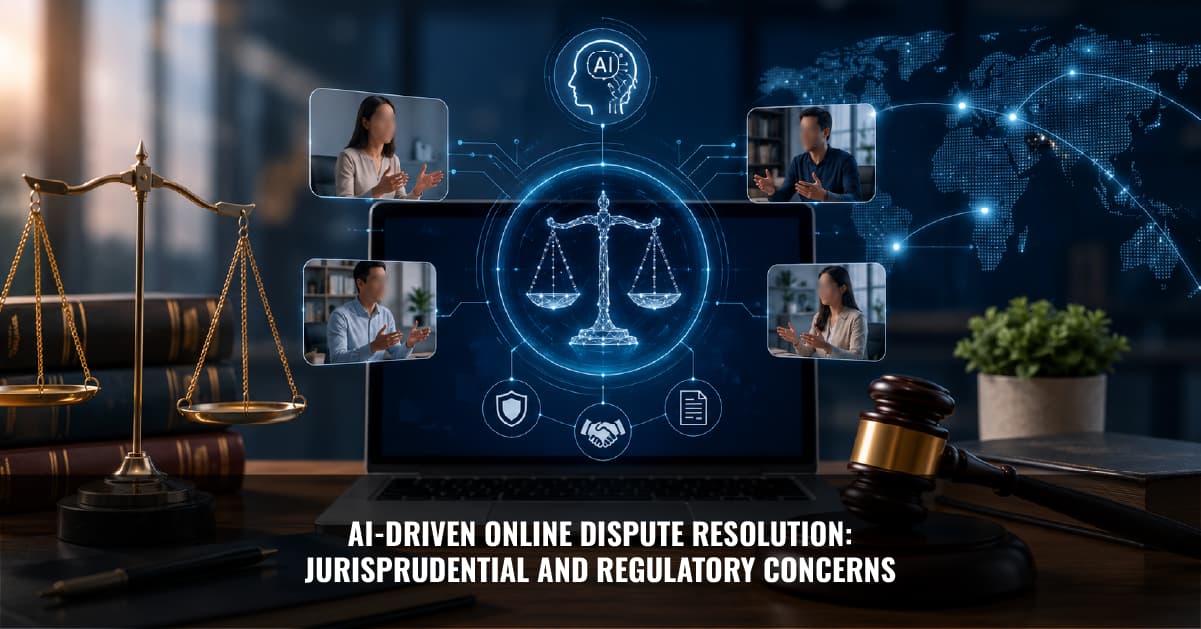
In the legal industry, where human judgment plays a significant role, AI has not fully taken over. But it has already found its way into tasks as mentioned above. Online dispute resolution (ODR) has emerged,[3] allowing parties to resolve issues through online sessions, sometimes with the assistance of AI tools as well.
This article aims to discuss how AI is being utilized in the legal field while addressing the significant challenges and potential issues posed by this expansion, reminding of the warning, “Speed thrills but kills,” as efficiency must not come at the cost of justice, because some scholars believe that AI robots might eventually take on the role, while others argue that the human touch is something only a human can provide, making AIs complete takeover impossible.[4]
Implications of AI on the Industry:
Technological advancements have become so significant that they assist in reaching solutions, including AI. Looking back at the history of technological tools and how they contribute to amicable solutions without the need for the judicial officer or third party, the first initiative was launched in 1996 at the universities of Massachusetts and Maryland.[5] It was introduced as a robust system on the eBay platform to resolve commercial disputes between buyers and sellers.[6] Interestingly, eBay successfully handled numerous disputes through this initiative.
The judiciary has also begun accepting technological tools. In the case of Loomis,[7] USA, an algorithmic formula was used to sentence a man who operated a vehicle without authorization. The software, COMPAS (Correctional Offender Management Profiling for Alternative Sanctions), analysed offender data to predict recidivism and similar group behaviours. This case introduced the concept of predictive justice and the use of technological tools.[8]
Predictive justice is an algorithmic tool that utilizes AI to analyse court decisions and presents how a decision should be formulated.[9] Furthermore, e-discovery, another technological tool, has also gained attention as it offers cost-effective and timely solutions in litigation. It manages data, preserves legal holds, and processes information.[10]Furthermore, the introduction of databases like Jurisphere has made the presence of AI evident in the legal industry, as it is already being widely used by several Tier 1 law firms in India.
Navigating the Challenges:
It’s essential to ensure that the people in the country where AI is being implemented are aware of this concept. Is there a strong digital literacy among the population? If not, it’s a disadvantage for those who lack digital literacy[11] because Skepticism can hinder positive outcomes and enforceability.[12]
In cases of, AI implementation, where in-person interaction is replaced by a digital forum, issues like data security and confidentiality become prominent.[13]. The proposed solutions through AI can exacerbate potential issues, including online impersonation.[14] Moreover, AI also faces internal challenges as & when AI reaches a decision or confronts a point, its analysis canters on objectivity or revolves around objectivity.[15] This objectivity lacks the human element present in human interference.[16] During disputes, a bench or jury is typically present, introducing subjectivity that aids in interpreting the case’s intricate nuances. The human consciousness and social intelligence applied to cases cannot be replicated by the AI model. Moreover, some programmers struggle to explain the basis of AI predictions, which raises concerns about the extent of reliance and its possibility.[17]
Conclusion/ recommendations:
In the earlier discussion on challenges, we understood that enhancing digital infrastructure in the country is essential. Furthermore, establishing a framework, such as a legal tech hub, could prove beneficial. For instance, Singapore’s Future Law Innovation Programme (FLIP), encourages the adoption of new technologies in the legal sector. A similar framework could help strengthen the AI model.[18]
AI’s vast scope and expansion have led to questions about data predictability, regulation, and the existence of various elements. Therefore, there is a need to develop a comprehensive data corpus that aids in identifying patterns and rules, providing insights into AI’s functioning.[19]
As seen above, AI’s application in the legal industry brings to light the possibility of biases in its internal assessment, given that its objective analysis can be influenced by biases.[20] Hence, creating a platform that pre-emptively rectifies biases in the solutions provided by AI in disputes is necessary.[21]
Therefore,AI’s growth comes with challenges, but by focusing on accountability, digital infrastructure, and ethical considerations, we can harness its potential while ensuring fairness remains the bedrock of our justice system.
[1]Joshua A. Kroll et al., Accountable Algorithms, 165 U. Pa. L. Rev. 633, 633 (2016)
[2]The future of arbitration: New technologies are making a big impact and AI robots may take on “human” roles, HOGAN LOVELLS PUBLICATIONS, 1, 1 (2018).
[3]United Nations Commission On International Trade Law, UNCITRALTechnical Notes on OnlineDispute Resolution, UNCITRAL, (Oct. 14, 2018),http://www.uncitral.org/pdf/english/texts/odr/V1700382_
English_Technical_Notes_on_ODR.pdf. Accessed 23 September 2025
[4] Steven Goldberg, Artificial Intelligence and the Essence of Humanity, NYU
PRESS, 151, 171 (1994)
[5] Ethan Katsh, ‘ODR: A Look at History’ in Mohamed Abdel Wahab and others (ed), Online Dispute Resolution Theory and Practice (EIP 2013) 23 accessed 23 September 2025
[6] Ethan Katsh, ‘ODR: A Look at History’ in Mohamed Abdel Wahab and others (ed), Online Dispute Resolution Theory and Practice (EIP 2013) 27
[7] State v. Loomis, 881 N.W.2d 749, 66, 68 (Wis. 2016)
[8] Supra note 7
[9] Supra note 7
[10]Using Technology and e-Disclosure, GLOBAL ARBITRATION REVIEW (Sept. 3, 2021),https://globalarbitrationreview.com/guide/the-guide-evidence-in-international-arbitration/1stedition/article/using-technology-and-e-disclosure#footnote-069. accessed 25September 2025
[11] Charlotte Austin, ‘Online dispute resolution – An introduction to online dispute resolution (ODR), and its benefits and drawbacks’ (Government Centre for Dispute Resolution, Ministry of Business, Innovation and employment, New Zealand Government, 2017) 18 accessed 24 September 2025
[12] Charlotte Austin, ‘Online dispute resolution – An introduction to online dispute resolution (ODR), and its benefits and drawbacks’ (Government Centre for Dispute Resolution, Ministry of Business, Innovation and employment, New Zealand Government, 2017)) 22 accessed 24 September 2025
[13] Louise Ellen Teitz, ‘Providing Legal Services for the Middle Class in Cyberspace: The Promise and Challenge of On-Line Dispute Resolution’ (2001) 70 Fordham Law Review 1009 accessed 24 September 2025
[14] Charlotte Austin, ‘Online dispute resolution – An introduction to online dispute resolution (ODR), and its benefits and drawbacks’ (Government Centre for DisReferences 136 Designing the Future of Dispute Resolution: The ODR Policy Plan for India pute Resolution, Ministry of Business, Innovation and employment, New Zealand Government, 2017)) 19 accessed 25September 2025
[15] Helen Nissenbaum, Values in Technical Design, in Encyclopedia of Science, Technology, and Ethics
lxvi, lxvi (Carl Mitcham ed., 2005)
[16] Steven Goldberg, Artificial Intelligence and the Essence of Humanity, NYU PRESS, 151, 171 (1994).
[17]Maxi Scherer, International Arbitration 3.0 – How Artificial Intelligence Will Change DisputeResolution?, in Austrian Yearbook on International Arbitration 504 (Klausingeret al., eds., 2019).
[18]Dominic Wrench, ‘Singapore: Why Singapore Is A Global Hub For Legal Tech’ (Mondaq, 9 August 2019) accessed 25 September 2025
[19] Dave Orr and Colin Rule, ‘Artificial Intelligence and the Future of Online Dispute Resolution’ (NewHandshake) accessed 25September 2025
[20] National Center for Technology and Dispute Resolution, ‘Ethical Principles for ODR Initiative atAccessibility’ accessed 24September 2025; Leah Wing, ‘Ethical Principles for Online Dispute Resolution: A GPS Device for the Field’ (2016) 3(1) International Journal on Online Dispute Resolution accessed 25September 2025
[21] Advisory Committee of the National Centre for Technology and Dispute, ‘Online Dispute ResolutionStandards of Practice’ (2009) accessed 25September 2025.