
Written By: Apoorv Agarwal
Case Details– Assistant Commissioner of Income Tax Vs. Aristo Pharmaceuticals Private Limited (Diary No. 3266 of 2025)
Bench-CJI Surya Kant, Justice B.V. Nagarathna and Justice Joymalya Bagchi
Date of Decision- 10.04.2026
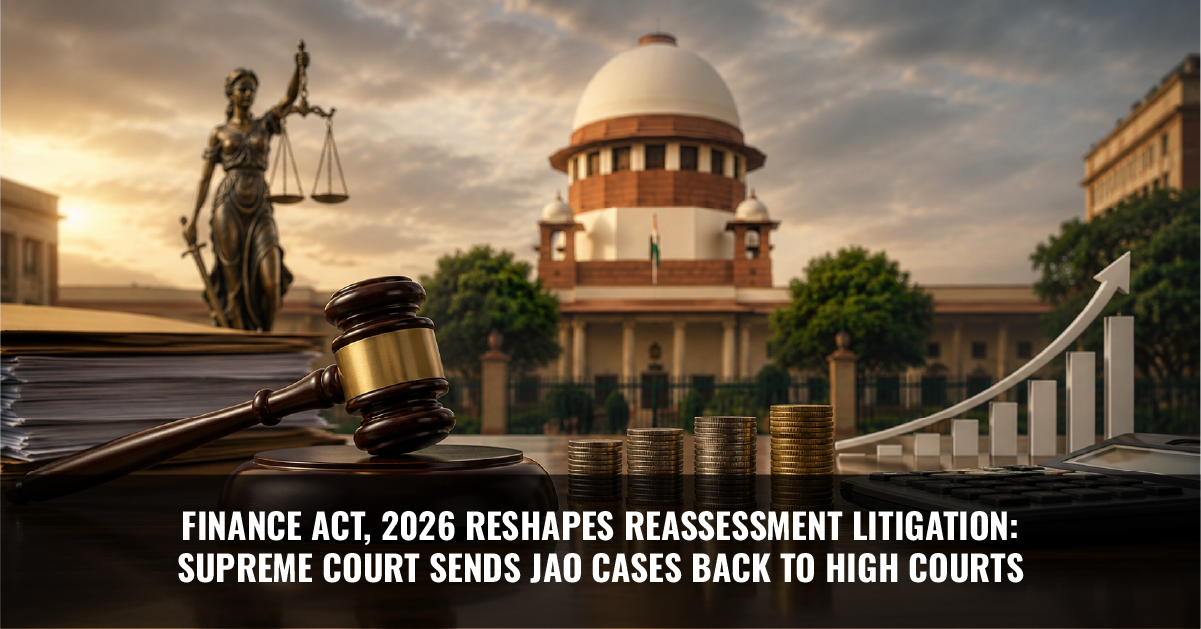
On April 10, 2026, the Supreme Court of Indiadisposed of a large batch of appeals concerning reassessment proceedings under the Income-tax Act, 1961 (‘IT Act’). The dispute centred on a key jurisdiction issue arising after the introduction of the faceless reassessment regime: whether notices under Section 148 and orders under Section 148A(d) could still be issued by the Jurisdictional Assessing Officer (‘JAO’), or whether such powers rested exclusively with the faceless assessment mechanism. While the Supreme Court did not decide the issue on the merits, the order has significantly altered the course of the litigation. Taking note of a subsequent legislative amendment introduced through the Finance Act, 2026, the Court set aside the judgments under challenge and remanded the matters to the respective High Courts for fresh consideration, including on the constitutional validity and retrospective operation of the amendment itself.
The controversy arose after the Finance Act, 2021, overhauled the reassessment framework under Sections 147 to 151 of the IT Act with effect from April 1, 2021. Under the amended regime, the Assessing Officer was required to conduct a preliminary enquiry under Section 148A, provide an opportunity of hearing to the assessee, and thereafter decide whether reassessment proceedings should be initiated. Subsequently, the CBDT introduced the E-Assessment of Income Escaping Assessment Scheme, 2022 under Section 151A, envisaging a faceless and automated mechanism administered through the National Faceless Assessment Centre (‘NFAC’). This led to conflicting judicial interpretations across High Courts. Certain High Courts held that JAOs continued to retain concurrent jurisdiction alongside the faceless mechanism, thereby validating reassessment notices issued by them. Others held that the statutory framework contemplated an exclusively faceless regime, rendering such notices without jurisdiction. The resulting divergence led to multiple appeals before the Supreme Court.
During the pendency of these proceedings, Parliament enacted Section 147A through the Finance Act, 2026, with retrospective effect from April 1, 2021. The provision clarifies that, notwithstanding anything contained in Section 151A, any scheme framed thereunder, or any judicial decision, the “Assessing Officer” for the purposes of Sections 148 and 148A shall mean an officer other than the NFAC or a faceless assessment unit under Section 144B(3). The Revenue argued that the amendment was merely clarificatory and reaffirmed Parliament’s original intent that initiation of reassessment proceedings always remained within the domain of the JAO.
The Supreme Court refrained from examining the correctness of the High Court decisions or the validity of the amendment. Instead, it observed that the legislative basis underlying the impugned judgments had now changed and, on that limited ground, the judgments were liable to be set aside. The Court expressly left open all questions concerning the scope, effect, retrospectivity, and constitutional validity of Section 147A for determination by the High Courts.
Importantly, the Court permitted assessees to amend their pending writ petitions within four weeks to challenge the constitutional validity of the amendment, including on grounds of impermissible retrospectivity. The Revenue was granted three weeks thereafter to respond. The Court also directed that reassessment proceedings pursuant to the impugned notices would remain stayed during the pendency of proceedings before the High Courts, subject to any conditions imposed by the respective courts. The High Courts were requested to dispose of the matters expeditiously, preferably by September 30, 2026.
The litigation before the High Courts is now likely to focus on whether Section 147A is truly clarificatory or whether it substantively alters the law with retrospective effect. While Parliament may enact clarificatory legislation retrospectively to remove ambiguity, courts have consistently scrutinised amendments that effectively nullify judicial decisions or retrospectively validate proceedings previously held to be without jurisdiction. Assessees are expected to argue that Section 147A fundamentally changes the legal position and retrospectively cures jurisdictional defects, whereas the Revenue is likely to maintain that the amendment merely clarifies the position that always existed in law.
The controversy may also raise broader questions concerning delegated legislation, statutory interpretation, and the limits of retrospective validating statutes. Assessees may contend that the Scheme framed under Section 151A could not override the parent statute and that the very enactment of Section 147A demonstrates the ambiguity in the earlier framework. Questions concerning legitimate expectation and the protection available to assessees who had already secured favourable judgments may also arise.
The Supreme Court’s order has therefore shifted the focus of the controversy from pure statutory interpretation to larger constitutional questions concerning retrospective fiscal legislation and legislative validation. By consciously refraining from expressing any final opinion on merits and leaving all issues open, the Court has adopted a restrained approach in light of the intervening legislative amendment. The eventual decisions of the High Courts are likely to have significant implications not only for reassessment proceedings under the Income-tax Act, but also for the broader limits of retrospective legislative intervention in tax law and the future contours of faceless tax administration in India.