
Written By: Apoorv Agarwal
1. Introduction
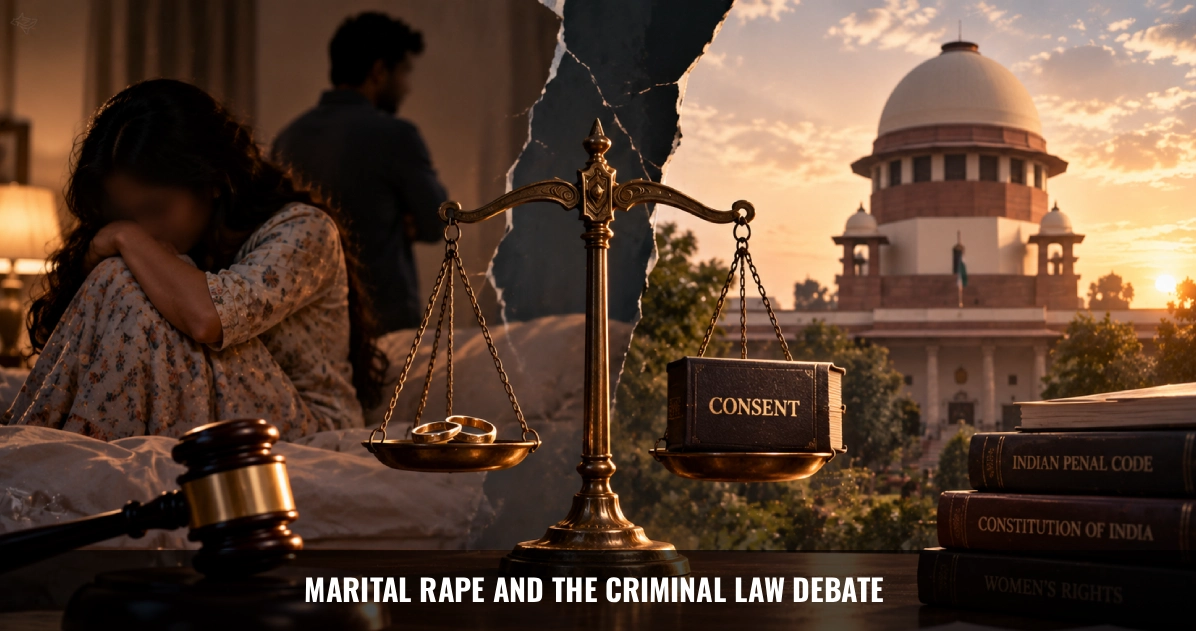
Marital rape is also known as spousal rape, refers to sexual intercourse by a husband against his own wife without her consent. Sexual violence within marriage is one of the most privatized and least addressed forms of violence against women. Historically, it was treated not as a crime but as a breach of man’s property right because in that period of time women were considered as property which first belongs to the father then to the husband. Adultery is criminalized because it is considered as stealing property not a crime against the victim but the Hon’ble Supreme Court in Joseph Shine[1] which decriminalised the Adultery as it is inconsistent with Article 14 and Article 15 Constitution of India.
In India rape outside marriage is criminal Offence, but the rape within the marriage is not, so long as the women is above the statutory age i.e. 18 years. This exception is given in Exception 2 to Section 63 of the Bhartiya Nyaya Sanhita, 2023 (hereinafter referred as (“BNS”), which replaced the identically worded Exception 2 to Section 375 of the Indian Penal Code. 1860 (hereinafter referred as “IPC”), Provides that sexual intercourse or sexual acts by a man with his own wife, the wife not being under eighteen years of age, do not constitute rape.
2. History
As discussed above marital rape was considered as crime, tort, theft of man’s property which first belongs to father then to husband but not a crime against a victim, by the definition the husband can commit the crime. This concept that husband cannot commit the crime was described by the English jurist Sir Matthew Hale (1st November 1609- 25 December 1676) in History of Pleas of the Crown, published posthumously in 1736, where he wrote
“The husband cannot be guilty of a rape committed by himself upon his lawful wife, for by their mutual consent and contract the wife hath given up herself in this kind unto her husband, which she cannot retract”.
(Emphasis Supplied)
Until the Twentieth Century American and English followed the legal doctrine of Coverture under which a married woman’s legal existence was considered to be merged with that of her husband. Upon marriage, she had no independent legal existence of her own.
3. Positive Development
- Feminist critique in the 19th century
During the nineteenth century various feminist movements, activists challenged the presumed right of a husband to engage in forced or coerced sex with their wife. Suffragists including Elizabeth Cady Stanton and Lucy Stone singled out a woman’s right to control marital intercourse as the core component of equality.”
In nineteenth century demands centred on the rights of women to control their own bodies; these movements were opposed but embrace by many including British liberal feminist John Stuart mill and Harriet Taylor, who criticised the marital rape as a double standard in law and as central to the broader subordination of women.
British philosopher and writer Bertrand Russell in his book Marriage and Morals (1929) deplored the situation of married women. He wrote
“Marriage is for woman the commonest mode of livelihood, and the total amount of undesired sex endured by women is probably greater in marriage than in prostitution.”
(Emphasis Supplied)
- 20th and 21st Century criminalization
During Twentieth and Twenty-First centuries, the marital rape exemption widely viewed as inconsistent with evolving standards of equality and bodily autonomy, and a growing number of countries began criminalising marital rape. As a result, many countries start criminalizing marital rape. The first country criminalizing the marital rape is Soviet Union in1922 followed by Poland and the House of Lord abolished their own exemption through R Vs R[2] and criminalizing marital rape.
4. Criminal Law Debate
In Indian Society, traditionally the marriage is seen as a sacred and inviolable institution, whereas this is the peak this this approach needs to be changed on constitutional and other ground discussed below:
4.1 Arguments in Favour of Criminalizing
- Article 14 – Article 14 guarantees equality before law and equal protection of law, whereas the rape exception creates a classification between unmarried and married women, denying the former classification the same protection merely because of the marital status. A classification achieves constitutional validity when it demonstrates two requirements which include intelligible differentia together with rational nexus linking the classification to its intended goal. The rule which provides protection to women’s bodies and punishes the people who try to hamper such protection, hence marital status bears no rational connection to a women’s interest in bodily autonomy, so the exception is difficult to justify as reasonable classification rather than arbitrary exclusion.
The Hon’ble supreme court in Maneka Gandhi Vs. Union of India[3] emphasized that “arbitrariness is the antithesis of equality”, so that a classification cannot satisfy Article 14. The marital exception which withdraws protection from an entire class of women for no reason connected to the harm in question is difficult to sustain as a valid classification.
- Article 15 – The Article 15 gives protection against discrimination on the basis of sex along with other grounds. The law demonstrates discrimination against married women because Section 63 of the BNS denies the protection of married women against non-consensual sexual activities, whereas the unmarried women are protected. The exception divided women into two categories namely unmarried women and married women whereas the former class of women gets the protection and cannot be denied the latter class of women only due to their marital status, the classification operates as discrimination linked to sex. Hence, the exception should be abolished on the ground that it violates Article 15 of the Indian constitution.
- Article 21 – Article 21 gives multiple rights to a person to live life with dignity and integrity. The Hon’ble Supreme Court in K.S Puttaswamy vs. Union of India[4] where the court established that the right to privacy is an inherent right which safeguards their personal freedom. The right to privacy includes the right to protect one’s body and make private choices. Further, the Hon’ble Supreme Court in Suchita Srivastava V. Chandigarh Administration[5] recognised right to reproduction, which is essential for personal freedom. The act of forcing someone to engage in sexual activity against their will constitute the violation of freedom to choose. Hence, denial of protection against the non-consensual sex violates the right to privacy which includes the right to make private choices, therefore, deserves to be deleted.
- Mental Health AND PHYSICAL HEALTH – A non-consensual sex adversely affects the mental health of the victim in various ways. Various reports available on the internet shows that women, who are experiencing marital rape are suffering from depression, post-traumatic stress disorder and also suffering from suicidal tendency. Reports for clear understanding that marital rape not only affects mental health but also severely affects physical health are reproduce below: –
- A 2019 JAMA study found married women experiencing marital rape are 2.5 time more likely to report depression. A
- Journal of Sexual Medicine (2021) noted 45% reduce sexual desire due to marital rape
- UNFPA (2022) reported 78% of women fear retaliation from marital rape
- Lancet (2017) found 39% develop PTSD from marital rape
- AINN (2021) reported 58% feel isolated from their community after marital rape
- BMJ (2022) noted 22% have contraceptive complications from marital rape
- WHO (2020) stated 37% experience reproductive health issues from marital rape
4.2 Arguments in Against the Criminalization
i. Sanctity and stability of marriage– In India marriage is widely regards as a sacred bond between two families not merely a contact between husband and wife, therefore, criminalizing marital rape will disturb the sacred structure of marriage institution because marital rape have very potential being misused, Therefore, the marital rape should remain in exception to save the sacred thread of marriage.
ii. Reformative approach rather than punitive approach – merely criminalizing marital rape without social awareness, education, counselling is unlikely to achieve its intended effect, therefore instead of punitive approach, reformative approach should be adopted.
iii. Difficulty in Proving of Consent –Because spouse typically engage in sexual activity on a continuing and often basis, that it will be unusually difficult as compared with rape with stranger to establish the absence of consent for specific consent beyond the reasonable doubt, raising the risk of wrongful acquittals and wrongful convictions.
iv. Delhi Government views – Delhi government too has defended the law on the ground that criminalization of marital rape is not the only remedy available to the victim of marital rape, even the best remedy available is under the protection of women from domestic violence Act, 2005, which treats the sexual abuse in marriage as domestic violence and can be resulted in divorce and also provides remedies like maintenance.
5. CONCLUSION
Therefore, the above discussion crystallized that it’s high time to move away from the traditional approach which sees women as property and allows men to have sexual access without wife consent. The exception against rape to married not only violates the fundamental rights given under Indian constitution but also severely affects victim’s health. The hon’ble supreme court by recognising reproductive rights and abolishing adultery clearly shows that all women have full control over their body and they are free to take all decisions related to their body. Criminalizing marital rape isn’t only about punishment but establishing that consent is an essence of all sexual relationship, including marriage.
In today’s world, where women including married women are equal to men and have their own legal existence cannot be denied protection on the traditional concept that married women give perpetual consent and all the rights of the married subsumed into husband. Therefore, not criminalizing marital rape jeopardize the principal that women’s body is their own and they have all the right to say no to the unwanted sexual intervention. The matter is currently sub judice before the supreme court of India in Hrishikesh Sahoo vs. State of Karnataka & Ors.[6] Listed on 18.11.206.
[1] Writ Petition (Criminal) No. 194 of 2017
[2] [1991] UKHL 12
[3] 1978 AIR 597, 1978 SCR (2) 621
[4] Writ Petition (Civil) No. 494 of 2012
[5] SLP (C) No. 17985 of 2009
[6] SLP(CRL). No. 4063 Of 2022