
Written By: Apoorv Agarwal
Introduction
Betting & Gambling are perhaps as old and mankind and have been practised since ancient times, with references made in the Mahabharat to the game of dice[1] as well as the Rig Veda 10.34.4[2] and 10.34.13[3] from a moralistic perspective; while the Manu Smriti described betting & gambling as the two vices capable of causing the destruction of the kingdoms (221)[4] and it amounting to open theft & asking the king to suppress the same (222)[5]. It is a subject which has been culturally, morally opposed and looked down upon, thus the Indian State has always sought to regulate the same.
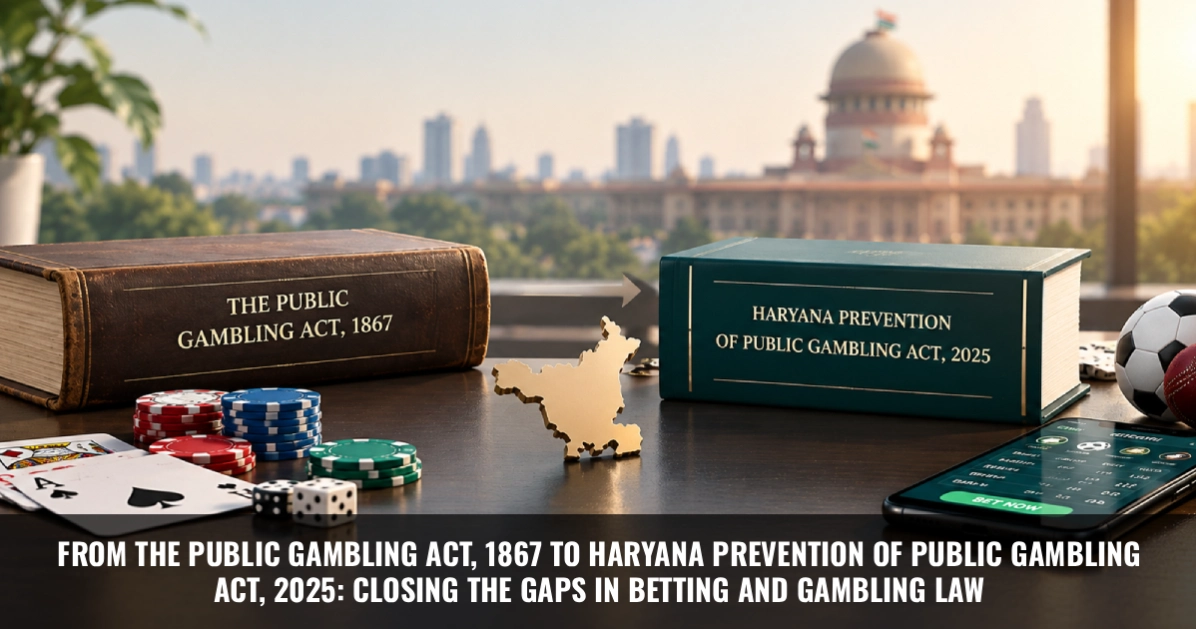
In doing so, prior to the promulgation of the Constitution, the Public Gambling Act, 1867 (PGA) a colonial-era statute was the central act concerning betting and gambling in India, and still continues to govern gambling in States and Union Territories not having a specific statue for the same, by virtue of Article 372[6] of the Constitution which allows for the continuance of pre-existing laws after the Constitution’s commencement.
Constitutional Framework on Legislative Competence of HPPGA against PGA
The Constitution under Article 246[7] delineates legislative powers of the Union & State under Three lists under the Seventh Schedule, namely, List I (Union), List II (State) & List III (Concurrent). Accordingly, “Betting & Gambling” is explicitly mentioned in Entry 34 of the List II, thus squarely falls under the State’s exclusive purview as per Article 246(3)[8].
In pursuance to this, numerous states either adopted the PGA itself or versions similar to it as their state legislation. However, several states including Haryana have also enacted their own distinct legislations specifically dealing with betting and gambling namely Haryana Prevention of Public Gambling Act, 2025 (HPPGA) and is a constitutionally valid enaction,
The HPPGA, a state legislation further will not be overridden by the PGA simply because it is a Union legislation as first under Article 254(1)[9] the doctrine of repugnancy applies only to subjects of the Concurrent List and only apply if the act was repugnant to the union’s act, however this is inapplicable here as Gambling falls under State List. Furthermore, in State of West Bengal v. Kesoram Industries Ltd,[10] the Court clarified that residual powers under Entry 97, List I, and Article 248[11] applies only to subjects not enumerated in the Concurrent or State List only, thus wouldn’t apply to a subject clearly mentioned in List II, thus Union cannot override the state specific power. Presently, Gambling is explicitly mentioned in List II, thus residuary powers don’t apply here and neither has the state under Article 252 explicitly provided its consent to the union to regulate the present subject matter. Thus, HPPGA legislatively competent and cannot be overridden by the PGA.
Overview & Limitations of the Public Gambling Act, 1867
As per the Statement of Objects & Reasons[12], the PGA aimed to prevent and criminalise public gambling and keeping of common gaming houses, and provide a specific act for the same to replace the inadequate provisions of the IPC on the same. However, the PGA has numerous limitations to it such as –
- For one, the PGA does not define gambling, leaving the same on the judiciary, the Calcutta High Court in Bimalendu De v. Union of India[13] & Supreme Court in M.J. Sivani & Ors. v. State of Karnataka & Ors[14] referred to the definition of Gambling given in the Black’s Law Dictionary: Making a bet occurs when there is a chance for profit if a player is skillful and lucky. As per K R Lakshmanan v. State of Tamil Nadu, (1996) 2 SCC 226 gambling refers to a payment of a price for a chance to win a prize, and that games in which parties can pay a price to win a prize may be games of chance or of skill, or of skill and chance combined. PGA allows for Search & Seizures too.
- As per Section 3, it applies only to owning or keeping, or having charge of physical common gaming houses, gambling venues only and as per Section 4 being found in such a venue is also penalised. Thus, lacks coverage of Online and Modern-Day electronic betting and gambling activities, leaving a huge legislative gap.
- As per Section 12 of the PGA, it is not applicable to ‘games of skill’ and only applies to ‘game of chance’ however, it doesn’t create any specific distinction between the two, again leaving to the judiciary to interpret. As per RMD Chamarbaugawala v. Union of India[15] & State of Andhra Pradesh v. K Satyanarayan and Others[16] established the ‘predominance test’ where the court examines which one, skill or chance plays the dominant role in determining the outcome of the game, and thus, the Court further held that even if a game contains elements of chance, if skill is the predominant factor influencing the outcome, the game will not be classified as gambling. Thereby, often certain games circumvent the PGA and not considered gambling thus not penalised, Such as Betting/Wagering on Horse Racing as per K R Lakshmanan is skilled based. Even Dream11 too as per Varun Gumber v. UT of Chandigarh[17] & Gurdeep Singh Sachar v. Union of India & Ors[18] is a game of skill and so falls outside betting and gambling ambit.
Overview of the Haryana Prevention of Public Gambling Act, 2025 (HPGA)
The HPPGA as per its Statement of Objects & Reasons[19] seeks to modernize the gambling laws in Haryana by replacing the outdated Public Gambling Act, 1867 which the Law Commission of India in its 249th Report termed as obsolete and recommended that it be repealed. It aims to regulate and prohibit public gambling more effectively in light of technological advancements and outset of online betting & gambling, aims to introduce stricter punishments for organisers of all kinds of gambling.
Key Features:
- In terms of definitions in Section 2, the act provides comprehensive definitions for terms like Bet [S.2(a)], Betting [S.2(b)], Common Gambling House [S.2(c)], Electronic Communication[S.2(d)], Gambling [S.2(e)], Game of Chance [S.2(f)], Game of Skill [S.2(g)], Organized gambling syndicate [S.2(k)] among many others which weren’t provided for in PGA.
- A critical distinction between PGA & HPPGA is that it crucially in its definitions of bet, betting, common gambling house, gaming, gambling they all refer to the online computer based electronic based method of these activities as well (monetary as well as non-monetary consideration (like cryptocurrency and other tokens) are included. Thus, finally bringing them into the net of public gambling and prohibiting them.
- Another Critical distinction is that it finally codifies game of skill vs. chance, with flexibility for government to notify additional games as skill-based.
- In terms of offences and Penalties, they are mentioned in Sections 3-12,
- Gambling in public or common gambling house (Sec. 3) – 1 year imprisonment or ₹10 k fine; repeat offences escalate to 1–3 years + ₹10 k.
- Operating or Financing Gambling Betting (Sec. 4) – the Owners/managers face 3–5 yrs + ₹1 lakh; repeat offenses attract 5–7 yrs + ₹2–5 lakh.
- Match/Spot Fixing (Sec. 4a) – Minimum 3 years and ₹5 lakh, escalated on repeat violations.
- Abetment (Sec. 5) – Abettors punished equally.
- Syndicate Membership (Sec. 6) – 3 to 5 yrs and ₹5 lakh; escalated for repeat offences.
- Presumption Clause (Sec. 10) – Presence in gambling house presumed guilt and it shifts burden to defendant to prove innocence.
- Allows for Seizure & Disposal (Secs. 11–12) – Instruments seized; disposal per Bharatiya Nagarik Suraksha Sanhita, 2023, with attachment/forfeiture of proceeds.
- Also criminalised syndicate crimes as per Sec 7.
- Repeal of PGA (Sec. 18) in Haryana, saving past actions.
Aftermath of Haryana Prevention of Public Gambling Act, 2025:
SportsBaazi, which runs a sports prediction platform, has added the following disclaimer to caution users in Haryana:
“Pursuant to the provisions of the Haryana Gambling Act and in the absence of sufficient legal clarity on the applicability of the law to online games of skill, we advise users located within the territorial jurisdiction of Haryana to proceed with caution and refrain from participating in any sports engagement formats like Fantasy and its variants offered on the Platform, until further notice. This advisory is issued purely as a matter of legal prudence and shall remain applicable until SportsBaazi receives legal and regulatory clarity regarding the implications of the Haryana Gambling Act on online real money gaming.”
Mobile Premier League (MPL), one of India’s leading online gaming platforms, has disabled features like MPL Opinio and MPL Fantasy for Haryana users, and stated the following in its Terms and Conditions:
“Formats that pertain to events whose outcome is unknown, specifically MPL Opinio and MPL Fantasy, shall not be used by users located in the state of Haryana.”
FIR No.155 of 2025, dated 07/06/2025 filed at Manesar Police Station (Haryana) under the Haryana Prevention of Public Gambling Act, 2025, and Section 318(4) of the Bharatiya Nyaya Sanhita, 2023 against Sportasy, a fantasy gaming platform.
As per the FIR it is alleged that the platform allows users to place real money bets on uncertain outcomes of live sporting events (may qualify as opinion trading?) in the nature of fantasy sports, which constitutes as betting and gambling under the Haryana Gambling Act.
Conclusion
The Haryana Prevention of Public Gambling Act, 2025 marks a deliberate departure from the Public Gambling Act, 1867, addressing the very limitations that rendered the colonial statute obsolete namely, the absence of statutory definitions, no coverage of online and electronic modes of betting and gambling and no codified distinction between games of skill and games of chance. By defining these terms expressly, extending their ambit to electronic communication and non-monetary consideration such as cryptocurrency, and prescribing graded penalties for organisers, financiers and syndicates, the HPPGA closes gaps that had for decades been left to judicial interpretation under the PGA. Enacted squarely within the State’s exclusive competence under Entry 34, List II, the HPPGA is not liable to be displaced by the PGA notwithstanding the latter’s continued application in States without comparable legislation. Its early impact is already visible in the compliance responses of platforms such as SportsBaazi and MPL and in the registration of FIR No. 155 of 2025 against Sportasy, though the treatment of online fantasy sports and opinion trading under the new regime remains untested before the courts and is likely to be the subject of future litigation.
[1] Chapter 9 – The Gambling Match from the Mahabharat.
[6] Article 372 of the Constitution
[7] Article 246 of the Constitution.
[8] Article 246 of the Constitution.
[9] Article 254 of the Constitution.
[10] State of West Bengal v. Kesoram Industries Ltd. (AIR 1961 SC 1677).
[11] Article 248 of the Constitution.
[12] PGA Statement of Objects & Reasons from Bill
[13] Bimalendu De v. Union of India, AIR 2001 Cal 30.
[14] M.J. Sivani & Ors. v. State of Karnataka & Ors, AIR 1995 SC 1770.
[15] RMD Chamarbaugawala v. Union of India, AIR 1957 SC 628
[16] State of Andhra Pradesh v. K Satyanarayan and Others, (1968) 2 SCR 387
[17] Varun Gumber v. UT of Chandigarh, Judgement dated 18th April 2017 in CWP No. 7559 of 2017.
[18] Gurdeep Singh Sachar v. Union of India & Ors, SLP (Crl.) Diary No. 42282 of 2019.