
Written By: Apoorv Agarwal, Mallika Luthra
Introduction
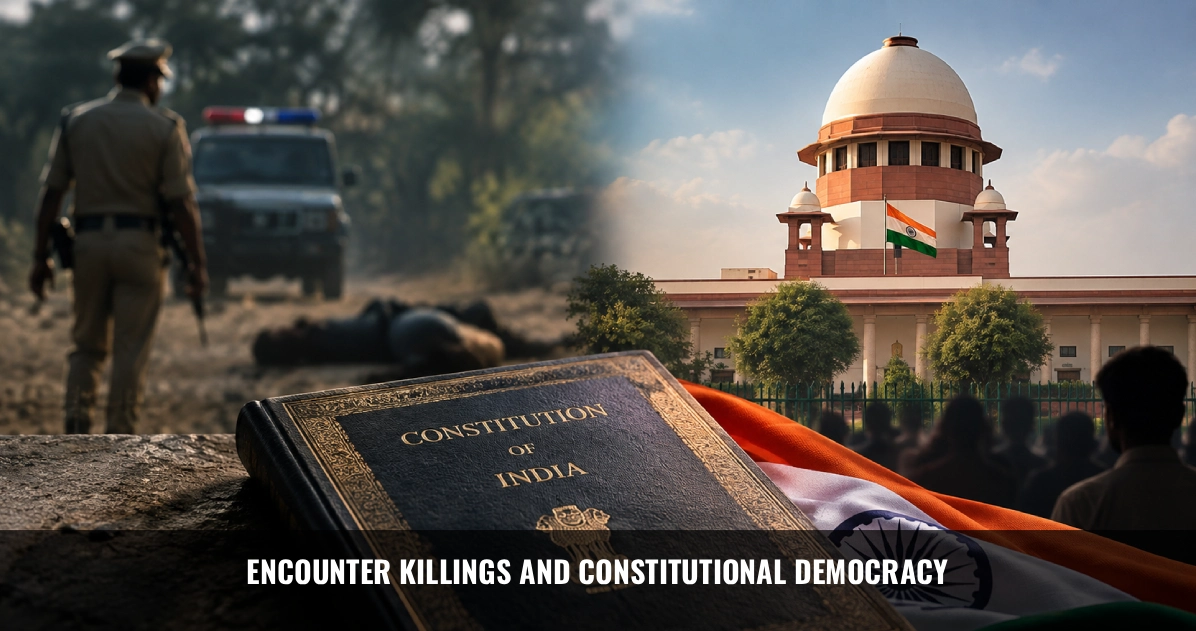
The legitimacy of a constitutional democracy rests upon its unwavering commitment to the rule of law and the administration of justice through established legal institutions. In recent years, however, India has witnessed an increasing public endorsement of encounter killings as an expedient means of delivering justice. This growing acceptance reflects a gradual erosion of public confidence in the criminal justice system. Delays in investigation and prosecution, prolonged judicial proceedings, and low conviction rates have collectively fostered a perception that the formal legal process is incapable of delivering timely justice. Consequently, a section of society has begun to perceive extrajudicial killings not merely as a policing strategy but as an acceptable substitute for judicial adjudication.
Such a perception strikes at the very foundation of constitutional governance. The Constitution of India does not permit justice to be administered through public sentiment or executive discretion. Rather, it mandates that every individual, irrespective of the nature of the allegations against them is entitled to the protection of law and to the guarantees of due process embodied in Article 21 of the Constitution. The constitutional promise of life and personal liberty is not contingent upon an individual’s popularity, social standing, or alleged criminality. It extends equally to every person and may be curtailed only in accordance with a procedure established by law.
The increasing glorification of encounter killings therefore presents a fundamental constitutional dilemma. It reflects a shift from the principle of rule of law towards a culture of rule by popular sentiment, where public outrage is allowed to dictate the course of criminal justice. It is equally important to recognise that encounter killings are often romanticised through popular media, political rhetoric and sensationalised news coverage. Individuals accused of serious offences are frequently portrayed as undeserving of constitutional protections, thereby creating a narrative that due process serves only to shield criminals rather than uphold justice. This narrative fundamentally misconceives the object of constitutional rights. The guarantees contained in Part III of the Constitution are designed not to protect criminality but to restrain arbitrary exercise of State power. Their true purpose is to ensure that the State itself remains accountable to law while exercising its coercive authority.
The Supreme Court has consistently maintained that the Constitution does not recognise any exception permitting the State to bypass judicial process merely because an accused person is alleged to have committed grave offences. Even the most hardened criminal remains entitled to the protection of Article 21 until deprived of liberty or life through a lawful procedure.
Popular opinions about an accused person and the hearsay or even previous proved mis-conducts of the accused does not grant police the right to diverge from the due process and take any step contrary to law to bring the accused in terms with the judicial process. In this context, it is imperative to analyse certain observations of the Hon’ble Apex court.
The Hon’ble Apex Court in “Om Prakash v. State of Jharkhand (2012) 12 SCC 72” made the following observation:
“It is not the duty of a police officer to kill the accused merely because he is a dreaded criminal. Undoubtedly, the Police have to arrest the accused and put them up for trial. The Supreme Court has repeatedly admonished trigger-happy police encounter. Such Killings must be deprecated. They are not recognised as legal by our criminal justice administration system. They amount to State-sponsored terrorism. But one cannot be oblivious of the fact that there are cases where the Police, who are performing their duty, are attacked and killed. In such circumstances, while the Police have to do their legal duty of arresting the criminals, they also have to protect themselves”.
This judgment highlights the protective scope of this provision. The case concerned an alleged fake encounter, where the Court quashed the criminal proceedings against the police officers on the ground that the acts were performed in the discharge of their official duties, making prior sanction for prosecution mandatory. However, applying this principle to fake encounter cases gives rise to a legal contradiction. A fake encounter or unlawful killing cannot ordinarily be regarded as part of a police officer’s official functions. Nevertheless, courts have consistently held that where the act has a reasonable nexus with official duty, even if it exceeds the limits of that duty, the protection under Section 218 of the BNSS applies. As a result, obtaining sanction for prosecution becomes a significant hurdle for victims’ families, particularly because the government, as the employer of the accused officers, is often reluctant to grant such approval, especially where such actions receive political support.
The Landmark Pronouncement: People’s Union for Civil Liberties v. State of Maharashtra and the Sixteen-Point Guidelines
A significant milestone in ensuring police accountability was the Supreme Court’s decision in People’s Union for Civil Liberties & Anr. v. State of Maharashtra & Ors., (2014) 10 SCC 635. The case arose from a writ petition filed by the PUCL challenging the authenticity of 99 alleged encounter killings in Mumbai between 1995 and 1997, which resulted in the deaths of 135 individuals.
Emphasising on the constitutional guarantee of life under Article 21, the Court held that while the police are empowered to combat serious crime, they cannot resort to extrajudicial methods. It observed that fake encounters undermine the rule of law, erode public confidence in the criminal justice system, and foster a culture of impunity. To ensure accountability and independent investigation of encounter deaths, the Supreme Court laid down 16 mandatory guidelines, declaring them to be the law of the land under Article 141 of the Constitution. These guidelines remain binding on all police authorities until a comprehensive legislative framework governing police encounters is enacted.
Speaking of provisional safeguards, Section 43 of the Bharatiya Nagarik Suraksha Sanhita, 2023 governs the procedure for arrest and authorises police officers to use all necessary means to effect an arrest where a person resists or attempts to escape. However, this power is limited by Section 43(4), which expressly prohibits the use of lethal force against a person who is not accused of an offence punishable with death or life imprisonment. Despite this restriction, police often justify encounter killings by portraying the deceased as a dangerous offender to bring the case within this exception.
Similarly, Sections 34- 44 of the Bharatiya Nyaya Sanhita, 2023 recognise the right of private defence, which is the most frequently invoked legal justification in encounter cases. While Section 38 permits the use of deadly force where there is a reasonable apprehension of death or grievous hurt, Section 37 makes it clear that no more force than necessary may be used. Police commonly claim that the accused opened fire first, leaving them with no option but to act in self-defence. However, forensic evidence and independent investigations have repeatedly challenged these claims. Reports by Human Rights Watch and the findings of the Justice Sirpurkar Commission on the 2019 Hyderabad encounter concluded that such accounts were often fabricated. These findings suggest that the plea of self-defence is frequently used as a post facto legal justification to legitimise extrajudicial killings and shield those responsible from accountability.
Conclusion
The portrayal of encounter killings as a “necessary evil” is a flawed narrative that seeks to justify unlawful state action. While legally sanctioned police encounters may be unavoidable in exceptional circumstances to protect the lives of police personnel and the public, maintain public order, and enforce the law, this rationale cannot be extended to legitimize an unaccountable police force that disregards the fundamental rights to life, dignity, and due process. Such justification exploits public frustration with the criminal justice system to normalize extrajudicial violence. This, in turn, creates a self-perpetuating cycle in which the shortcomings of the formal justice system are invoked to defend unlawful violence, while the continued reliance on such violence further weakens the credibility and effectiveness of legal institutions. Encounter killings, therefore, are not a legitimate response to crime but rather a manifestation of deeper constitutional and systemic failures in governance.