

Written By: Apoorv Agarwal
Introduction
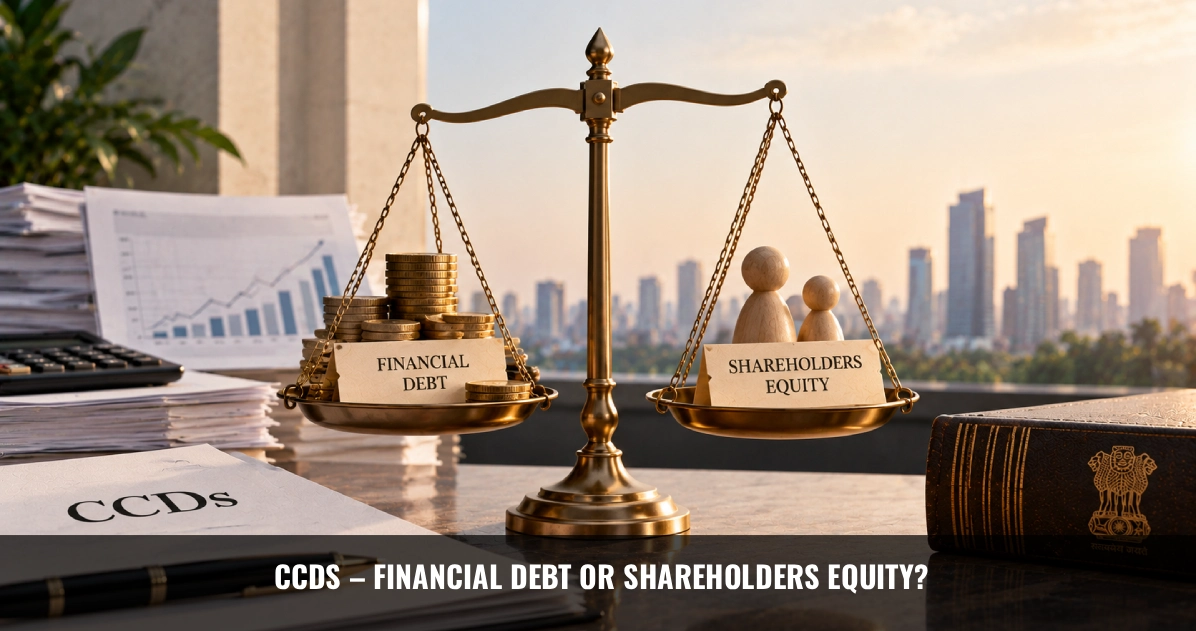
Under section 71(1) of the companies act, a compulsorily convertible debenture is a hybrid form of security which can be converted upon redemption. CCDs offer returns by way of interest, while also facilitating ownership in the issuing entity at a later date.[1] Despite falling within the ambit of debentures, CCDs are not redeemable for cash and have been held to not constitute a ‘debenture’ in its classic sense. This feature of CCDs has also led the Reserve Bank of India to treat CCDs as equity instruments under the foreign direct investments (FDI) guidelines. However, contentions raised in and judgements delivered pursuant to insolvency proceedings under Insolvency and Bankruptcy Code, 2016 (“Code”) have stirred up debate on treatment of CCDs and accompanying rights in the event of the issuer company’s insolvency. The first major point of discussion originates from the point that CCDs have different treatment in different legislations, such as Foreign Exchange Management Regulations, 2017 (“FEMA”) they are treated as equity from day one and not as debt unlike Companies act.[2] This argument is brought forward every time there is a dispute regarding the same.
Judicial Precedents and Key Cases
The first major case to start the debate of debt vs equity was through a division bench of the Hon’ble Supreme court in the case of M/s. IFCI Limited v. Sutanu Sinha and Others[3] dated November 9, 2023. The apex court held that CCD’s should be treated as an equity instrument instead of a debt instrument, since it was not stipulated that these CCDs would partake the character of financial debt on the happening of a particular event. The court while coming to a decision relied on the case of Narendra Kumar Maheshwari v. Union of India [4], wherein the Supreme Court laid down a repayment of principal test to differentiate between debt and equity. According to the principle, do the terms of the convertible debenture states the repayment of the borrowed principal amount? If the answer is yes, then the convertible debenture is treated as a debt instrument, even though such repayment may be optional and may not occur upon maturity. Conversely, if the convertible debenture’s terms do not provide for a repayment of the principal amount it is to be regarded as an equity instrument. Applying this test, the Supreme Court observed that CCDs must be converted into equity shares upon maturity and therefore, the possibility of repayment of the principal amount does not arise. Consequently, the Supreme Court held that CCDs would be treated as equity and not debt.
The same principal was also used at the landmark judgment of Sahara India[5] wherein the Hon’ble court while applying the test held that optionally convertible debenture, holder has an option to choose whether it wants its principal amount repaid or converted into equity. Since the option contemplates repayment of the principal amount upon maturity, the SEBI concluded that OCDs would be treated as debt and not equity.
Another case wherein the repayment of principal test was applied was Shubham Corporation Private Limited v. Kotoju Vasudeva Rao by the adjucating authority of the NCLAT Chennai bench. In the following case CCDs were to be converted into equity either before or at the end of the ten years. Since the main purpose of the instruments were to convert into equity without attracting any liability of repayment, they were considered as an equity instrument. The case noted that the precondition of a ‘debt’ for an insolvency claim is to have an element of obligation of repayment.[6]
In the case of SGM Webtech Pvt. Ltd. v. Boulevard Projects Pvt. Ltd [7] by the adjucating authority of principal bench of NCLT, it was held that that a debenture is a debt that must be paid back over time. More importantly, SGM holds that at the time of winding up or admission of a case under the IBC, if the debentures are not matured and not convertible for the period of redemption is not complete, they shall be treated as debentures and as a consequence, it will remain as debt. Furthermore, this debenture was recorded by the corporate debtor in its books of accounts as debt for which interest based on an annual fixed coupon rate was being paid through Tax Deducted at Source (“TDS“). The bench held that the position under the IBC would supersede other laws due to the non-obstante clause under section 238 of the IBC, despite the Corporate Debtor and the Resolution Applicant bringing up the status of CCDs under the FEMA Guidelines, the court held that
“if the debentures are not matured and not convertible for the period of redemption is not complete, they shall be treated as debentures and as a consequence, it will remain as debt”[8]
A similar stance was noted in the case of Srei Multiple Asset Investment Trust v. IDBI Bank Ltd. and Ors.[9] However it is noteworthy that if the obligation of repayment is considered to be a judging criterion for a CCD to be debt, for what this repayment obligation exists, becomes the next question. M/s IFCI Limited v. Sutanu Sinha[10] links this repayment to the principal amount means that only if the borrowed principal amount is payable at any point in time, then it will be a debt instrument under IBC.
However, on the contrary, in Narendra Kumar Maheshwari v. Union of India & Ors.,[11]the SC observed that CCDs do not “postulate any repayment of principal”. Moreover, in Agritrade Power Holding Mauritius Limited and Ors. v. Ashish Arjunkumar Rathi[12], where there was no repayment of the principal amount due maturing of the CCDs, the interest accrued till the date of conversion nonetheless became payable as financial debt. Now, if the test is strictly followed then the determination of CCDs on the sole basis of principal amount will lead to absurdity when the facts differ. This would bring inconsistency between the judgments and disregard the main purpose of the principle laid down in the case of Narendra Kumar Maheshwari.
Continuing the debate, in a ruling by the Principle bench of NCLT in the case of Indian Renewable Energy v. Waaree Energies Limited.[13] The adjucating authority looked at time value of money and held CCDs as a debt instrument, The case arose from an appeal challenging the decision of the National Company Law Tribunal, which had upheld the status of an investor holding CCDs under a Debenture Subscription Agreement (“DSA”) as a financial creditor. The investor had subscribed to CCDs that provided for either equity conversion within a specified period or redemption with interest in case of default. When the issuer failed to fulfil its repayment obligations, the investor initiated arbitration proceedings, securing an award that included interest. Initially, the Resolution Professional (“RP”) accepted the investor’s claim and allowed them to participate in the Committee of Creditors (“CoC”), recognizing the CCDs as financial debt. However, the RP later reversed this decision, asserting that CCDs, being equity instruments, lacked the “time value of money” and therefore could not be considered as a financial debt under the IBC.
Upon review, the NCLAT upheld the NCLT’s ruling, affirming the classification of CCDs as financial debt. The Tribunal emphasized that the DSA included clear provisions for redemption and interest in case of default, demonstrating the “time value of money” and that the CCDs were convertible at the option of the investor. Despite the equity-linked nature of CCDs, the Tribunal found that the instruments exhibited characteristics similar to commercial borrowings, particularly due to the redemption obligations and the potential for interest in the event of default. Referring to Supreme Court decision in IFCI Ltd. vs. Sutanu Sinha, the NCLAT emphasized that hybrid instruments must be classified based on their specific contractual terms. The NCLAT found that the DSA clearly indicated financial debt as the transaction had a time value of money. Consequently, the claimant retained its voting share in the Committee of Creditors (CoC), securing its position in the resolution process.
Three types of factual situation that arrives while considering the instrument as debt or equity, firstly if the principal or interest, or amount is due, then it should be considered as debt, given that it is unpaid before the commencement of insolvency process (CIRP). Second when no amount is due, but only the conversion at the maturity or the trigger event whichever is earlier is due. In this case, the holder has already paid for the debentures in the view of getting a future benefit and then this future benefit is negated by the insolvency. Consequently, as relief, the claim by the holder for the amount of the CCDs should be allowed as debt then to benefit the holder, otherwise as equity, given the conversion has taken place before CIRP. Since IBC does not provide a clear stance on treatment of such hybrid securities, the court should prioritize the benefits of the creditor, as the jurisprudence behind IBC prioritizes creditors, especially financial creditors. Third, where no amount is due for repayment, and only conversion on maturity is associated with the CCD. Here, if the CCDs have already matured before the initiation of insolvency, then they can be considered as equity since the promised benefit has already been accrued and used by the holder and no extra benefit can be conferred on such holder by counting it as debt.
Conclusion
In conclusion, while the recent judgments indicate a trend of CCDs being considered as financial debt, the debate is far yet settled. The only clarity which the jurisprudence indicated, is that a decision would be taken on the factual scenario, considering various factors in relation to the hybrid instrument. IBC being a special legislation, would supersede FEMA, definition of treating CCDs as an equity instrument, but even in IBC, there are differentiated opinions. IBC should prefer an approach more suitable towards creditors and which makes the process of repayment similar, as that is the main objective of the code. Moreover, in any case, it should be mandated to have a clause stipulating the treatment for conversion or non-conversion of the CCDs date on winding up, dissolution, insolvency, or liquidation, i.e., the clause must stipulate the nature of the issued CCDs as either debt or equity beforehand to account for the future mentioned probable causes. It is established that the commercial courts should not delve into the implied contractual terms and read them as it is; therefore, an express stipulation for the CCDs makes the judgment easy, another solution could be that IBC itself clears the stance and bring an exhaustive definition of debt instruments, which brings an end to the long standing debate.
[1] Companies Act, No. 18 of 2013, § 71(1)
[2] Foreign Exchange Management (Transfer or Issue of Security by a Person Resident Outside India) Regulations, 2017, Reg. 2(xv).
[3] IFCI Ltd. v. Sutanu Sinha, (2024) 248 Comp Cas 217
[4] Narendra Kumar Maheshwari v. Union of India, 1990 Supp SCC 440
[5] Sahara India Real Estate Corpn. Ltd. v. SEBI, (2012) 10 SCC 603
[6] NCLAT Chennai: Compulsory Convertible Debentures Repayment Under Sec 9 IBC Is Financial Debt, LiveLaw, https://www-livelaw-in.opj.remotlog.com/ibc-cases/nclat-chennai-compulsory-convertible-debentures-repayment-sec-9-ibc-financial-debt-259493.
[7] SGM Webtech Pvt. Ltd. v. Boulevard Projects Pvt. Ltd., CA-967(PB)/2018, NCLT Principal Bench (Dec. 20, 2019) (India).
[8] Id.
[9] Srei Multiple Asset Investment Trust vs Idbi Bank Limited Company Appeal (AT) (Ins) No. 593 of 2020
[10] IFCI Ltd. v. Sutanu Sinha, (2024) 248 Comp Cas 217
[11] Narendra Kumar Maheshwari v. Union of India, 1990 Supp SCC 440
[12] Ashish Arjunkumar Rathi Resolution Professional of SKS Power Generation Chhattisgarh Ltd., In re, 2024 SCC OnLine ITAT 1681
[13] Indian Renewable Energy Development vs Waaree Energies Company Appeal (AT) (Insolvency) No.1380 of 2024
![Read more about the article Personal Liability under Section 122(1A) of the CGST Act: A Critical Analysis of Amit Manilal Haria v. Joint Commissioner, CGST & Central Excise [2026 SCC On Line Bom1510] by Hon’ble Bombay High Court](https://www.asvlawoffices.com/wp-content/uploads/2026/07/Artboard-39-768x402.jpg)