
Written By: Apoorv Agarwal, Manya Jaiswal
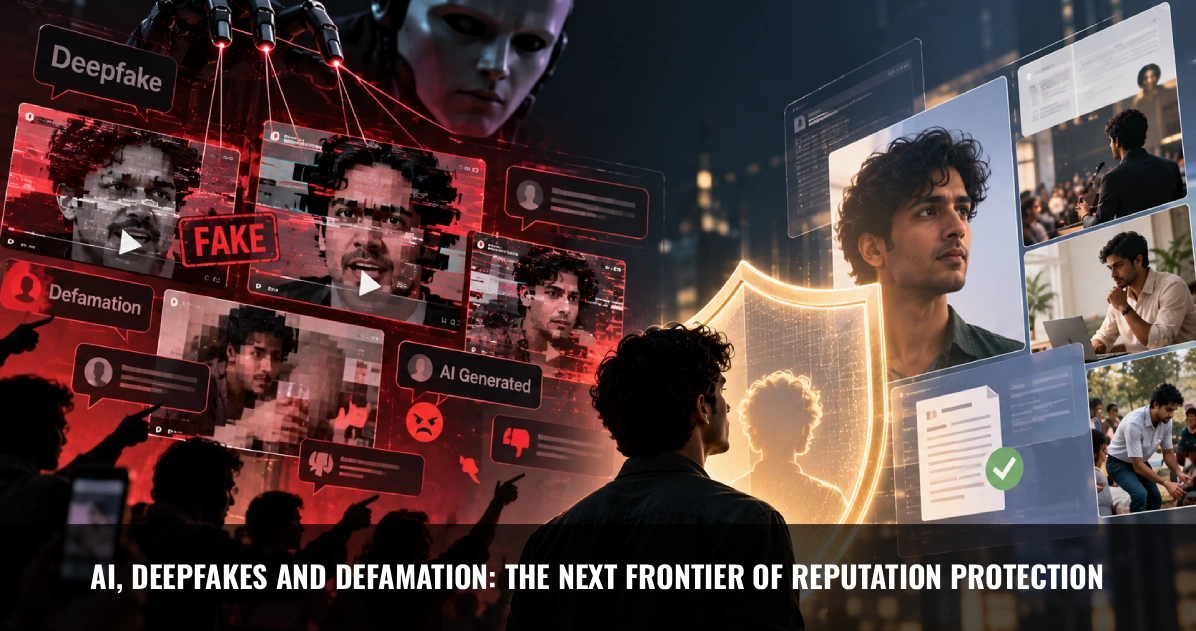
Artificial Intelligence (“AI”) has transformed the digital landscape, redefining the manner in which information is created, disseminated and consumed. While the technology has undoubtedly accelerated innovation across industries, it has simultaneously created unprecedented legal challenges. Among its most concerning manifestations is the emergence of deepfakes, AI-generated audio, video or image content capable of convincingly replicating an individual’s appearance, voice and mannerisms. Unlike traditional forms of digital manipulation, deepfakes blur the distinction between truth and fabrication, making them particularly dangerous instruments for misinformation, impersonation and defamation. A fabricated video portraying the Managing Director of a listed company admitting to financial fraud, a doctor prescribing unsafe medical treatment or a public figure making inflammatory remarks can now be generated within minutes and disseminated across multiple social media platforms before its authenticity is questioned. The law of defamation, developed in an era of newspapers and television broadcasts, is therefore, being tested by a technology capable of manufacturing convincing falsehoods at an unprecedented scale.
The legal consequences of AI-generated content extend beyond conventional reputational harm. Reputation today is not merely a matter of personal dignity, it is a valuable commercial asset. For businesses, professionals and public personalities, goodwill is often built over decades but can be destroyed within hours through the viral circulation of manipulated content. Unlike traditional defamatory publications, deepfakes possess three characteristics that significantly aggravate the injury caused, anonymity of the creator, rapid dissemination through algorithm-driven platforms and the near-permanent digital footprint of the content. Even after a court directs the removal of the offending material, copies frequently continue to circulate across different platforms, making complete erasure virtually impossible. The challenge before the legal system, therefore, is not simply to determine liability but to ensure that legal remedies are capable of responding with the same speed at which reputational harm is inflicted.
Although India does not presently have a dedicated statute regulating artificial intelligence or deepfake technology, it would be incorrect to conclude that victims are without legal remedies. The existing constitutional and statutory framework provides multiple avenues for protecting reputation, privacy and identity. The legal enquiry necessarily begins with the interplay between Articles 19(1)(a), 19(2) and 21 of the Constitution of India. While Article 19(1)(a) of the Constitution guarantees freedom of speech and expression, the said right is expressly subject to the reasonable restrictions contemplated under Article 19(2) of the Constitution, including defamation. The constitutional protection afforded to free speech has therefore never extended to publications intended to unjustifiably damage another person’s reputation. Correspondingly, Article 21 of the Constitution, through expansive judicial interpretation, recognises the right to live with dignity, honour and reputation as an integral facet of the right to life.
The Hon’ble Supreme Court authoritatively examined this constitutional balance in Subramanian Swamy v. Union of India[1], wherein the constitutional validity of criminal defamation was challenged. Upholding the validity of the law, the Court observed that reputation is an inseparable component of human dignity protected under Article 21 of the Constitution and that constitutional freedoms must coexist harmoniously rather than operate in conflict with one another. Although the decision preceded the emergence of generative AI, its underlying principle assumes greater significance today. A deepfake is capable of causing reputational injury on a scale never previously contemplated by the law. Consequently, the constitutional recognition of reputation as a protected right provides a strong legal foundation for extending traditional principles of defamation to AI-generated content.
Equally significant is the recognition of privacy as a fundamental right in Justice K.S. Puttaswamy (Retd.) v. Union of India[2]. The Supreme Court held that informational privacy, identity and individual autonomy are intrinsic components of Article 21 of the Constitution. AI-generated deepfakes invariably involve the unauthorised use of a person’s facial features, voice or other identifying characteristics to create synthetic media. Such misuse is not merely defamatory; it also amounts to an invasion of informational privacy and personal autonomy. Consequently, victims of deepfake technology may invoke not only the law relating to defamation but also the broader constitutional protection of privacy and dignity.
From a statutory perspective, the Bharatiya Nyaya Sanhita, 2023 (“BNS”) continues to provide criminal remedies against defamatory publications. Section 356 of the BNS, criminalises defamation, while other provisions relating to cheating by personation, forgery and falsification of electronic records may also be attracted depending upon the manner in which AI-generated content has been created and circulated. Although the BNS does not expressly refer to artificial intelligence, its provisions are sufficiently broad to encompass technologically sophisticated forms of impersonation and reputational harm. The absence of AI-specific legislation, therefore, does not render existing criminal law ineffective; rather, it requires courts to apply established legal principles to emerging technological realities.
The Information Technology Act, 2000 (“IT Act”) supplements these protections by addressing offences committed through computer resources. Sections 66C and 66D of the IT Act criminalise identity theft and cheating by personation using electronic means, both of which may become relevant where AI-generated content falsely depicts another individual. More importantly, Section 79 of the IT Act, read with the Information Technology (Intermediary Guidelines and Digital Media Ethics Code) Rules, 2021, governs the liability of intermediaries such as Meta, Google, YouTube and X. While intermediaries enjoy conditional safe harbour protection in respect of third-party content hosted on their platforms, such immunity is contingent upon compliance with statutory due diligence requirements and lawful directions issued by courts or competent authorities. Consequently, once unlawful AI-generated content is brought to the notice of an intermediary through appropriate legal process, continued inaction may expose the intermediary to legal consequences.
The Indian judiciary has demonstrated a progressive willingness to adapt existing legal principles to the challenges posed by artificial intelligence. In Ankur Warikoo & Anr. v. John Doe & Ors.[3], the Hon’ble Delhi High Court granted a comprehensive John Doe injunction restraining unknown persons from creating and circulating AI-generated deepfake content misusing the entrepreneur’s name, voice and likeness. Recognising the speed with which such content proliferates online, the Court directed digital intermediaries to promptly remove the infringing material and restrained further dissemination. The judgment is significant because it acknowledges that AI-generated impersonation threatens not merely an individual’s reputation but also their commercial identity and goodwill.
Similarly, the courts have increasingly recognised personality rights as an independent basis for protecting individuals against the unauthorised commercial exploitation of their identity. The Bombay High Court, while granting interim relief to actor Shilpa Shetty Kundra against AI-generated deepfake content, reiterated that technological innovation cannot dilute the legal protection afforded to dignity, privacy and personality rights. These developments indicate a clear judicial trend towards treating AI-generated misuse of an individual’s identity as a composite infringement involving defamation, privacy and commercial misappropriation rather than merely a conventional tort.
From a litigation perspective, the greatest challenge in deepfake-related disputes lies not in establishing legal rights but in securing timely relief. Reputational harm caused by synthetic media is often immediate and irreversible. By the time a civil suit reaches final adjudication, the offending content may already have reached millions of viewers. Consequently, the emphasis in modern defamation litigation has shifted from compensatory damages to preventive remedies. Victims increasingly seek urgent ex parte injunctions, John Doe orders against unidentified perpetrators, mandatory takedown directions against intermediaries and preservation of electronic evidence at the very inception of proceedings. Equally important is the prompt preservation of metadata, URLs, timestamps and server records, as these frequently constitute crucial evidence in establishing the origin and dissemination of AI-generated content. In such cases, timing is often more valuable than the eventual award of damages.
Despite the adaptability demonstrated by Indian courts, the existing legal framework remains largely reactive. Neither the Constitution, the BNS nor the IT Act was drafted with generative artificial intelligence in contemplation. Questions concerning mandatory disclosure of AI-generated content, liability of AI developers, watermarking obligations and automated detection mechanisms continue to remain outside the scope of existing legislation. In contrast, jurisdictions such as the European Union have begun regulating artificial intelligence through dedicated legislative frameworks imposing obligations relating to transparency, accountability and risk management. India may similarly benefit from a comprehensive statutory framework addressing deepfakes, synthetic media and AI-enabled impersonation while ensuring that innovation is not stifled by overregulation.
Artificial intelligence is poised to reshape every aspect of modern society, including the manner in which legal disputes concerning reputation are adjudicated. While Indian law already provides substantial constitutional, civil and criminal remedies against AI-generated defamation, the rapid evolution of synthetic media demands a corresponding evolution in legal regulation. The challenge is no longer whether the law can protect reputation in the digital age, but whether it can do so with sufficient speed and effectiveness to prevent irreparable harm. As courts continue to adapt traditional legal principles to emerging technologies, the need for a dedicated legislative framework governing artificial intelligence has become increasingly evident. Until then, the judiciary will continue to play a pivotal role in ensuring that technological advancement does not outpace the law’s enduring commitment to protecting dignity, reputation and personal identity.
[1] Subramanian Swamy v. Union of India AIR 2016 SC 2728
[2] Justice K.S. Puttaswamy (Retd.) v. Union of India AIR 2017 SC 4161
[3] Ankur Warikoo & Anr. v. John Doe & Ors. 2025 SCC OnLine Del 3727