
Written By: Apoorv Agarwal, Gaurav Singh
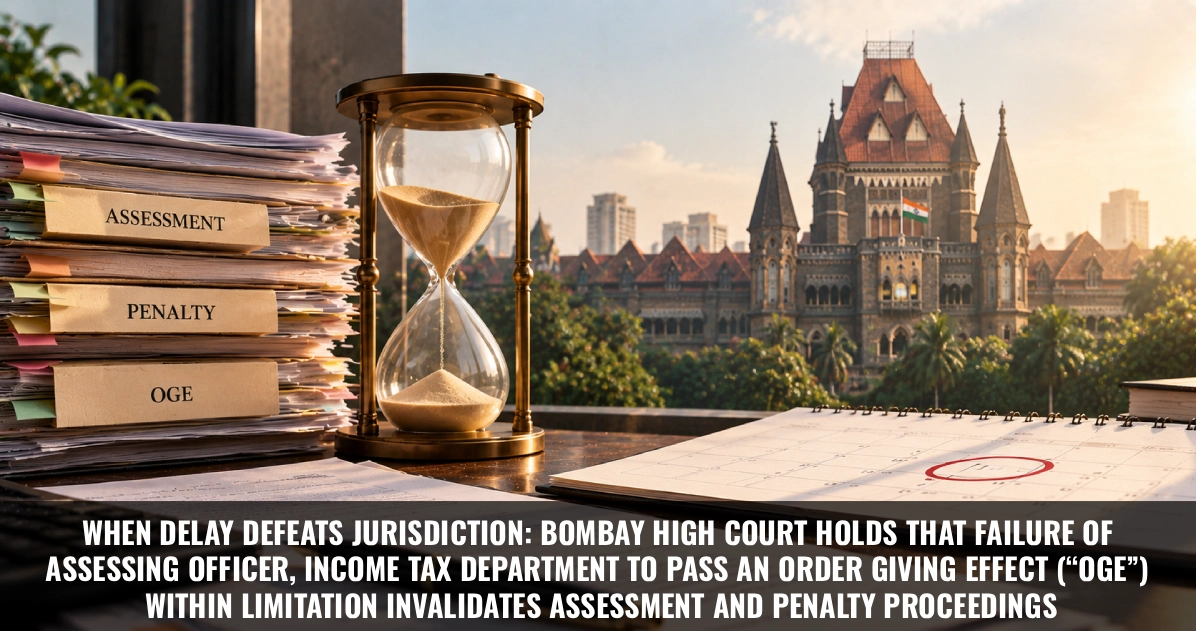
The Income-tax Act, 1961 (“Income Tax Act”) has rigid timelines not only for the completion of assessments but also for the implementation of appellate orders. These timelines are often seen as procedural requirements. However, the Hon’ble Bombay High Court has recently reiterated that the limitation under Section 153 of the Income-tax Act is not merely a procedural formality; it is a jurisdictional mandate.
In the case of Global Hospitality Licensing SARL v. Assistant/Deputy Commissioner of Income-tax (International Taxation), Ward 2(3)(2), Mumbai and Ors, bearing Writ Petition No. 1611 of 2024, the Hon’ble High Court was called upon to decide the consequences of the Assessing Officer not passing an Order Giving Effect (“OGE”) to the appellate order within the statutory timeframe. The ramifications of this answer are far-reaching for both the taxpayer and the Revenue. The Hon’ble High Court held that such failure leads to the abatement of the assessment proceedings and therefore any penalty based on such assessment also cannot be sustained.
The Background
The petitioner in this case is a company registered in Luxembourg that had filed its return of income for Assessment Year 2009-10 declaring nil income on the plea that receipts earned from Indian hotels under International Marketing Program Participation Agreements (“IMPPA”) were not taxable in India. However, on scrutiny, the Assessing Officer treated these receipts as business income, taxed them at 40 per cent, denied TDS credit and initiated penalty proceedings under section 271(1)(c) of the Income Tax Act.
The Commissioner of Income Tax (Appeals) [“CIT (A)”] partly allowed the case of the assessee on appeal. The CIT(A) held that the receipts were taxable as royalty and directed the Assessing Officer to recompute the tax liability by applying the beneficial rate, verify the TDS credit and provide an opportunity of hearing before passing the consequential order.
This is where the dispute arose.
Despite the appellate directions, the Assessing Officer never passed the Order Giving Effect within the limitation prescribed under Section 153 of the Income Tax Act.
Why an Order Giving Effect Matters
An Order Giving Effect is often seen as a routine administrative exercise. But the Hon’ble High Court dismissed that understanding. The Hon’ble High Court observed that the execution of an appellate order often involves much more than a mechanical correction. It may be necessary to recalculate income, apply the appropriate rate of tax, verify the TDS credits, work out the interest and quantify the final demand or refund.
These functions have a direct impact on the rights and obligations of the taxpayer. Therefore, the Hon’ble High Court held that an Order Giving Effect is not an administrative order but a quasi-judicial assessment order, carrying substantive civil consequences.
This distinction became central to the outcome of the case.
Understanding the Limitation Under Section 153
Section 153(5) of the Income Tax Act generally requires an Assessing Officer to give effect to an appellate order within three months. But where the implementation is subject to the verification of documents or opportunity of hearing, the second proviso extends the limitation by applying Section 153(3) of the Income Tax Act. This meant that the Order Giving Effect had to be passed within nine months from the end of the financial year in which the appellate order was received, at the relevant time
Since the CIT(A) had directed verification of TDS credit and granted an opportunity of hearing, the extended period applied, i.e. 9 months. The last date for passing the Order Giving Effect was 31 December 2019. It was undisputed that no such order had been passed within that period.
Assessment Is More Than Determining Income
One of the most significant aspects of the judgment is the Court’s reliance on the Hon’ble Supreme Court’s decision in Kalyankumar Ray v. CIT (1991) 191 ITR 634.
The Hon’ble High Court reiterated that an assessment does not conclude merely by determining taxable income. It is a single integrated process that also includes computation of tax, adjustment of prepaid taxes, determination of refund or demand, and issuance of the consequential assessment order. Until these steps are completed, the assessment itself remains incomplete.
Accordingly, an Order Giving Effect is not an optional or collateral step; it forms part of the assessment itself.
The Consequence of Missing the Limitation
The Hon’ble High Court held that the Order Giving Effect was part of the assessment process and the failure to pass the same within the prescribed limitation had a direct legal consequence.
The assessment proceedings stood abated.
The Hon’ble High Court has relied upon the decision of the Hon’ble Supreme Court in CIT vs. Shelly Products [2003] 261 ITR 367 (SC) and its own decision in Laqshya Media Ltd. Vs. Asst/Dy. CIT [WP no. 468 of 2026]. In both these decisions, it has been held that once the statutory period for completion of assessment expires, the Revenue loses the authority to disturb the return of income filed by the assessee. The return must therefore be considered as accepted, and no further demand can be made.
The Revenue argued that any delay can be compensated by interest under Section 244A of the Income Tax Act. This argument was rejected by the Hon’ble High Court, which noted that compensatory interest cannot cure a jurisdictional defect or validate time-barred proceedings. The Court reiterated the fact that no tax can be collected except under the authority of law, citing Article 265 of the Constitution.
What Happens to the Penalty?
Once the Court determined that the assessment had ceased to exist, the fate of the penalty proceedings was inevitable. The penalty u/s 271(1)(c) of the Income Tax Act was initiated based on the original assessment treating the receipts as business income.
As the assessment proceedings were finalised in this matter and the return of the assessee was final, there was no tax liability left and therefore, no tax was sought to be evaded.
Without a valid assessment, the foundation of the penalty was gone. The Hon’ble High Court accordingly quashed both the penalty order and the consequential demand notice.
Impact of the Judgment-
This Judgment is a reminder that the statutory limitation under the Income-tax Act is not a matter of administrative discipline; it is the very jurisdiction of the tax authorities. The Hon’ble Bombay High Court has ensured that appellate directions cannot be indefinitely kept unimplemented to the prejudice of taxpayers by recognising an Order Giving Effect as an intrinsic part of the assessment process.
From a practical perspective, the judgment also underscores the importance of monitoring limitation periods after appellate orders. Taxpayers and practitioners should carefully examine whether Orders Giving Effect have been passed within the time limits prescribed under Section 153 of the Income Tax Act. In the absence of a valid order within the statutory period, this decision offers a strong basis to challenge not only consequential tax demands but also penalty proceedings based on such assessments.
More broadly, the judgment reinforces a fundamental principle of tax administration: statutory timelines are not mere procedural technicalities; they are jurisdictional safeguards that protect certainty, finality, and the rule of law.