
Written By: Apoorv Agarwal
Every brand you trust has one thing in common — a name, a word, a symbol that instantly tells you who’s behind the product, without you needing to read a single word further. A golden arch, and you know it’s McDonald’s. A bitten apple, and you know it’s Apple. Three stripes on a shoe, and you know it’s Adidas.
That’s a trademark. It’s not just a logo or a catchy name, it’s the law’s way of saying: this word belongs to you, and only you get to use it to sell your goods. It protects the years of hardwork gone by in making the brand, the investment and the trust a company spends building around one word.
Hindware has owned a word like that since 1991 -“HINDWARE.” A coined word, found in no dictionary, built entirely from scratch into a name Indian households now associate with sanitaryware.
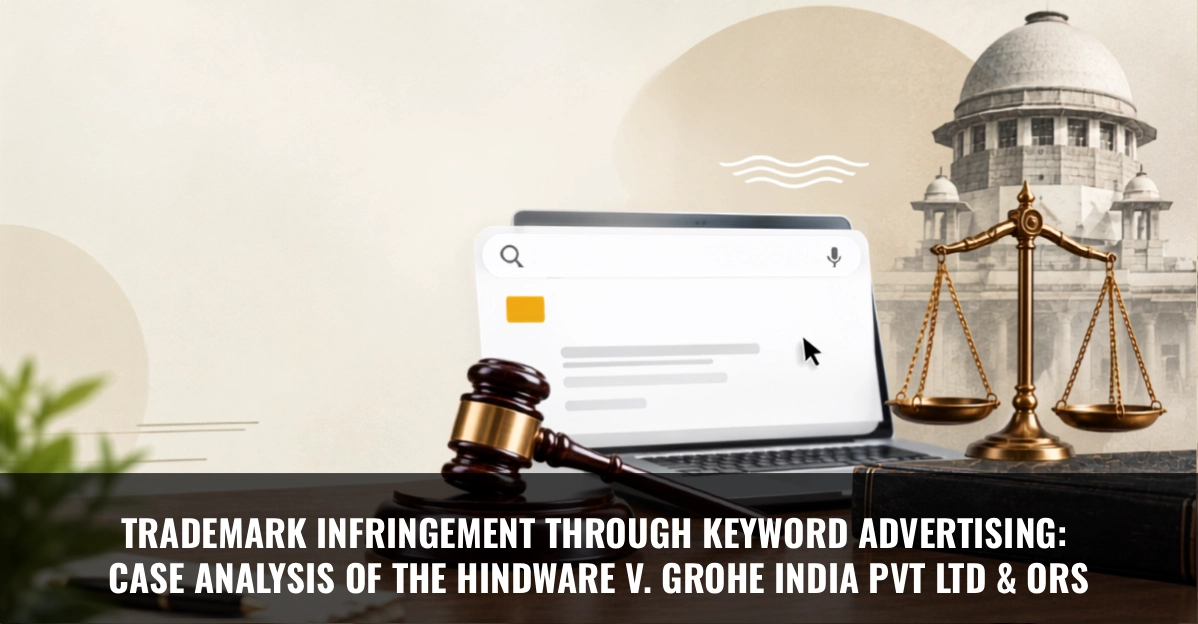
Now, type “Hindware” into Google search.
For over a decade, the first result wasn’t Hindware. It was Grohe. It was Cera — competitors of Hindware, sitting right on top of the one word that belonged to Hindware and nobody else.
On 22nd May 2026, the Delhi High Hon’ble court in the matter of HINDWARE LTD vs GROHE INDIA PVT LTD & ORS[1]finally called this what it is. Not “smart advertising” , Not “healthy competition” but an Infringement.
I. Background and Factual Matrix
Hindware is a leading Indian brand specializing in sanitaryware, bathroom fittings, tiles, and home appliances. In 2013, Hindware discovered that a google search of key “Hindware,” and Cera’s ads(Cera is a leading competitor of Hindware) bought through Google’s AdWords programme, via a website developer called Omkara Infoweb were showing up. A year later, they found Grohe, another competitor doing the same thing.
What it essentially means for Hindware is that the rivals were paying Google to hijack the exact moment a customer typed Hindware’s own name into a search bar, and redirecting that customer to themselves.
Grohe and Cera eventually came to a settlement agreement under Order 23 Rule 3 of Code of Civil Procedure, 1908 (“CPC”)[2] with Hindware. Google did not. Google fought for over a decade without relying on a single flimsy argument. It fought with a wall of them, built across three different laws.
II. Google’s Defence
Here’s what Google actually argued, provision by provision. If you’re a litigator, this is where it gets interesting.
A. Section 29 of the Trade Marks Act, 1999: Whether There Was “Use”
Google’s foundation argument was based on the contention that Sections 2(2)(b)[3] and (c)[4] of the Trademark Act 1999 (hereinafter referred to as “the Act”) require the mark to be printed, visual and perceivable. Keywords are invisible backend triggers, known only to the advertiser so how can something nobody can see amounts to “use” under Section 29(1)[5] at all?
On Section 29(2)[6], likelihood of confusion, on this aspect Google argued that no consumer confusion was ever proved, the ad text was clearly labelled as sponsored, and mere diversion of a user’s attention without confusion is not a ground of violation under the foregoing section. On Section 29(4)[7], dilution of a well-known mark: Google argued this provision doesn’t even apply here, because it requires dissimilar goods, and Hindware, Grohe and Cera all sell sanitaryware. It was contended by Google that a party cannot claim confusion under 29(2)[8] and dilution under 29(4)[9] in the same breath. On Section 29(6)(d)[10],Google argued that “advertising” must be read as a noun, meaning that the mark has to physically appear inside the ad text, not merely trigger its display in the background. On Section 29(8)[11] aspect, unfair advantage in advertising: Google argued the provision requires the advertisement to be “of that very mark”, an invisible backend keyword doesn’t qualify, and besides, every major search platform follows the same policy, making it industry practice, not unfair advantage. And defensively, it invoked the American doctrine of Initial Interest Confusion arguing that even a moment’s diversion toward a rival’s ad, without actual confusion, is not an infringement.
B. Sections 30 and 35: Fair Use and Bona Fide Use
Google contended that even if the Hon’ble court found “use,” it’s an exempted use under Section 30(1)[12] and 30(2)(a)[13] of the act. Google argued its AdWords policy reflects “honest practices in industrial and commercial matters” and on the aspect of advertising it reiterated that the “use” is fair use just like such as in case of comparative advertising, bona fide use of the trademark by informational, news related and review based websites or by authorized resellers. Under Section 35[14], the “own name and bona fide description” which is saving clause under the section, Google argued that triggering a search result via a trademark is a form of bona fide descriptive use and underneath both: Article 19(1)(a)’s constitutional protection for commercial speech and advertising.
C. Section 79 of the IT Act: The Intermediary Defence
Google’s final line of argument was , that it is an “intermediary,” under the Information Technology Act 1979( hereinafter referred to as “IT Act”) ,the Ads programme merely hosts third-party data and the advertiser alone chooses the keyword at their sole discretion. The Keyword Planner Tool, Google contended is optional and used only for internal reference , a value-add, not a trigger for liability. Google leaned heavily on two earlier Division Bench rulings Google LLC v. DRS Logistics[15] and Google LLC v. MakeMyTrip[16] to argue that keyword use has already been found not to amount to infringement.
Three statutes. Multiple sub-sections each. That’s not a flimsy defence — that’s a fortress.
The Hon’ble court dismantled it wall by wall.
III. RULING OF THE COURT
A. Territorial Jurisdiction
The Hon’ble Court on the issue of jurisdiction held that , for Territorial Jurisdiction- there is section 20 of CPC and section 134[17] of the Act. On the collective reading of foregoing sections and Burger King Corporation Versus Techchand Shewakramani and Others[18] it is established that, section 134 is in addition to section 20 of the CPC, which gives Plaintiff a right to file a suit for an infringement at its place of office. Also , section 20 gives the right to file a suit at a place where “cause of action arose”. The hon’ble court ruled that, since the website of google can be accessed from Delhi and the Plaintiff ‘s products are sold on E-commerce are sold in Delhi, the court has jurisdiction.
B. Section 29: Whether Invisible Keywords Constitute Use
Section 2(2)(c) of the Act defines “use” in relation to services as any statement about the availability or provision of that service, and the Hon’ble court read the phrase “in any other relation whatsoever” to mean exactly what it says: wider interpretation. Use doesn’t have to be seen to count.
Then there’s Section 29(6)(d) , using a mark “in advertising” amounts to use. The Hon’ble court rejected Google’s “noun, not verb” reading outright, and compared Google’s keywords to meta-tags: code nobody sees, but code that actively steers traffic away from the trademark owner and toward the infringer. Invisible mechanics, very visible consequences.
On Section 29(4), the Hon’ble court didn’t accept Google’s “you can’t have it both ways” argument either , the provision was found squarely applicable because Google’s own conduct, independent of the advertiser, caused the unfair advantage and dilution.
Here’s the line that should make every brand owner sit up: a trademark’s job is to be a source identifier; it tells you whose product you’re about to buy. When someone types “Hindware” into Google, they’ve already made a decision. They know what they want. The brand did the hardest part of marketing: creating unambiguous intent. Google’s AdWords model, the Hon’ble court said, converts that decision-making moment into an auction, where a rival can simply outbid the original brand for its own name.
Read that twice. A company can be forced to bid against strangers for the right to be found under its own name.
C. Google’s Role in the Advertising Ecosystem
This is where Google’s judgment becomes uncomfortable.
The Hon’ble court walked through the mechanics in detail — Google’s Keyword Planner Tool actively suggests trademarked terms to advertisers to boost their “Quality Score.” Multiple rivals can bid on the same brand name in a real-time auction. And Google only gets paid on a cost-per-click basis — meaning it profits specifically when a confused or intercepted customer clicks the wrong ad.
The Court’s ruled that , Google wasn’t merely hosting a marketplace. It was actively selling access to goodwill it never built and never owned — and charging the trademark owner, too, since even Hindware had to bid on its own name to stay visible.
That’s not a platform fee. That’s a toll on your own identity.
D. Sections 30 and 35: The Fair-Use Defences
The Hon’ble court rejected both fair-use defences, point by point.
Section 30(1) protects the use of a trademark “for the purposes of identifying goods or services as those of the proprietor” — meaning the use has to point back to Hindware, not away from it. Google wasn’t identifying Hindware’s products. It was selling Hindware’s name to Hindware’s direct competitors, so their advertisements would trigger instead. That’s not identification — that’s diversion, dressed up as one.
Section 30(2)(a) protects descriptive use — indicating kind, quality, geography, or purpose. But “HINDWARE” is a coined word with no dictionary meaning. It describes nothing about sanitaryware. There was no descriptive content here for Section 30(2)(a) to protect.
Section 35 — the “own name and bona fide description” clause — requires honest use, free of any intent to ride on someone else’s goodwill. The Court’s answer was blunt: Google’s use was driven precisely by the intention to exploit the goodwill Hindware had spent decades building. That’s the opposite of bona fide.
Even the free-speech argument didn’t survive. Commercial advertising is protected under Article 19(1)(a) — but the Hon’ble court held that protection was never absolute, and advertising that takes unfair advantage of another’s trademark falls outside it.
Three defences. Three rejections. Google’s safety net had holes in every strand.
E. Section 79 of the IT Act: The Safe-Harbour Defence
Google’s last stand was the “intermediary” defence — the claim that it merely hosts third-party data, chosen entirely by the advertiser, with an optional Keyword Planner Tool that carries no liability.
The Hon’ble court ruled that Safe harbour disappears the moment a platform stops being a passive conduit and starts actively selecting, suggesting, and monetising the infringing activity. Google runs the auction. Google ranks ads based on its own Quality Score. Google’s own tool recommends the trademarked keywords first. An “optional” tool that every serious advertiser ends up using isn’t really optional — it’s how the system quietly nudges you toward infringement while keeping its hands technically clean.
Citing the earlier DRS Logistics ruling against Google — the very precedent Google leaned on for support — the Hon’ble court held: you cannot encourage and sell the use of a trademark, and then claim the data isn’t yours to be responsible for.
F. The Conclusion of the Ruling
Permanent injunction, restraining Google LLC and Google India from using “HINDWARE” or its variants as an advertising keyword. Rs. 30 lakh in damages, jointly and severally.
The number is almost beside the point. What the Hon’ble court actually did was draw a line — a clear, citable, precedent-setting line — between a passive conduit and an active commercial participant. And it placed Google on the wrong side of it.
IV. Wider Implications of the Judgment
Within days of the judgment surfacing, India’s founders started talking. Nithin Kamath of Zerodha said Zerodha has faced exactly this problem for over a decade — search your own brand, and the first result is often a competitor’s ad. Sridhar Vembu of Zoho also backed the ruling.
Because here’s the uncomfortable truth this case exposes: India’s digital ad market is worth over ₹1.36 lakh crore today, headed toward ₹2.7 lakh crore by 2030 — built on infrastructure like keyword auctions that has, until now, operated with almost no accountability framework. A dominant platform quietly monetising the very brand recognition that companies spend years and crores building — with zero consent, zero revenue share, and, until 22nd May 2026, zero consequence.
This case was fought and won on the basis of Section 29 of the Trade Marks Act. But underneath it is a much bigger question: what happens when one company controls the very gateway through which every other business must reach its customers — and then charges you rent to walk through your own front door?
Hindware had to litigate for over a decade to get here. Not every business has that runway. But every business now has this judgment.
X. Conclusion
A trademark is not just a logo or a design. It is, at its core, a word — one word, protected, because a company spent years and crores making sure that word means something specific in a customer’s mind.
For over a decade, that word was being auctioned off, one click at a time, by a platform that called itself invisible.
Turns out, it’s the word that matters. And the law just said so.
[1] Hindware Ltd. v. Grohe India (P) Ltd., 2026 SCC OnLine Del 3913
[2] 3. Compromise of suit.—Where it is proved to the satisfaction of the Court that a suit has been adjusted wholly or in part by any lawful agreement or compromise [in writing and signed by the parties] or where the defendant satisfied the plaintiff in respect to the whole or any part of the subject-matter of the suit, the Court shall order such agreement, compromise or satisfaction to be recorded, and shall pass a decree in accordance therewith [so far as it relates to the parties to the suit, whether or not the subject matter of the agreement, compromise or satisfaction is the same as the subject-matter of the suit:]
[Provided that where it is alleged by one party and denied by the other that an adjustment or satisfaction has been arrived at, the Court shall decide the question; but not adjournment shall be granted for the purpose of deciding the question, unless the Court, for reasons to be recorded, thinks fit to grant such adjournment.]
[Explanation.— An agreement or compromise which is void or voidable under the Indian Contract
Act, 1872 (9 of 1872), shall not he deemed to be lawful within the meaning of this rule.]
[3] (b) to the use of a mark shall be construed as a reference to the use of printed or other visual representation of the mark;
[4] (c) to the use of a mark,—
(i) in relation to goods, shall be construed as a reference to the use of the mark upon, or in any physical or in any other relation whatsoever, to such goods;
(ii) in relation to services, shall be construed as a reference to the use of the mark as or as part of any statement about the availability, provision or performance of such services;
[5] 29. Infringement of registered trademarks.—(1) A registered trade mark is infringed by a person who, not being a registered proprietor or a person using by way of permitted use, uses in the course of trade, a mark which is identical with, or deceptively similar to, the trade mark in relation to goods or services in respect of which the trade mark is registered and in such manner as to render the use of the mark likely to be taken as being used as a trade mark.
[6] (2) A registered trade mark is infringed by a person who, not being a registered proprietor or a person using by way of permitted use, uses in the course of trade, a mark which because of—
(a) its identity with the registered trade mark and the similarity of the goods or services covered by such registered trade mark; or
(b) its similarity to the registered trade mark and the identity or similarity of the goods or services covered by such registered trade mark; or
(c) its identity with the registered trade mark and the identity of the goods or services covered by such registered trade mark,
[7] (4) A registered trade mark is infringed by a person who, not being a registered proprietor or a person using by way of permitted use, uses in the course of trade, a mark which—
(a) is identical with or similar to the registered trade mark; and
(b) is used in relation to goods or services which are not similar to those for which the trade mark is registered; and
(c) the registered trade mark has a reputation in India and the use of the mark without due cause takes unfair advantage of or is detrimental to, the distinctive character or repute of the registered trade mark.
[8] Id at 2
[9] Id at 4
[10] 6) For the purposes of this section, a person uses a registered mark, if, in particular, he—
(d) uses the registered trade mark on business papers or in advertising.
[11] (8) A registered trade mark is infringed by any advertising of that trade mark if such advertising—
(a) takes unfair advantage of and is contrary to honest practices in industrial or commercial matters; or
(b) is detrimental to its distinctive character; or
(c) is against the reputation of the trade mark.
[12] 30. Limits on effect of registered trade mark.—(1) Nothing in section 29 shall be construed as preventing the use of a registered trade mark by any person for the purposes of identifying goods or services as those of the proprietor provided the use—
(a) is in accordance with honest practices in industrial or commercial matters, and
(b) is not such as to take unfair advantage of or be detrimental to the distinctive character or repute of the trade mark.
[13] (2) A registered trade mark is not infringed where—
(a) the use in relation to goods or services indicates the kind, quality, quantity, intended purpose, value, geographical origin, the time of production of goods or of rendering of services or other characteristics of goods or services;
[15] Google LLC v. DRS Logistics (P) Ltd., (2023) 4 HCC (Del) 515
[16] Google LLC v. Makemytrip (India) (P) Ltd., (2023) 5 HCC (Del) 107
[17] 134. Suit for infringement, etc., to be instituted before District Court.—(1) No suit—
(a) for the infringement of a registered trade mark; or
(b) relating to any right in a registered trade mark; or
(c) for passing off arising out of the use by the defendant of any trade mark which is identical with or deceptively similar to the plaintiff’s trade mark, whether registered or unregistered, shall be instituted in any court inferior to a District Court having jurisdiction to try the suit.
(2) For the purpose of clauses (a) and (b) of sub-section (1), a ―District Court having jurisdiction‖ shall, notwithstanding anything contained in the Code of Civil Procedure, 1908 (5 of 1908) or any other law for the time being in force, include a District Court within the local limits of whose jurisdiction, at the time of the institution of the suit or other proceeding, the person instituting the suit or proceeding, or, where there are more than one such persons any of them, actually and voluntarily resides or carries on business or personally works for gain.
Explanation.—For the purposes of sub-section (2), ―person‖ includes the registered proprietor and the registered user
[18] Burger King Corporation Versus Techchand Shewakramani and Others (2018 SCC OnLine Del 10881)