
Written By: Apoorv Agarwal
Introduction
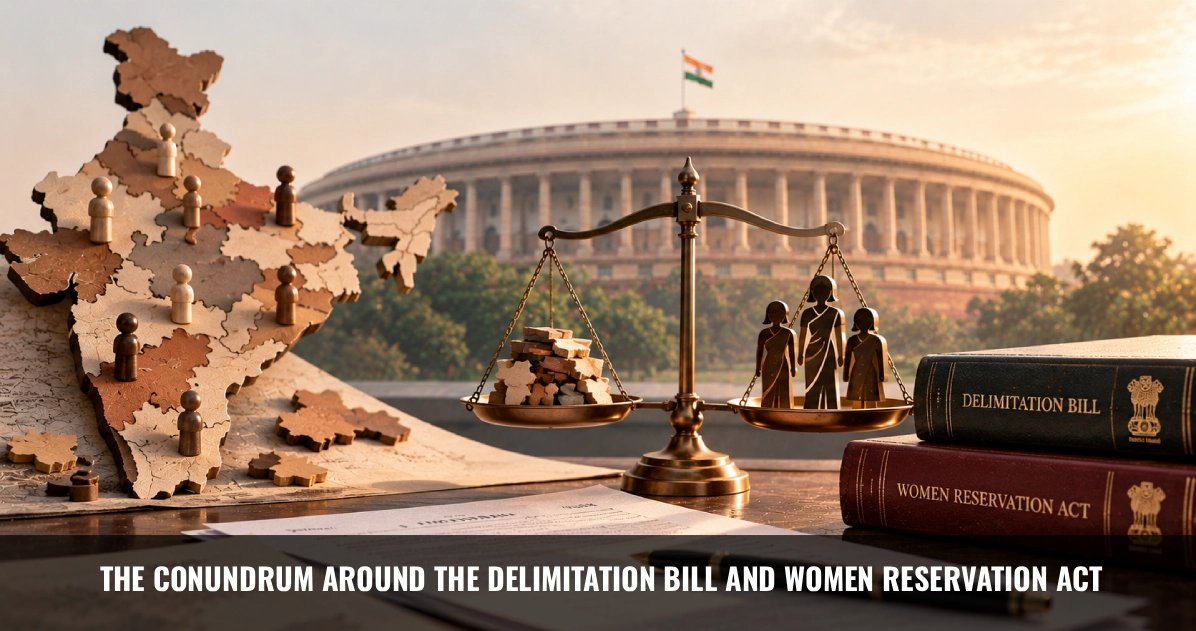
With the defeat of the 131st Constitutional Amendment Bill, 2025, along with the Delimitation Bill, 2026 and the Union Territories Laws (Amendment) Bill, 2026 purported to increase the Parliamentary and legislative seats and implementing the 1/3rd reservation for women in the Parliament and the State Assemblies, the long-standing demand for reserving the seats for women took another halt and the wait now will be longer than ever.
This article while keeping aside the politics involved behind the introduction of the bills and the defeat of the same, will focus towards the co-relation between all the three bills with the 106th Constitutional Amendment Act, 2023 and other intricate legal issues involved in the entire episode and the merits of the bills.
In brief, the two bills sought to be introduced majorly focussed on meeting with the requirements of the increasing the parliamentary and the legislative seats on account of the growing population of the country and the need for higher women participation in the legislative framework of the country.
The Constitution (One Hundred and Sixth Amendment) Act, 2023:
Following the years of demand and struggle, the President on 28.09.2023 provided it’s assent to the act reserving 1/3rd of the seats in one-third of seats for women in Lok Sabha and State Assemblies. The said reservation has been brought by way of the insertion of new article 330A[1] and Article 332A[2]. The said Act also paved way for reserving the seats for women in the legislative assembly of the NCT of Delhi by way of amending Article 239AA[3].
The important and most crucial highlight of this Act was the effective date of the implementation of the Act, which was, after the conclusion of the delimitation exercise to be undertaken after the date of the commencement of this Act. In other words, the reservation for women would be effective based on the delimitation exercise and the fresh census report published after the date of the commencement of this Act.
The said exercise was likely to be taken up from 01.03.2027, however, considering the herculean task of carrying out the said exercise in the country, the likelihood of concluding the census and the delimitation exercise was not feasible before or till the next scheduled general elections in the year 2029.
The Three Bills:
The Constitution (131st Amendment) Bill, 2026, the Union Territories Laws (Amendment) Bill, 2026, and the Delimitation Bill, 2026 introduced in Lok Sabha by the Ministry of Law and Justice on 16.04.2026 was meant to increase the seats in the Lok Sabha, State assemblies (including assemblies in the Union Territories); to enable the delimitation exercise based on the census conducted in the year 2011 and to further enable reservation for women based on the said delimitation.
Key features of the bills:
- Increase in the maximum number of seats in Lok Sabha- By way of amending Article 81 of the Constitution of India, the 131st amendment bill, 2026 sought to increase the strength of the seats in Lok Sabha, from previous 550 to 850 members and in State assemblies to 560 [4]and empowered the Parliament to decide as to which census report will be taken into consideration for increasing the number of seats in the Parliament.[5]
- Change in the commencement date in implementing the women reservation: Per the terms of the 106th Amendment Act, the women reservation was to take effect pursuant to the delimitation exercise based on the census to be conducted in the year 2027. However, the new bill purported to reserve the seats for women in the Parliament and the State assemblies based on the census and delimitation exercise conducted in the year 2011.
- Appointment of the Delimitation Commission- The Delimitation Bill, 2026 empowers the central government to constitute a Delimitation Commission to carry out delimitation. It will comprise: (i) a Chairperson who is or has been a Supreme Court Judge, (ii) the Chief Election Commissioner or an Election Commissioner nominated by the Chief Election Commissioner, and (iii) the State Election Commissioner of the concerned state. The central government will appoint the Chairperson.[6]
The defeat of the three bills in Lok Sabha:
The 131st Constitutional amendment bill and the accompanies bills were introduced in the Lok Sabha in the presence of 528 members, the bill was favoured by 298 members and opposed by 230, resultantly, the 2/3rd majority required for a Constitutional bill to pass from the house could not be achieved and consequently the bill lapsed on 17.04.2026.
Per Article 368[7] of the Constitution of India, for a constitutional amendment to pass, such bill is required to be passed with majority from both the house and by a majority of not less than 2/3rd of the member sitting and voting. Considering the said requirement, a total of 352 votes in favour of the bill was required for it to be passed from the Lok Sabha, however, the maths did not favour the ruling government and the bills collapsed.
Difference between an ordinary bill and a constitutional bill:
An ordinary bill covers all the bills other than Money bills under Article 110 and Finance Bill under Article 117 of the Constitution of India. The procedure of passing such a bill involves introduction of the bill in either house of the Parliament, discussion of the bill and the bill is passed if it gains the simple majority from both houses. Finally, the bill becomes the Act once the Presidents assents to the bill.
A constitutional amendment bill like the ordinary bill can be introduced in either of the houses, however for the bill to get passed from both the houses, the majority required is 2/3rd of the votes of the members sitting and voting, and the said procedure makes it difficult for the constitutional amendments to be passed from the houses and become an Act.[8]
Conclusion:
While a lot can be said regarding the intent to the ruling government to fast track the implementation of the 106th amendment act providing for reserving 1/3rd seats for women in the Parliament and State legislatures, however, the present controversy did in fact upheld the fundamental idea of Constitutionalism[9] which provides for due process and keeps necessary checks before the introduction of a socio-legal reform affecting the public at large.
[1] “330A. (1) Seats shall be reserved for women in the House of the People.
[2] “332A. (1) Seats shall be reserved for women in the Legislative Assembly of every State
[3] “(ba) Seats shall be reserved for women in the Legislative Assembly of the National Capital Territory of Delhi.
[4] 170. (1) Subject to the provisions of article 333, the Legislative Assembly of each State shall consist of not more than five hundred, and not less than sixty, members chosen by direct election from territorial constituencies in the State.
[5] In article 81 of the Constitution,–– (a) for clause (1), the following clause shall be substituted, namely:–– “(1) The House of the People shall consist of— (a) not more than eight hundred and fifteen members chosen by direct election from territorial constituencies in the States; and (b) not more than thirty-five members to represent the Union territories, chosen in such manner as Parliament may by law provide.”; (
b) for clause (3), the following clause shall be substituted, namely:–– ‘(3) In this article, the expression “population” means the population as ascertained at such census, as Parliament may by law determine, of which the relevant figures have been published.’
[6] https://prsindia.org/billtrack/the-constitution-131st-amendment-bill-2026
[7] An amendment of this Constitution may be initiated only by the introduction of a Bill for the purpose in either House of Parliament, and when the Bill is passed in each House by a majority of the total membership of that House and by a majority of not less than two-thirds of the members of that House present and voting, it shall be presented to the President who shall give his assent to the Bill and thereupon the Constitution shall stand amended in accordance with the terms of the Bill:
[8] Article 368(2) of the Constitution of India, 1950.
[9] Constitutionalism ensures that all state actions are conducted within the bounds of law. It emphasizes the rule of law, separation of powers, and checks and balances to prevent abuses of authority and protect citizens’ freedoms…. Read more at: https://vajiramandravi.com/upsc-exam/constitutionalism/