
Written By: Apoorv Agarwal
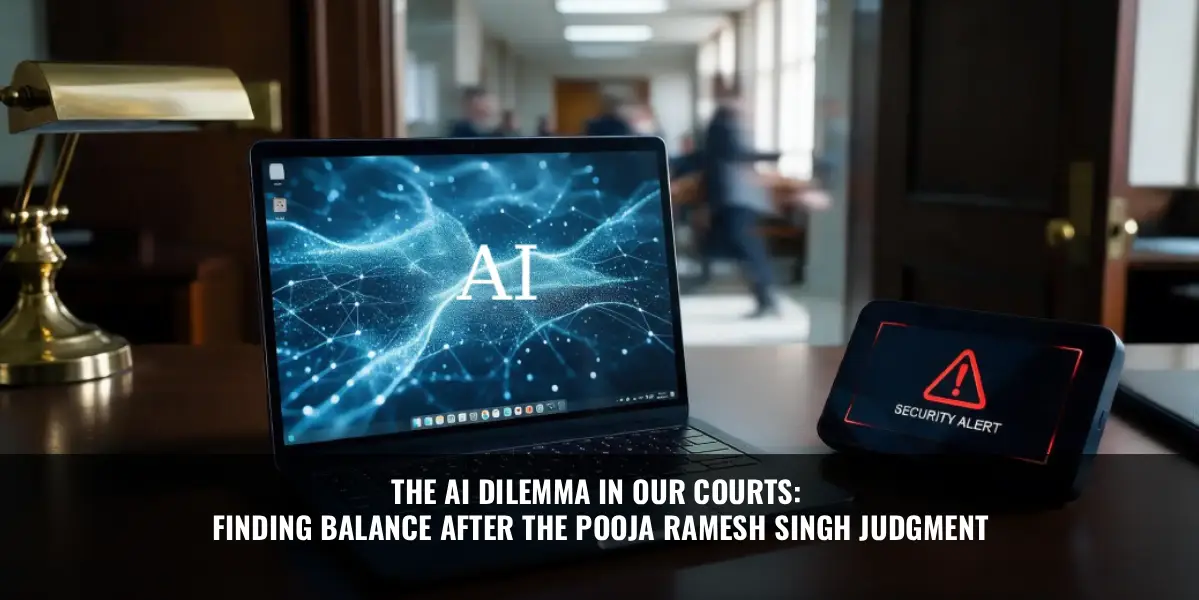
The Supreme Court’s response to hallucinated precedents marks a defining moment in Indian legal technology. In the contemporary legal landscape, the pressure on advocates and judges is unrelenting. As the statutory frameworks grow increasingly intricate, and commercial disputes demand turnaround in a short span of time, this environment of urgency has resulted in the advent of artificial as a bridge and a tool capable of summarizing voluminous records, cross-referencing multi-bench precedents, and drafting initial pleadings within minutes.
Yet, as the legal profession embraces algorithmic efficiency, an uncomfortable technological reality has surfaced. Large language trained AI-models do not truly comprehend the law, they operate by calculating probability through sequences of words. When prompted beyond their training parameters, they do not hesitate to invent statutory provisions, misattribute holdings, and synthesize fictional precedents with persuasive legal language. What happens when this digital mirage slips undetected into judicial determinations?
That question was answered in the judgment of Pooja Ramesh Singh v. Jammu and Kashmir Bank Ltd. on July 2, 2026, when the Supreme Court of India delivered its ruling highlighting the use of AI in the legal landscape and its unavoidable harm without the human evaluation. The judgment is not merely a highlight of unverified automated responses, it also represents AI incapability and its nature of false legal reasoning.
The Digital Legal Mirage
The factual background of the case illustrates how quietly algorithmic fabrications can infiltrate the adjudicatory machinery. The dispute originated in insolvency proceedings initiated under Section 7 of the Insolvency and Bankruptcy Code, 2016, by Jammu and Kashmir Bank against Essel Infraprojects Ltd., the corporate guarantor for credit facilities availed by an associate entity. Before the National Company Law Tribunal (NCLT) in Mumbai, the suspended director argued that corporate restructuring through demerger and amalgamation, coupled with a renewed sanction letter, had extinguished the guarantor’s liability.
The tribunal rejected these arguments and admitted the Section 7 petition on August 28, 2024. To anchor its reasoning, the tribunal cited a string of authoritative-sounding Supreme Court decisions. When the matter went in appeal, the National Company Law Appellate Tribunal (NCLAT) affirmed the admission order. In paragraph 12 of its opinion, the appellate tribunal reproduced the precedents cited by the lower tribunal, including decisions such as State Bank of India v. Shree Ram Urban Infrastructure Ltd., Everest Kento Cylinders Ltd. v. Union of India, ICICI Bank Ltd. v. Urban Infrastructure Real Estate Ltd., V.S. Dempo and Co. Ltd. v. Reliance Communications Ltd., Canara Bank v. N.G. Subbaraya Setty, and Sarbjit Singh v. Union Bank of India.
Before the Supreme Court, Senior Advocate Madhavi Divan revealed an astonishing flaw that several of the cited judgments were entirely fictitious, while others paired genuine case citations with paragraphs that existed nowhere in reported law. An independent inquiry confirmed the breakdown. ICICI Bank, V.S. Dempo, and Sarbjit Singh were non-existent citations. In Everest Kento Cylinders and Canara Bank, correct citations were attributed to entirely hallucinated paragraphs. In State Bank of India, a wrong citation was coupled with fabricated text. Crucially, the respondent financial creditors clarified via affidavit that their counsel had never cited these cases at the bar, the tribunal had introduced them through its own unverified research. The hallucinated fabrications had then passed entirely unnoticed through statutory appellate scrutiny.
The Methyl Isocyanate Warning
Faced with this systemic failure, the Division Bench of Justices P.S. Narasimha and Alok Aradhe set aside both the tribunal and appellate orders, remitting the matter for fresh consideration. In doing so, the Bench delivered an unequivocal warning regarding the uncritical adoption of artificial intelligence in judicial determinations. The Court observed that the production of fake, hallucinated material and its utilization as precedents is like the release of methyl isocyanate in the province of law and justice and an invisible, insidious, and catastrophic force by the time anyone notices.
Beyond the metaphor, the Court offered a profound critique of human delegation. It observed that human beings naturally seek comfort in delegating tidious tasks, but if cognitive reasoning itself is delegated until it becomes a habit, the essential core of human existence our disciplined capacity to discern right from wrong, truth from falsehood, and dharma from adharma, is severely compromised. In the Judicial reasoning, the Court reminded the legal community, is not a mechanized pattern-matching exercise, it is an intellectual saadhana, a disciplined and conscious pursuit forged through lived human experience, scientific temper, and ethical discernment.
To protect this sanctity, the Court established a rigid zero-tolerance policy. It held that relying on or citing hallucinated material without verification constitutes professional misconduct for an advocate and a grave lapse for a judge. A judgment tainted by even an iota of such material is considered no decision in the eyes of the law, rendering it void regardless of whether the hallucinated text had an outcome-determinative effect. Consequently, the Court directed the Bar Council of India to constitute a dedicated committee to frame guiding principles and disciplinary rules to penalize such occurrences.
The Strict Liability Dilemma
The Supreme Court’s insistence on procedural integrity is unimpeachable, but the practical enforcement of an absolute zero-tolerance mandate raises difficult regulatory questions. By framing the presence of an unverified hallucination as automatic misconduct, the regulatory direction leans heavily toward a standard of strict liability. In traditional jurisprudence, strict liability is reserved for ultra-hazardous activities where proof of intent is dispensed with to enforce extreme deterrence. Applying this standard to the probabilistic outputs of generative technology creates a challenging paradox.
Most commercial AI tools operate as opaque systems, and even seasoned practitioners may not fully appreciate how a retrieval model might splice genuine legal phrasing with hallucinated citations. With the introduction of AI, and its time efficient model which analyzes tremendously lengthy databases in few seconds, it has resulted in the more productive work efficiency, if such are used with bonafide intention and as assistance tools, Today, seeing the quick analysis nature of AI, several legal databases trained AI systems are also introduced.
If the Bar Council enacts rules that treat every unverified algorithmic citation as an act of professional misconduct warranting disciplinary sanctions, the outcome may not be enhanced diligence, but institutional paralysis. Junior advocates and resource-constrained litigators, who stand to benefit most from accessible research assistance, may be deterred from adopting technology altogether, thereby widening the efficiency gap between well-resourced law firms and individual practitioners.
The UK Precedents
The Indian Supreme Court’s defensive caution offers an instructive contrast to other common law jurisdictions grappling with similar challenges. In 2025, the United Kingdom’s Solicitors Regulation Authority (SRA) authorized Garfield Law Ltd., the country’s first purely artificial intelligence-driven law firm. Instead of prohibiting algorithmic processes, the regulator required structural guardrails, including strict monitoring protocols, mandatory professional indemnity coverage, and explicit safeguards prohibiting the system from autonomously proposing case law without named human supervision.
Similarly, when a junior associate at Pinsent Masons LLP inadvertently submitted a hallucinated statutory excerpt to the UK High Court in Anthony Malcolm Cork v. Mark Smith [2026], the court took a measured approach. Even though the AI tool generated a misleading secondary justification to mask its original error, the presiding judge refrained from initiating formal contempt proceedings, distinguishing between deliberate dishonesty and negligent oversight. The court treated the error as an admonishable lapse of supervision rather than deliberate professional bad faith.
The path forward
As the Bar Council of India deliberates on guidelines pursuant to the Supreme Court’s mandate, it must strive to balance ethical deterrence with technological progress. Disciplinary regulations should differentiate between reckless attempts to deceive the court and inadvertent citation errors resulting from faulty software. Sanctions should ideally target gross negligence and willful blindness, rather than establishing an indiscriminate, no-fault liability regime.
Furthermore, instead of relying solely on punitive prohibitions, the guidelines should prescribe clear verification protocols, mandating that any advocate relying on automated research must verify all extracted propositions against primary reporting databases before presenting them in court. The Bar Council should also integrate comprehensive modules on algorithmic bias, generative mechanics, and verification methodologies into continuing legal education curricula and state bar enrollment processes.
The Supreme Court’s verdict in Pooja Ramesh Singh serves as a vital reminder that while technology can assist the administration of justice, the moral and intellectual burden of judgment remains an exclusively human endeavor. As the legal ecosystem evolves, the objective must not be to build an insurmountable wall against innovation, but to cultivate a Bar and Bench capable of interrogating its outputs with skepticism, rigor, and independent understanding. The human must remain in the loop, not as an algorithmic scapegoat, but as the enduring guardian of the rule of law.