
Written By: Apoorv Agarwal
Case: Satya Prakash Bagla v. Evaan Holdings Pvt. Ltd. & Ors. | SLP(C) No. 4534/2025 Bench: The Chief Justice & Justice Sanjay Kumar | Date: February 24, 2025
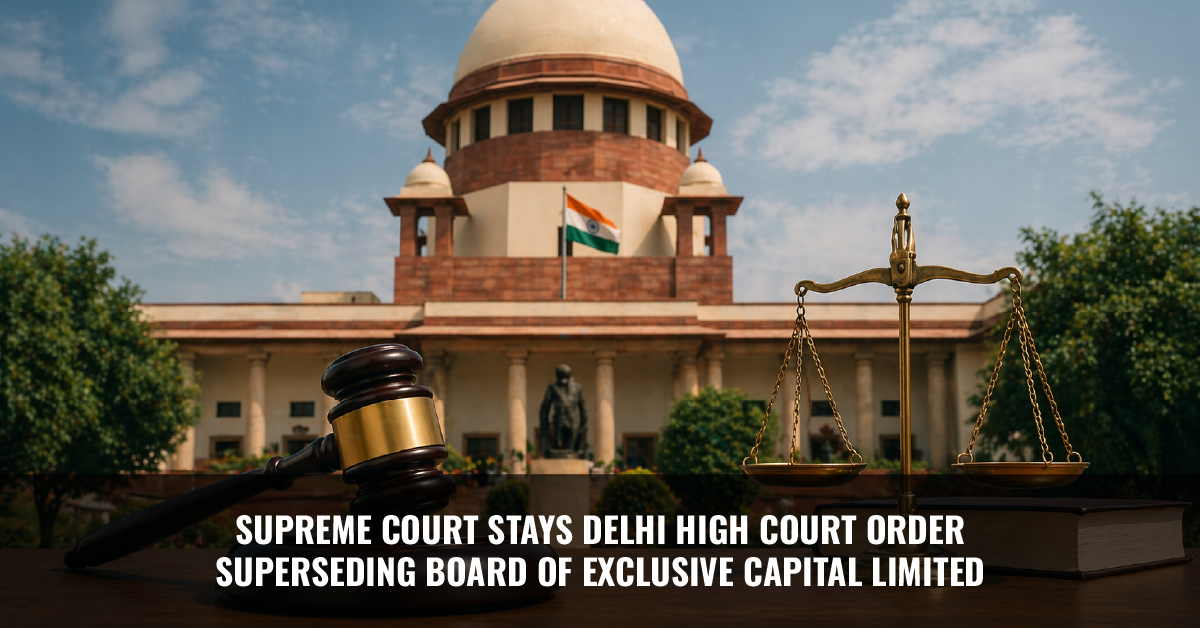
In a significant interim ruling, the Supreme Court of India stayed a Delhi High Court order that had superseded the Board of Directors of Exclusive Capital Limited (ECL), a Delhi-based Non-Banking Financial Company, and replaced it with an Interim Committee of Administrators. The ruling raises important questions about the boundaries of writ jurisdiction and the risks of judicial directions that travel far beyond the relief actually sought.
The roots of this dispute lie in a corporate restructuring that began in 2021, when Mr. Satya Prakash Bagla took over as majority shareholder and Managing Director of ECL. Between October 2021 and March 2022, a company called Teesta Retail Private Limited invested ₹315 crores into ECL against Optionally Convertible Debentures (OCDs). In August 2022, ECL converted these OCDs into Compulsorily Convertible Preference Shares (CCPS) to address leverage ratio concerns a decision taken with the full consent of the investor.
It was only in September 2022, after all of this had taken place, that Mrs. Kanta Agarwala and Mr. Suresh Agarwala became shareholders of ECL purchasing shares with complete knowledge of the OCD-to-CCPS conversion. Despite this, in February 2024, they filed an oppression and mismanagement petition before the National Company Law Tribunal (NCLT), alleging financial irregularities and mismanagement by the Board.
In parallel, Evaan Holdings Private Limited a company controlled by the Agarwala family, in which the Respondents hold 90% shareholding filed a writ petition before the Delhi High Court seeking directions against the Reserve Bank of India for alleged inaction in investigating ECL’s affairs. The primary grievance was narrow: that the RBI had failed to discharge its regulatory obligations as the apex supervisory body of NBFCs.
However, the Single Judge’s order of October 23, 2024 went far beyond this prayer. Instead of confining itself to the question of RBI’s alleged inaction, the Court superseded ECL’s entire Board of Directors and appointed an Interim Committee of Administrators to manage the company’s affairs effectively deciding disputes that were already pending adjudication before the NCLT and NCLAT. The Division Bench upheld this sweeping order on February 12, 2025, prompting Mr. Bagla to approach the Supreme Court by way of a Special Leave Petition.
The Supreme Court took immediate note of the concern at the heart of this matter. The bench comprising the Chief Justice and Justice Sanjay Kumar observed that while the writ petition’s primary prayer concerned the RBI’s alleged inaction, the interim directions issued by the Single Judge had gone considerably further effectively adjudicating inter-party disputes that were already sub-judice before the NCLT and NCLAT. This conflation of forums and issues warranted urgent correction.
The Court granted the following key reliefs:
- Board Reinstated: The order superseding ECL’s Board of Directors and appointing the Interim Committee of Administrators was stayed, restoring management control to the existing Board.
- Business Continuity Ensured: ECL was permitted to continue its day-to-day operations, subject to one safeguard any financial transaction exceeding ₹10 lakhs required prior notice to the Observer (Retd. Justice R.K. Gauba), who retained the power to escalate matters to the NCLT if warranted.
- Observer’s Role Preserved: The NCLAT’s directions concerning the Observer, including the scope of his powers, were left intact and continued to operate.
- RBI to Proceed Independently: The Court directed that RBI proceedings pursuant to its show-cause notice must continue and be concluded preferably within four weeks. In a significant observation, the Court made clear that the RBI must reach its decision entirely on the merits, without being influenced by either the High Court’s observations or the Supreme Court’s own stay order — underscoring the regulator’s independence and institutional integrity.
- All Proceedings to Continue: Parties retained full liberty to approach the NCLT and NCLAT for appropriate directions, with those forums free to proceed unaffected.
This order carries important implications on two fronts. First, it reaffirms the principle that writ jurisdiction, however broad, must remain tethered to the relief actually sought. A petition directed at regulatory inaction cannot become a vehicle for restructuring corporate governance or deciding disputes pending before specialised tribunals. Second, it reinforces the institutional primacy of the RBI as the expert statutory regulator of NBFCs directing it to act independently and on the merits, insulated from judicial observations that might otherwise colour its decision-making.
For practitioners and companies alike, the case is a timely reminder that parallel proceedings across multiple forums carry real risks not least the risk that an interim order in one forum may dramatically alter the legal and commercial landscape in another.