
Written By: Apoorv Agarwal
Introduction
The Insolvency and Bankruptcy Code, 2016 (IBC) fundamentally transformed India’s insolvency regime by replacing fragmented recovery mechanisms with a unified, creditor-driven process focused on timely resolution and value maximisation. While the Code has largely achieved these objectives for individual corporate debtors, it remains conspicuously silent on one increasingly common commercial reality, the insolvency of corporate groups.
Modern business enterprises rarely function through a single legal entity. Large conglomerates often operate through a network of holding companies, subsidiaries, associate companies and special purpose vehicles, all of which remain legally distinct but commercially integrated. Their finances, management, assets and liabilities are frequently intertwined to such an extent that the insolvency of one entity inevitably affects the viability of the others. Yet, the IBC continues to treat each company as an independent corporate debtor, requiring separate insolvency proceedings irrespective of their economic interdependence.
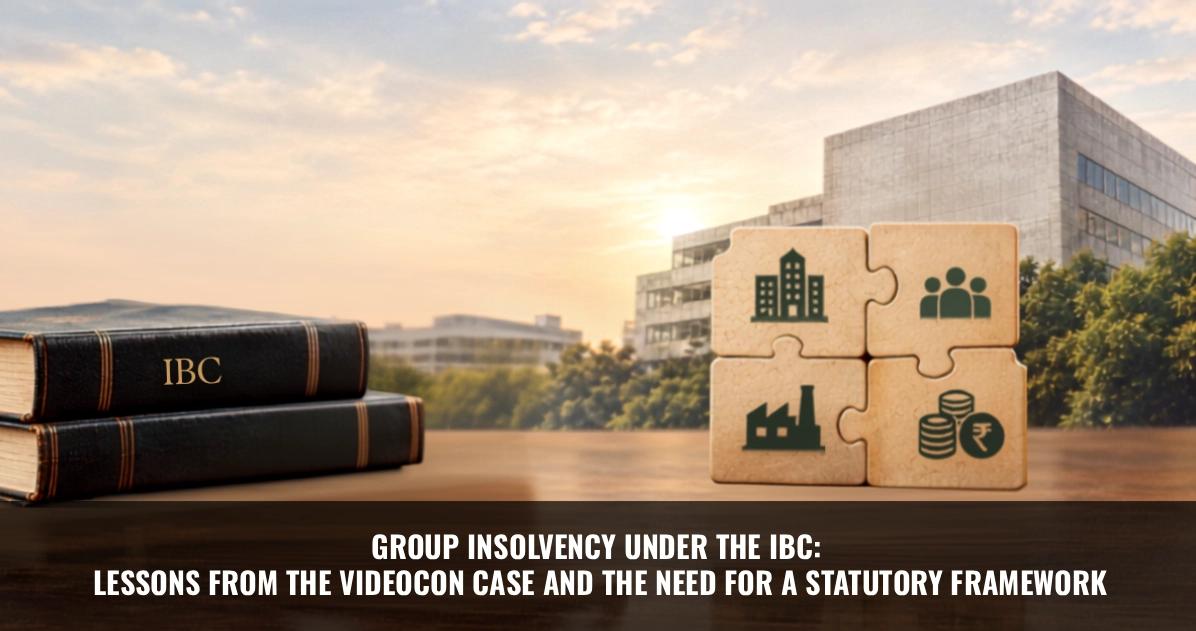
The case of SBI vs. Videocon Industries Ltd. exposed this legislative gap in unprecedented fashion. Faced with multiple insolvency proceedings against companies that operated as a single economic enterprise, the National Company Law Tribunal (NCLT), Mumbai Bench, invoked the doctrine of substantive consolidation and ordered the consolidation of thirteen group companies into a single Corporate Insolvency Resolution Process (CIRP). The decision marked the first comprehensive judicial recognition of group insolvency under Indian law and demonstrated the practical necessity of treating certain corporate groups as one economic unit despite their separate legal personalities.
While the judgment undoubtedly facilitated a more efficient resolution process, it also highlighted the absence of a statutory framework governing group insolvency. The reliance on judicial innovation, without legislative guidance, has inevitably raised questions concerning predictability, creditor protection and the limits of judicial discretion.
This article analyses the Videocon decision, examines the principles governing substantive consolidation, and argues that India must move beyond judge-made solutions towards a comprehensive statutory framework for group insolvency under the IBC.
The Videocon Insolvency: A Turning Point in Indian Insolvency Jurisprudence
The financial collapse of the Videocon Group remains one of the most significant insolvency proceedings witnessed under the IBC. The conglomerate consisted of numerous companies engaged in diverse commercial activities, yet their financial and operational affairs were deeply interconnected. Common management, cross-guarantees, inter-corporate borrowings and shared assets meant that the fortunes of each company were inseparable from those of the others.
Following persistent defaults, a consortium of financial creditors led by the State Bank of India initiated insolvency proceedings under Section 7 of the IBC against several entities of the group. Separate CIRPs commenced against individual companies, but the fragmented approach soon proved commercially impractical. Potential resolution applicants were reluctant to bid for isolated entities because their assets and liabilities were intrinsically linked with those of other group companies. Independent resolution proceedings threatened not only to reduce enterprise value but also to prolong the insolvency process, thereby frustrating the fundamental objectives of the IBC.
Recognising these commercial realities, the NCLT adopted an unprecedented course by directing the substantive consolidation of thirteen Videocon entities while excluding two companies that retained operational and financial independence. Rather than treating each corporate debtor in isolation, the Tribunal considered whether the companies collectively constituted a single economic enterprise whose value could only be preserved through a unified insolvency process.
The practical consequences of the decision were considerable. Consolidation enabled the preparation of a common information memorandum, facilitated a unified invitation for resolution plans and eliminated duplication across parallel CIRPs. More importantly, it allowed resolution applicants to evaluate the enterprise as an integrated business rather than as fragmented legal entities possessing limited standalone value.
The judgment represented a pragmatic response to commercial realities. Nevertheless, it also underscored the structural limitations of the existing insolvency framework. The Tribunal was compelled to fashion an equitable remedy despite the complete absence of statutory provisions dealing with group insolvency.
Substantive Consolidation: Understanding the Doctrine
The doctrine of substantive consolidation did not originate in Indian law. It evolved through judicial decisions under the United States Bankruptcy Code as an equitable remedy designed to address situations where maintaining separate corporate identities would defeat the objectives of insolvency proceedings.
Unlike procedural coordination, which merely synchronises parallel insolvency proceedings while preserving separate estates, substantive consolidation combines the assets and liabilities of multiple legal entities into a single insolvency estate. Creditors of the individual companies thereafter participate in a common resolution process, and the consolidated estate is treated as though it belonged to a single debtor.
Given its far-reaching consequences, American courts have consistently regarded substantive consolidation as an exceptional remedy rather than the default rule. Decisions such as Food Fair, Auto-Train Corp. and Augie/Restivo Baking Co. developed guiding principles requiring courts to examine whether creditors dealt with the entities as a single economic unit and whether disentangling their financial affairs would prove prohibitively expensive or practically impossible.
Drawing inspiration from these authorities, the NCLT in Videocon adopted a structured approach instead of ordering consolidation solely because the companies belonged to the same corporate group. The Tribunal identified several indicators demonstrating that the entities lacked genuine commercial independence.
Among the considerations examined were common ownership and management, interdependence of business operations, pooling of financial resources, cross-guarantees, common assets and liabilities, intertwined banking arrangements, common control over decision-making and the inability of individual entities to function independently. Collectively, these factors established that the group operated not as a collection of autonomous companies but as an integrated commercial enterprise.
Importantly, the Tribunal recognised that substantive consolidation should remain an exception. It acknowledged that creditors who extended finance to individual companies might legitimately expect to recover only from the assets of those companies. Accordingly, consolidation cannot be justified merely because companies belong to the same corporate group; rather, it must demonstrably enhance value and promote a more effective insolvency resolution than separate proceedings.
To ensure that the doctrine was not applied indiscriminately, the Tribunal effectively adopted a two-stage inquiry. The first stage examined whether the entities were sufficiently integrated to warrant consideration for consolidation. The second assessed whether consolidation would ultimately produce greater value for stakeholders than maintaining separate CIRPs. Applying this framework, the Tribunal consolidated thirteen companies while excluding KAIL Ltd. and Trend Electronics Ltd., both of which retained sufficient operational and financial independence to justify separate insolvency proceedings.
This calibrated approach reflected an important principle: substantive consolidation is not intended to disregard the doctrine of separate corporate personality but to recognise that, in exceptional cases, commercial reality may outweigh legal form.
The Legislative Vacuum under the IBC
While the Videocon decision successfully addressed an immediate commercial problem, it also exposed a significant gap in the IBC. The Code is primarily structured around the insolvency of a single corporate person and contains no provisions dealing specifically with enterprise groups. Consequently, tribunals are left to rely on equitable principles to resolve disputes involving interconnected companies, resulting in uncertainty and inconsistent outcomes.
The absence of a statutory framework becomes particularly problematic because group companies often function with varying degrees of financial and operational integration. In some cases, subsidiaries maintain complete commercial independence despite common ownership. In others, the distinction between separate entities exists only on paper, with finances, assets, management, and business operations functioning as a unified enterprise. A rigid application of separate legal personality may therefore undermine value maximisation, while indiscriminate consolidation may unfairly prejudice creditors who intentionally contracted with individual entities.
The challenge, therefore, lies in identifying cases where substantive consolidation is justified without eroding the fundamental principles of company law.
One of the principal concerns arising from judicially ordered consolidation is its potential impact on creditor expectations. Financial institutions often assess the creditworthiness of a specific company before extending finance. Their lending decisions, pricing of risk, and security arrangements are based upon the assumption that the assets of that company alone will constitute the insolvency estate. Consolidation alters this commercial understanding by pooling assets and liabilities across multiple entities, thereby redistributing recoveries among creditors who may never have dealt with one another.
For this reason, substantive consolidation cannot become a routine mechanism merely because companies belong to the same corporate group. Rather, it should remain an exceptional remedy employed only where maintaining separate insolvency proceedings would substantially diminish enterprise value or render effective resolution impossible.
Separate Legal Personality and the Limits of Consolidation
Any discussion on group insolvency inevitably raises questions concerning the doctrine of separate corporate personality, firmly established by the House of Lords in Salomon v. A. Salomon & Co. Ltd.. The decision recognised that an incorporated company possesses a legal identity distinct from its shareholders, directors, and affiliated entities. This principle continues to underpin modern company law by protecting limited liability and ensuring commercial certainty.
At first glance, substantive consolidation appears inconsistent with this doctrine because it effectively disregards the separate legal existence of related companies. However, such an understanding oversimplifies the relationship between the two concepts.
Substantive consolidation does not negate the principle established in Salomon. Rather, it operates as a narrowly tailored insolvency remedy designed to address situations where the corporate structure no longer reflects commercial reality. The doctrine is invoked not because separate legal personality is irrelevant, but because rigid adherence to legal form would frustrate the objectives of insolvency law.
Courts therefore face the difficult task of balancing two equally important considerations. On one hand lies the need to respect corporate separateness and preserve creditor expectations; on the other lies the objective of maximising value by recognising the economic reality of an integrated enterprise. The Videocon decision attempted to strike this balance by emphasising that consolidation must remain an exception supported by compelling evidence rather than a consequence of common ownership alone.
Learning from International Practice
India’s evolving jurisprudence on group insolvency mirrors developments in several foreign jurisdictions. While the United States relies primarily on judicially developed principles of substantive consolidation, international efforts have increasingly favoured structured legislative guidance.
A notable example is the UNCITRAL Model Law on Enterprise Group Insolvency, which recognises that members of a corporate group frequently operate as a single economic unit despite maintaining separate legal identities. Instead of advocating automatic consolidation, the Model Law encourages procedural coordination, cooperation between insolvency representatives, coordinated planning, and, where appropriate, group-wide solutions that preserve value while respecting creditor rights.
Similarly, the Insolvency Law Committee (ILC) in India acknowledged that the existing framework inadequately addresses enterprise groups. The Committee recommended introducing a comprehensive framework for group insolvency that would facilitate coordinated resolution while preserving the separate legal personality of group entities unless exceptional circumstances justify otherwise. Rather than making substantive consolidation the norm, the ILC envisaged a flexible framework permitting coordinated proceedings, information sharing, and common resolution strategies.
These developments demonstrate that the issue is not whether India should recognise group insolvency, it already has through judicial precedent, but whether judicial innovation should continue to substitute for legislative certainty.
The Way Forward
The Videocon judgment undoubtedly represents a significant milestone in India’s insolvency jurisprudence. Nevertheless, reliance upon judicial discretion alone cannot provide the certainty necessary for an effective insolvency regime.
The IBC would benefit from a dedicated statutory framework governing enterprise group insolvency. Such legislation should clearly define the circumstances in which substantive consolidation may be invoked, prescribe procedural safeguards, and establish objective criteria for determining when separate entities should be treated as a single economic unit.
Any future framework should incorporate three essential safeguards.
First, consolidation should remain an exceptional remedy available only where substantial evidence demonstrates that separate resolution proceedings would materially diminish enterprise value or render effective resolution impracticable. Mere common ownership or shared directors should never suffice.
Secondly, creditor interests must remain central to the decision-making process. Adjudicating authorities should carefully evaluate whether consolidation would unfairly prejudice creditors who extended finance to individual entities on the basis of their separate corporate identities. Appropriate mechanisms should therefore be devised to protect legitimate creditor expectations while balancing the broader objective of value maximisation.
Finally, greater emphasis should be placed on procedural coordination before substantive consolidation is considered. Joint hearings, coordinated resolution professionals, common information memoranda, and synchronised timelines may often achieve the efficiencies of group insolvency without disturbing corporate separateness. Consolidation should therefore represent the final step rather than the default response.
Such an approach would preserve the flexibility demonstrated in Videocon while simultaneously ensuring greater predictability and consistency across future insolvency proceedings.
Conclusion
The Videocon insolvency marked a defining moment in the evolution of India’s insolvency framework by bringing the concept of group insolvency into mainstream judicial discourse. Faced with a legislative vacuum, the NCLT adopted the doctrine of substantive consolidation to preserve enterprise value and facilitate an effective resolution of a highly integrated corporate group. The decision reflected commercial pragmatism and reaffirmed that insolvency law must respond to economic realities rather than rigid legal formalism.
However, the judgment also demonstrated the limitations of relying solely on judicial innovation. Questions concerning creditor protection, procedural safeguards, and the threshold for consolidation continue to remain unanswered. As corporate groups become increasingly sophisticated and commercially integrated, these issues are likely to arise with greater frequency.
India’s insolvency regime has now reached a stage where judicial precedent alone is insufficient. A comprehensive statutory framework for enterprise group insolvency, drawing upon international best practices while remaining faithful to the objectives of the IBC, would provide much-needed certainty, promote consistent decision-making, and strengthen creditor confidence. Such reform would not only address the shortcomings exposed by Videocon but also ensure that the IBC remains capable of resolving complex corporate failures in an increasingly interconnected business environment.