
Written By: Apoorv Agarwal
An Examination of Section 52 and the Constitutional Foundations of User Rights in India
Introduction
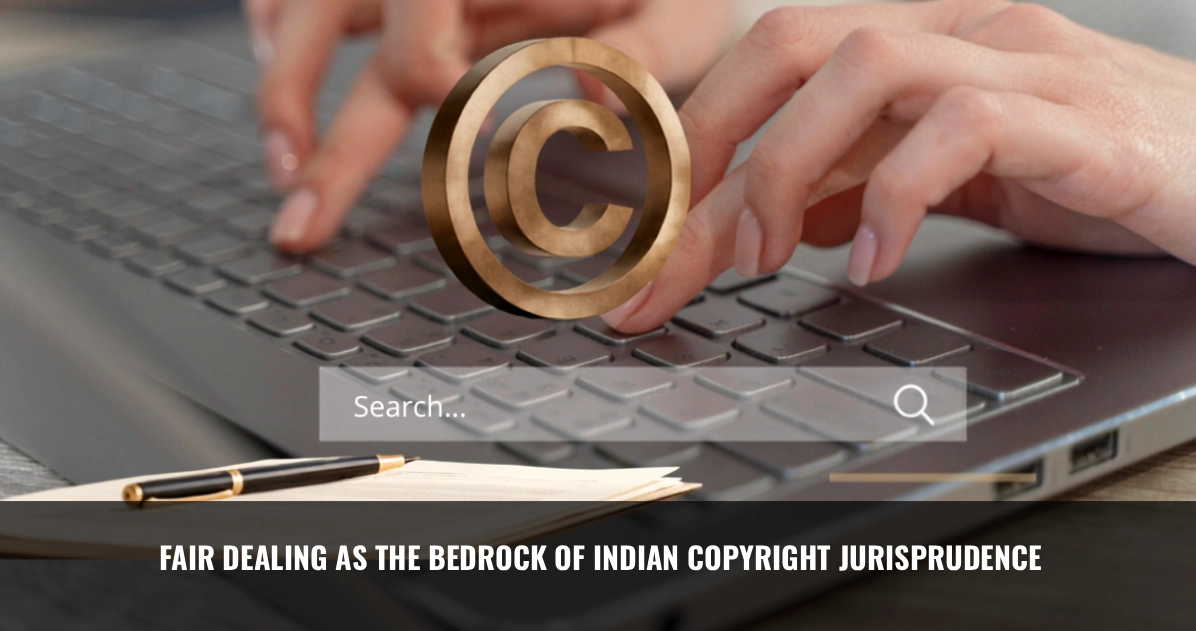
Copyright law in India is frequently introduced to students and practitioners through the language of entitlement: an author writes, and the law rewards. Section 14 of the Copyright Act, 1957 lists out a generous bundle of exclusive rights 1 reproduction, adaptation, translation, public performance, and communication to the public, among others, that vest in the owner of a literary, dramatic, musical or artistic work the moment it is fixed in a tangible form. It is tempting, given the prominence of section 14 in the statutory scheme, to treat it as the centre of gravity of the Act. This article argues that such a reading inverts the actual architecture of Indian copyright law. The true bedrock of the statute is not the exclusivity conferred by section 14, but the limitation placed upon that exclusivity by section 52, commonly described as the fair dealing provision.
The argument is not merely rhetorical. As this article demonstrates, the structure of the Act itself, the constitutional history that produced it, and decades of judicial interpretation all converge on the conclusion that fair dealing is not an afterthought bolted onto an otherwise complete right, but the condition on which the right is permitted to exist in the first place. Section 14 opens with the words “subject to the provisions of this Act”2, and section 52 is the most significant of those qualifying provisions. The exclusivity an author enjoys is, from the very first line of the operative section, a conditional and bounded exclusivity, not an absolute one.
The Constitutional Genesis of Section 52
Unlike many other limitations found in comparative copyright statutes, the Indian fair dealing provision cannot be understood purely as an internal policy compromise within copyright law.
The Delhi High Court, in Wiley Eastern Ltd. v. Indian Institute of Management3, traced the lineage of section 52 directly to Article 19(1)(a) of the Constitution, the guarantee of freedom of speech and expression. This is a significant doctrinal move. It means that the limitations contained in section 52 are not simply legislative grace extended to users at the pleasure of Parliament; they are the statutory expression of a constitutional guarantee that already exists independently of the Copyright Act. A provision of this character cannot sensibly be read down or treated as a narrow carve-out, because doing so would risk narrowing the constitutional freedom that the provision was designed to operationalise.
This constitutional anchoring also explains why section 14, despite its expansive language, has never been treated by Indian courts as creating anything resembling a natural or absolute property right. The Supreme Court, in Entertainment Network (India) Ltd. v. Super Cassettes Industries Ltd.4, situated Indian copyright firmly within the utilitarian, Anglo-Saxon tradition, observing that the grant of exclusivity is instrumental, designed to incentivise creation, and must always be weighed against the competing public interest in the dissemination of knowledge. The Court did not treat the balancing exercise as an exception to be invoked sparingly; it treated the balance itself as the organising principle of the statute. Read alongside Wiley Eastern, the message is consistent: section 52 does not chip away at a complete right, it defines the actual boundaries of a right that was always conditional.
“Exception” as a Misleading Label
Much of the conceptual confusion surrounding fair dealing in India stems from loose terminology. Section 52 is routinely, even in judicial opinions, described as providing “exceptions” to copyright. The label is not neutral. To call something an exception is to suggest that the default, normal state of affairs is full exclusivity and that any departure from that default requires special justification to be construed narrowly because it cuts against the grain of the statute. That framing has crept into Indian copyright discourse largely by osmosis from older English and American case law, but it sits uneasily with the actual text of the Indian Act.
Section 14 itself states that the rights it confers operate “subject to the provisions of this Act”, and the Karnataka High Court, in Academy of General Education v. B. Malini Mallya5, read this language to mean that the exclusivities under section 14 simply do not arise, or cease to bind, in circumstances falling within section 52. On this reading, fair dealing is not a defence that excuses an act of infringement after the fact; it defines the outer perimeter of the right itself. An act that satisfies section 52 was never an infringing act to begin with, because the exclusive right never extended that far. Recasting the relationship in this way, from exception-to-a-right to definition-of-a-right, has real consequences for interpretation. Provisions that define the scope of a right are ordinarily read according to their purpose, not narrowed reflexively the way carve-outs and provisos often are.
Colonial Origins: Kartar Singh v. Ladha Singh
It is sometimes assumed that a generous, access-oriented conception of copyright limitation is a recent, post-liberalisation development in Indian law, perhaps influenced by international debates over open access and the digital commons. The historical record tells a different story. As early as 1934, while colonial India was still governed by the Imperial Copyright Act, 1914, the Lahore High Court confronted the question of how far an author’s exclusivity could be stretched to choke off subsequent scholarship. In Kartar Singh v. Ladha Singh6, the Court held in unambiguous terms that copyright could not be used as a tool to shut every door of research and scholarship, describing such an outcome as foreclosing “all frontiers of human knowledge.”
The significance of Kartar Singh lies less in its specific facts than in the instinct it reveals. Even under a colonial statute imported wholesale from England, and even decades before the Indian Constitution gave the limitation a textual constitutional home, an Indian court understood copyright as a bounded, instrumental device rather than an unqualified entitlement. The post-independence Act of 1957 and its later amendments in 1994 and 2012, which expanded and clarified the scope of permitted dealings, can fairly be read as the legislative continuation of that judicial instinct rather than a sharp break from it.
The Modern Application: Libraries, Education, and the DU Photocopy Litigation
The most consequential modern test of fair dealing’s centrality came not from a case about novels or films, but from a dispute over a university photocopy shop. In The Chancellor, Masters and Scholars of the University of Oxford v. Rameshwari Photocopy Services7, a group of major academic publishers sued a small photocopying shop operating out of Delhi University for compiling and selling course packs containing excerpts from copyrighted textbooks. The publishers argued that the scale and systematic nature of the copying took the activity outside the protection of section 52(1)(i), the clause permitting reproduction of a work by a teacher or pupil in the course of instruction.
The Delhi High Court, first through a detailed single-judge ruling and then on appeal before a Division Bench, sided decisively with the educational institution and the photocopy shop. The Court reasoned that the reproduction of copyrighted material for educational purposes is not a derogation from copyright that must be tolerated grudgingly but an activity that the statute affirmatively contemplates, in keeping with India’s social reality of limited access to costly imported textbooks and a student population that, in large part, cannot afford to purchase every prescribed text. The judgment is widely regarded as the high-water mark of pro-access reasoning in Indian copyright law, and it is difficult to imagine the Court reaching that result while treating section 52 as a narrow, disfavored exception rather than a purposive expression of the Act’s underlying balance.
Why Fair Dealing Should Be Read Broadly, Not Grudgingly
Once fair dealing is understood as constitutionally rooted and structurally definitional rather than exceptional, the interpretive consequence follows naturally: courts should construe section 52 in light of its purpose, which is the promotion of research, criticism, education, and the broader dissemination of knowledge, rather than reading it down to the narrowest set of facts the words can be made to bear. This is not a claim that authors deserve no protection. India’s utilitarian model of copyright, as the Supreme Court recognised in Entertainment Network, exists to provide authors with sufficient incentive to keep creating, particularly in a society where alternative sources of livelihood for writers, researchers, and artists are scarce and where commercial publishing markets remain comparatively thin. But the sustenance of the author is the goal that the right is meant to serve; it is not, by itself, a justification for expanding exclusivity beyond what sustenance requires. A right calibrated to provide a living wage for authorship looks very different from a right calibrated to maximise extraction from every possible secondary use, and Indian courts, from the Lahore High Court in 1934 to the Delhi High Court in the DU photocopy litigation, have consistently favored the former conception over the latter.
The Unresolved Problem of Access
A purely doctrinal account of fair dealing risks overstating how much the right actually delivers to the people it is meant to protect. Consider a researcher who wishes to rely, for entirely non-commercial scholarly purposes, on a journal article held behind a publisher’s paywall. The use itself, reading, quoting modestly, and building upon the argument, is squarely protected by section 52(1)(a)(i), the clause permitting fair dealing with a literary work for private or personal use, including research. Yet section 52 says nothing about how the researcher is meant to reach the article in the first place. If the only avenue of access is a payment the researcher cannot afford, the statutory permission to deal fairly with the work becomes, in practical terms, hollow.
This gap between the right to use and the ability to access is rarely addressed directly in Indian case law, and it exposes a genuine limitation in treating fair dealing alone as sufficient to vindicate the constitutional values underlying Article 19(1)(a). A paywall is, in a meaningful sense, a private mechanism of copyright enforcement that operates wholly outside the statute, untouched by section 52 because section 52 only ever speaks to what a person may lawfully do with a copy already in their possession, not to how that copy may lawfully be obtained. The doctrine, however generously construed, cannot by itself dissolve that barrier. Addressing it requires complementary institutional responses, library licensing schemes, statutory or voluntary access mandates for publicly funded research, and renewed judicial attention to whether the manner of access itself, and not merely the subsequent use, ought to fall within the protective reach of section 52 in appropriate circumstances. Until that question receives a clearer answer, the promise of fair dealing in India will remain, for many researchers, considerably larger on paper than it is in practice.
Conclusion
Section 52 of the Copyright Act, 1957 is too often described in the vocabulary of exception, as though it were a grudging concession carved out of an otherwise complete and self-sufficient right. The argument advanced in this article is that this framing gets the statute backwards. The exclusivity granted under section 14 is, by its own express terms, subject to the rest of the Act, and section 52 supplies the most important of the qualifying limitations on that exclusivity. Its roots run through the constitutional guarantee of free speech in Article 19(1)(a), as the Delhi High Court recognised in Wiley Eastern, and through nearly a century of judicial instinct stretching back to the Lahore High Court’s 1934 refusal, in Kartar Singh v. Ladha Singh, to let copyright close off the frontiers of scholarship. That instinct found its fullest modern expression in the Delhi High Court’s treatment of educational photocopying in the DU course pack litigation, where the Court declined to treat large-scale reproduction for instructional purposes as a suspect activity requiring narrow construction of the statute.
None of this is to suggest that authors and publishers are owed nothing. The utilitarian justification for copyright that the Supreme Court endorsed in Entertainment Network depends on authors receiving enough protection to sustain their creative work. But sustenance is a modest, bounded objective, and it does not require, let alone justify, the kind of sweeping exclusivity that would leave fair dealing as a narrow, disfavoured afterthought. Treating section 52 as foundational rather than exceptional is simply a more accurate description of what the statute, read as a whole and against its constitutional backdrop, actually does.
At the same time, doctrine alone cannot finish the job. As the paywall example illustrates, the formal right to deal fairly with a work means little to a researcher who cannot afford to reach the work at all. A truly bedrock conception of fair dealing in India, one faithful to the Lahore High Court’s nine-decade-old warning against closing the frontiers of human knowledge, will need to grapple not only with what users are permitted to do with a copyrighted work, but with whether the law does enough to ensure they can get to it in the first place. That remains the unfinished business of Indian copyright jurisprudence.
Endnotes
1. The Copyright Act, 1957, § 14 (India).
2. Id.
3. Wiley Eastern Ltd. v. Indian Institute of Management, AIR 1996 Del 233 (Del HC).
4. Entertainment Network (India) Ltd. v. Super Cassettes Industries Ltd., (2008) 13 SCC 30.
5. Academy of General Education, Manipal v. B. Malini Mallya, (2009) 4 SCC 256.
6. Kartar Singh v. Ladha Singh, AIR 1934 Lah 777.
7. The Chancellor, Masters and Scholars of the University of Oxford v. Rameshwari Photocopy Services, 2016 SCC OnLine Del 6229 (single judge); affirmed in relevant part, 2017 SCC OnLine Del 12326 (Div. Bench).