
Written By: Apoorv Agarwal, Raj Maitrey
Introduction
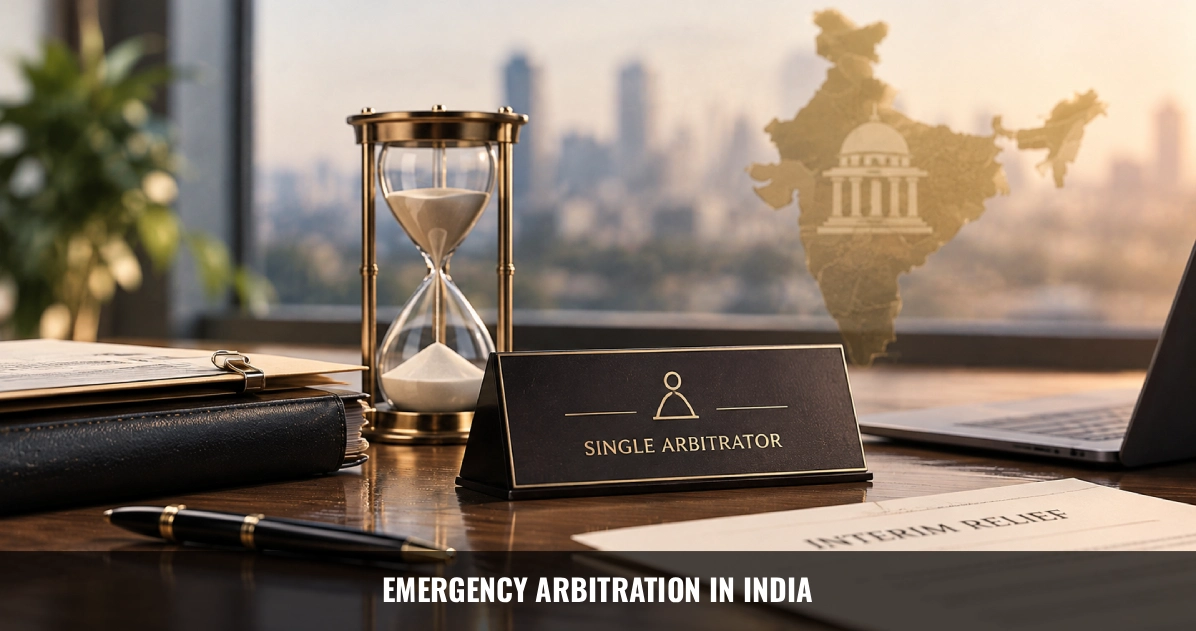
Emergency Arbitration is when an arbitral institution selects a sole arbitrator to adjudicate on applications for interim relief on an accelerated basis that cannot wait for the formation of the formal tribunal. An emergency arbitrator’s order is temporary but legally binding, although it can be changed or suspended by a substantive or formal tribunal after it is formed.[1] In the past, emergency arbitration was not specifically recognized in India. However, in the ruling of, Amazon.com NV Investment Holdings LLC v. Future Retail Limited and Ors., AIR 2021 SC 3723, the Supreme Court, held that emergency arbitration falls under the A&C Act and that the arbitral tribunal’s explanations include emergency arbitration within its scope.[2] Although there is not any section that defines emergency arbitration, it comes under the ambit of arbitration tribunal only. Or in other words, the Arbitration and Conciliation Act now considers Emergency Arbitration as a part of it. Some institutions in India have given recognition to Emergency Arbitration (EA) and have laws based on it. These include Delhi International Arbitration Center, Mumbai Center for International Arbitration and Madras High Court Arbitration Center.[3]
Case Analysis
The landmark case of Amazon.com NV Investment Holdings LLC v. Future Retail Limited and Ors.[4] brought in certain developments and reforms in the field of Indian arbitration law and has been further detailed below.
Facts- Future Retail Limited made a deal with Reliance Industries Limited to sell its supermarket chain Big Bazaar to the latter. The sale was of the wholesale and retail trade of Big Bazaar. Apart from Big Bazaar, food trade unit Foodhall and textile trade unit Brand Factory were also to be sold to Reliance Retail via the deal. Reliance Retail is a subsidiary of Reliance Industries Limited. The online shopping platform Amazon opposed this deal and took the matter to the Singapore International Arbitration Centre. Amazon claimed that it already had a contract with Future Coupons, a subsidiary of Future Retail whereby only Amazon was entitled to acquire shareholdings of Future Retail either wholly or partly. This acquirement could be done only during the period between three and ten years of the commencement of the agreement. Amazon contended that the deal with Reliance Retail constituted a breach of contract as the agreement was already in place. The matter was heard by an Emergency Arbitrator of the Singapore International Arbitration Centre or the SIAC. The Emergency Arbitrator interdicted the deal from being executed. The matter was brought before a Single-Judge bench of Delhi High Court who held that the order passed by the Emergency Arbitrator in within the scope of Section 17(1)[5] of the Arbitration and Conciliation Act, 1996. The matter was appealed before a Division-Bench of Delhi High Court which stayed the Single-Judge order and subsequently judgment. Special Leave Petitions were filed and the matter was brought to the Supreme Court.
Issued and Ratio
The Hon’ Supreme Court highlighted two significant issues in this case and clarified the position of law on the same. These two issues were:
- Whether an ‘arbitral tribunal’ under sec. 17(1) of Arbitration and Conciliation Act, 1996, would include an Emergency Arbitrator? To this, the Court held that ‘arbitral tribunal’ would include Emergency Arbitrator under sec. 17(1) of the Arbitration Act. Sec. 17(1) deals with the interim measures that may be ordered by an arbitral tribunal.[6] The Court found that Emergency Arbitrators were in fact extremely helpful to the Judicial System as they helped in “decongesting the Civil Courts” and “affording expeditious interim reliefs to the parties” in a dispute. The Respondents had contended that the proceedings before the Emergency Arbitrator were coram non judice as the same did not fall within the purview of the Arbitration Act. This view was denied by the Court for the reasons already explained. The Court further held that institutional rules also play an important role when it comes to matters of the Arbitration law.
- Second issue that arose was whether the appeal made to the Division Bench of Delhi High Court by the respondents is in consonance with the existing provisions and propriety? To this, the Court held that no appeal whatsoever lies against an order of enforcement of the order passed by the Emergency Arbitrator. Before reaching the SC an Appeal was made to the Division bench of Delhi High Court against the order of enforcement passed by a Single Judge bench. The Division Bench had stayed the implementation of the order of enforcement of the Single Judge Bench. The Apex Court held that an appeal to order of enforcement was not maintainable in the eyes of Law and hence the decision of the Division bench was set aside by the Division Bench of the Supreme Court consisting of Hon’ Justice Rohinton Fali Nariman and Hon’ Justice B. R. Gavai.
Considering all these features, this judgment of the Hon’ Supreme Court of India is considered as a definitive precedent when it comes to the position of Emergency Arbitrators[7] in Arbitral Law and the maintainability of appeal against the order of enforcement of the order passed by Emergency Arbitrators.
Conclusion
The landmark judgement of Amazon.com NV Investment Holdings LLC v. Future Retail Limited and Ors. was important in clarifying the scope of Article 17(1) of the Arbitration Act with regards to the Emergency Arbitrator provision, and that the award given by an Emergency Arbitrator cannot be appealed against and continues to be the defining precedent which lays down the law related to Emergency Arbitrations in India.
[1]Okpi Bernard Adaafu, Interim Measures in International Commercial Arbitration, Social Science Research Network (Mar, 01, 2021), https://papers.ssrn.com/sol3/papers.cfm?abstract_id=3791700
[2]Pramod Nair, Enforceability Of Emergency Arbitrator Decisions in India – The Decision in Amazon v. Future Retail, Bar and Bench ( Aug 07, 2021, 11:06 a.m.), https://www.barandbench.com/columns/the-decision-in-amazon-future-retail
[3]Yadav V., Emergency Arbitration under Institutional Arbitration Rules: A Comparative Study, 3, IJL, 158, 159-160 (2017)
[4] Amazon.com NV Investment Holdings LLC v. Future Retail Limited and Ors., AIR 2021 SC 3723.
[5] The Arbitration and Conciliation Act, 1996, § 17(1).
[6] Supra note 27.
[7] Aashish Aryan, Supreme Court rules on Future Retail v Amazon: what now, The Indian Express (Aug 7, 2021, 8: 41 a.m.), https://indianexpress.com/article/explained/sc-rules-on-future-retail-v-amazon-what-now-7442342/.