

1. Introduction
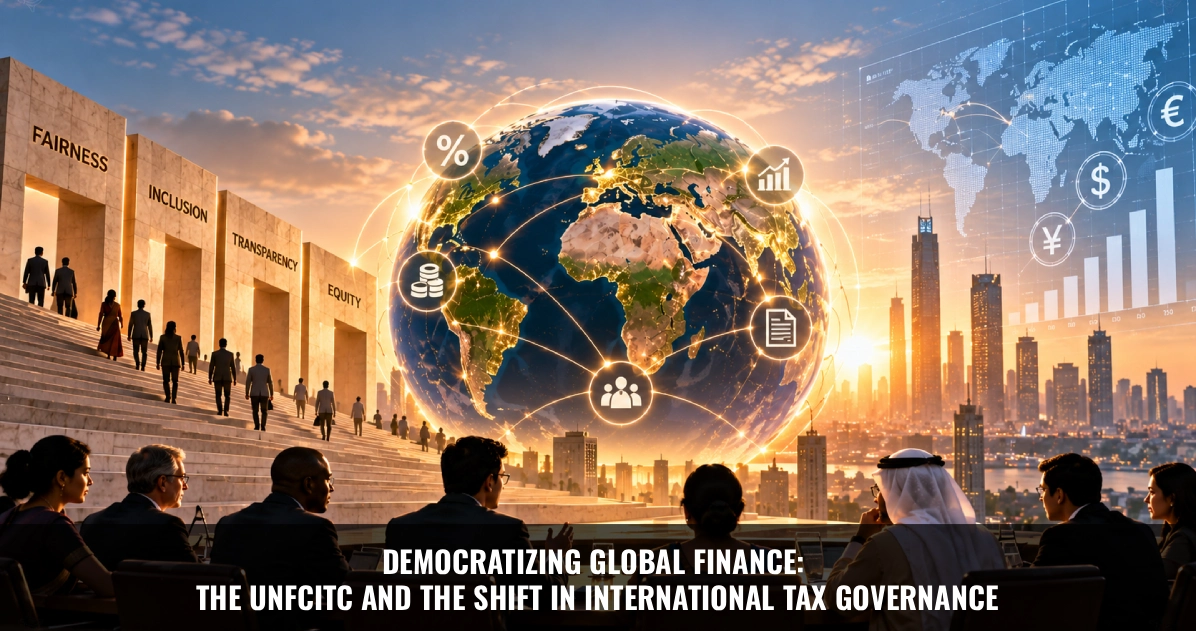
International economic law is currently undergoing one of the most significant structural transformations of our generation. For decades, the rules governing how money moves, how profits are recorded, and how global corporations are taxed have been largely dictated by a handful of wealthy nations. However, we are presently witnessing a historic transfer of global tax architecture from the traditional domain of the OECD directly into the halls of the United Nations. In 2024, the UN General Assembly approved the terms of reference for the development of a UN Framework Convention on Tax, a major initiative to enhance international tax coordination. This is not just a diplomatic reshuffle; it is a fundamental renegotiation of state sovereignty, economic fairness, and the legal mechanisms that govern the modern global economy.
2. Background: The Broken Consensus and the $350 Billion Problem
To understand the necessity of a UN-led convention, we first have to look at the bleeding balance sheets of the global economy. Almost USD 350 billion is lost every year due to multinational corporations shifting profits to low-tax jurisdictions. Historically, the Organization for Economic Co-operation and Development (OECD) has been the primary architect of international tax standards.[1]
The OECD’s highly publicized “Two-Pillar” framework perfectly illustrates the current gridlock. Pillar One, which proposed giving countries new rights to tax the profits of highly digitalized companies, remains stalled, complex, and limited in scope. Meanwhile, Pillar Two established a global minimum corporate tax set at 15%, a move criticized for allowing low effective tax rates to continue and imposing complex rules that disadvantage the global South. The realization that the convoluted rules of the current system steer tax revenues away from public budgets has driven the push for a legally binding treaty under the UN.
The convoluted rules of the current system steer tax revenues away from public budgets, particularly in the Global South, and favor corporate profit extraction. The realization that the existing architecture cannot adequately address these inequities has driven the push for a legally binding treaty under the UN.[2]
3. The Institutional Shift: A Democratic Legal Order
The transition to the UN represents a massive shift towards inclusive, democratic decision-making. With the global tax architecture finally being discussed at the UN, every country now has a vote, meetings are webcast, papers are public, and, if consensus fails, decisions can pass by simple or two-thirds majority.
The voting record on the Terms of Reference reveals the stark geopolitical divide underpinning this shift. In December 2024, the Terms of Reference were adopted by the UN General Assembly with 110 countries, primarily from the Global South, voting in favor. Only eight countries voted against, including the United Kingdom and the United States, while forty-four countries abstained. This combination of transparency and inclusive voting makes it far harder for a small bloc of rich countries to dominate the agenda.
4. Core Mechanics: The Structural Anatomy of the UNFCITC
From a structural perspective, the UN Framework Convention on International Tax Cooperation (UNFCITC) is being negotiated as a legally binding international treaty. The final architecture will be adopted in stages, starting with a core convention text and two early protocols, followed by other protocols on specific technical areas.[3]
A protocol is a separate agreement under the convention dealing with a defined topic, and each of these will require its own separate national ratification. Because these protocols are optional texts that states can choose to sign up for after agreeing to the core Convention, there is a very real risk of fragmented standards. Depending on how governments engage, we might see a staggered or uneven adoption of global tax rules, where some states join early, others delay, and some opt out entirely.
Protocols are optional texts with additional rules that states can choose to sign up to after agreeing to the core convention. Because of this opt-in nature, there is a real risk of fragmented standards where some states may join early, others may delay, and some may not participate at all.
5. Key Legal Frontiers
Negotiators have fast-tracked two early protocols to be developed in parallel with the core convention, representing the absolute frontier of international economic law.[4]
- A. Taxing the Attention Economy and Digital Services: The first protocol focuses on taxing cross-border services in a digitalized economy. The rise of the digital economy has severed the traditional link between physical presence and tax liability. When examining how to effectively tax the attention economy, advocates are pushing for “unitary taxation.” This would mandate that multinationals should be taxed as single global entities, using a formula that reflects where real economic activity happens, including the essential contribution of labor to the creation of profits. By pushing for a protocol that aggressively targets cross-border digital services, the UN convention is attempting to end the flow of profits into tax havens. It is an attempt to legally recognize that the value extracted from users, digital interactions, and local market engagement must be taxed in the jurisdiction where that value is generated.
- B. Sovereignty, Arbitration, and Dispute Resolution: The second protocol focuses entirely on tax dispute prevention and resolution. A major priority in this arena is defending a country’s sovereign right to make tax rules in the public interest by ruling out Investor-State Dispute Settlement (ISDS) systems. ISDS is a mechanism that lets corporations sue governments in private tribunals over tax policies. Designing a multilateral dispute resolution framework that relies on state-to-state cooperation rather than corporate arbitration is a massive shift in how international economic disputes will be litigated. The labor movement views ISDS as a direct threat to domestic sovereignty, arguing that private arbitration tribunals should not have the jurisdiction to overturn or penalize public interest tax policies. Designing a multilateral dispute resolution framework under the UN that relies on state-to-state cooperation rather than investor-state arbitration represents a massive shift in how international economic disputes will be litigated in the future.
6. Stakeholder Demands: The Labor Perspective
The drive for the UNFCITC is heavily backed by global civil society and the labor movement, who view this as a chance to reset the global economy. Their legal demands for the convention are highly specific:
- A Higher Global Minimum: Multinationals should pay tax on their profits at no less than 25 percent, ensuring they contribute fairly to public services.
- Corporate Transparency: The convention must mandate public country-by-country reporting (CbCR), requiring multinationals to publicly disclose their revenues, profits, taxes paid, and economic activity in every country where they operate.
- Progressive Taxation: The treaty should explicitly support states’ efforts to expand progressive taxation, allowing for the expansion of wealth taxes, financial transaction taxes, and capital gains taxes.
7. Conclusion
The road ahead for international economic law is currently being paved in real-time. We are in the thick of a highly compressed and consequential drafting process, with all three core texts, the overarching Convention and the two fast-tracked early protocols being negotiated simultaneously between 2025 and 2027. The negotiating committee is expected to complete its rigorous work and submit the final, binding texts to the UN General Assembly (UNGA) in September 2027, at the start of its eighty-second session. What emerges from these sessions will permanently alter the landscape of global commerce.
At its core, the UN Framework Convention is about fundamentally rethinking the international tax framework for the digital age. As the global market increasingly pivots toward intangible value, taxing the attention economy requires a legal architecture that the old OECD models simply were not built to support. By moving toward unitary taxation and focusing on where real economic activity and labor actually occur, the UN protocol on cross-border digital services offers a lifeline to market jurisdictions that have historically been sidelined.[5]
Equally transformative is the procedural shift accompanying these substantive tax rules. The intersection of international taxation and dispute resolution is undergoing a paradigm shift.
Ultimately, there is a severe cost to sitting out of this transition. If progressive voices, trade unions, and allied civil society stay quiet, corporate lobbyists and a handful of powerful economies will shape a settlement that keeps driving the race to the bottom, continuing to squeeze the public budgets of the Global South. By establishing a single set of democratically agreed-upon rules, the international community has its best chance in decades to ensure multinationals pay taxes where real economic activity takes place.
The UN Framework Convention on International Tax Cooperation is not just another treaty; it is the definitive legal battleground of our time, rewriting the boundaries of state sovereignty, corporate accountability, and international economic justice.
[1] tax just. Network, the state of tax justice 2023, at 12 (2023)
[2] Org. For econ. Co-operation & dev., action plan on base erosion and profit shifting 13–15 (2013); see also oecd/g20 base erosion and profit shifting project, statement on a two-pillar solution to address the tax challenges arising from the digitalisation of the economy (oct. 8, 2021)
[3] pub. Servs. Int’l, int’l trade union confed’n & network of unions for tax just., the un framework convention on international tax co-operation: briefing for unions (2025).
[4] Rep. of the Ad Hoc Comm. to Draft Terms of Reference for a U.N. Framework Convention on Int’l Tax Cooperation on Its Second Session, U.N. Doc. A/79/333, at 4–5 (Aug. 16, 2024); see also G.A. Res. 79/235, Terms of Reference for a United Nations Framework Convention on International Tax Cooperation (Dec. 24, 2024).
[5] U.N. Intergovernmental Negotiating Comm. on the U.N. Framework Convention on Int’l Tax Cooperation, Roadmap and Timeline for the Negotiation Process, U.N. Doc. A/AC.295/2025/L.1 (Feb. 2025)