
Written By: Apoorv Agarwal, Ritika Gusain
Introduction
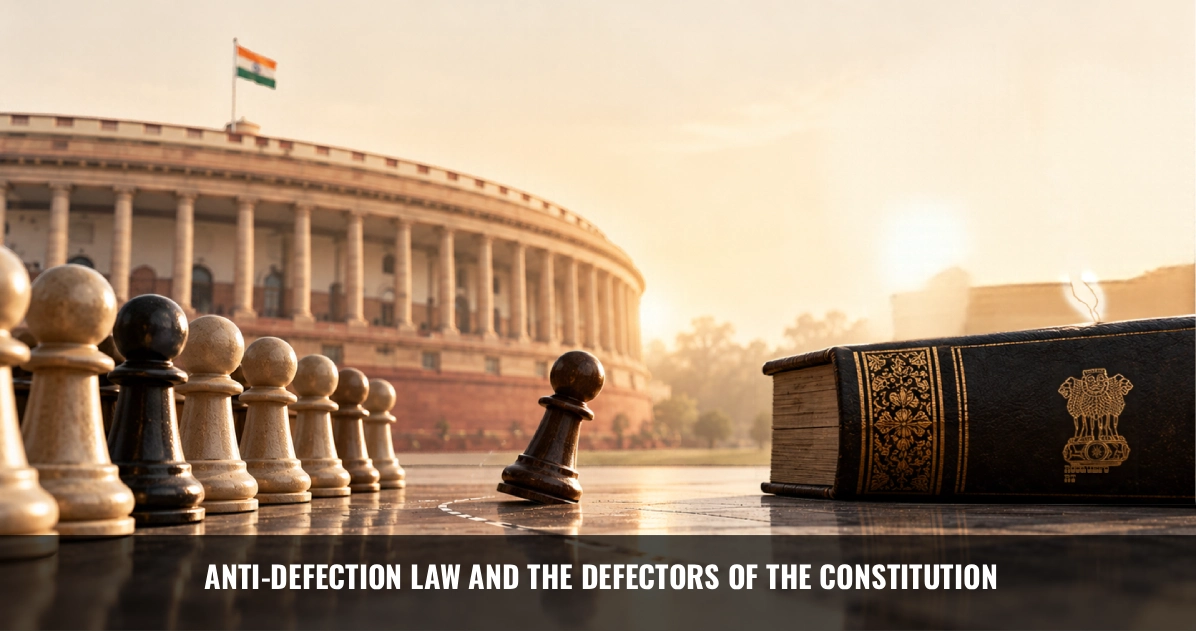
The anti-defection law was enacted to address a specific problem in Indian politics i.e., the widespread practice of elected representatives, switching parties after elections often in exchange for ministerial positions or money. The problem became rampant by the 1960s and 70s, exemplified by Haryana MLA Gaya Lal, who switched party allegiance three times in a single day in 1967. Such defections were de-stabilising State Governments with alarming regularity, prompting the Parliament to insert the Tenth Schedule into the Constitution through the 52nd Amendment in 1985.[1]
A related objective is safeguarding the electoral mandate since the voters generally cast their vote for a candidate as a representative of a party rather than purely as an individual. A shift in party allegiance defeats the very choice of the voters.[2] The law was also to ensure the government stability since repeated defections were causing the premature collapse of State Governments and disrupting effective governance. Finally, it sought to maintain party discipline by binding members to vote in line with the party, keeping legislative parties functioning as cohesive units rather than fragmented groups of individuals.[3]
History
Pre-1985: Following the 1967 General Elections, multiple State Governments collapsed as hundreds of legislators defected for ministerial positions or monetary gains. To curb this political opportunism, the Parliament recommended the formation of the Y.B. Chavan Committee in 1967 chaired by the then Union Home Minister Y.B. Chavan, which examined the existing issues and in its 1969 Report, recommended, inter alia, that if a legislator changes party for monetary gains, they should be excluded from the Parliament and also be barred from contesting elections for some time. Although, there was no law that followed immediately, the Report formed the basis of the subsequent amendment in the Constitution.[4]
Post-1985- The 52nd Amendment Act, 1985 inserted the Tenth Schedule, disqualifying legislators who defected while permitting two exceptions, a split if one-third of legislators broke away from the party and a merger if two-third of the legislators agreed. In Kihoto Hollohan v. Zachillhu 1992 SCR (1) 686, the Hon’ble Supreme Court upheld the 52nd Amendment Act but held that the Speaker’s decisions was subject to judicial review. The split provision was deleted by the 91st Amendment in 2003 after it became an evident loophole, leaving only the merger exception intact and barring defectors from holding ministerial posts until re-elected.
The Anti-Defection Law- A Framework That Enables What It Forbids
When Parliament inserted the Tenth Schedule into the Constitution through the 52nd Amendment Act in 1985, the problem it was solving was visibly embarrassing. Elected legislators were switching parties mid-term for money, ministries, and personal advancement, toppling governments and making a mockery of electoral mandates in the process.[5] The law that emerged was meant to bind a legislator’s post-election conduct to the party on whose ticket they were elected. However, till now, that law has not ended defections. It has simply refined them, giving political actors a constitutional framework within which they execute the very betrayal the law was designed to prevent.[6]
The Merger Exception or The Loophole
The 91st Amendment in 2003 removed the split provision, which had allowed one-third of a legislative party to break away without disqualification, and retained only the merger exception. A merger is deemed valid if at least two thirds of the legislative party agrees to it. On paper this looks like a stricter standard. In practice it has become the operating manual for organised defection.[7]
The Raghav Chadha defection is the most instructive recent example of this. In April 2026, seven of the Aam Aadmi Party’s (AAP) ten Rajya Sabha MPs including Raghav Chadha, Sandeep Pathak, Swati Maliwal and Harbhajan Singh announced a merger with the BJP. The Rajya Sabha Chairman accepted this merger within three days. AAP as a political organisation had not merged with the BJP. The parent party was intact, functioning and contesting the defection in real time. Yet the merger was approved simply because two-thirds of the legislature party in the Upper House had consented to it.[8]
This is where the legal argument becomes serious. The Tenth Schedule draws a clear textual distinction between a “political party” and a “legislature party” and the Supreme Court in its 2023 Shiv Sena judgment held that this distinction is substantive, not cosmetic. A merger of the legislature party without a corresponding merger of the original political party is arguably not a merger at all. It is defection with better paperwork.
The TMC rebel MPs went even further by announcing a merger with the Nationalist Citizens Party of India, a registered but unrecognised party with no elected members anywhere in the country. This raises a question the Tenth Schedule never anticipated. Can twenty legislators validly merge into a party of zero legislators?[9]
Role of the Speaker
Even if the substantive law were sound, the enforcement mechanism would undermine it. Disqualification petitions under the Tenth Schedule are decided by the Speaker or Chairman of the relevant House, a figure who belongs to or was elected by the ruling majority. The conflict of interest here is not incidental. Justice Verma flagged it in his dissent in Kihoto Hollohan (supra) back in 1992, at the very moment the law was being judicially approved. His concern has since been validated by three decades of Speakers either sitting on petitions for years or deciding them with suspicious speed depending on which outcome suits the ruling party.[10]
Judicial Review
The deeper problem is of timing. Anti-defection litigation takes years to unfold. Governments are formed, budgets passed, policies enacted and terms completed, all while a disqualification petition sits pending. When courts finally pronounce, they often find the question academic because elections have already intervened and the political reality has moved on entirely.
The 2023 judgment of the Hon’ble Supreme Court in Subhash Desai vs. Principal Secretary, Governor of Maharashtra & Ors.(2023) SCC OnLine SC 607 is constitutionally significant but it arrived after the Shinde government had governed Maharashtra for over a year. The ECI had already allotted the party symbol. The court could correct the law for the future but could not undo what had already been built on a flawed foundation. The AAP disqualification petition filed by Sanjay Singh sits in the same trajectory. By the time it is finally adjudicated, the Rajya Sabha membership of the seven defectors will in all likelihood have expired, making the entire proceeding of little practical consequence.[11]
Conclusion
The problems with the anti-defection law are not recent discoveries. They go to the design of the law itself. The merger exception has been reduced to a numerical threshold that any organized group of legislators can clear without the parent party’s consent.
The Dinesh Goswami Committee flagged the issue in 1990, the Law Commission recommended reform in 1999, and the Supreme Court has repeatedly urged Parliament to consider an independent tribunal. Thirty-five years of recommendations have produced no amendment.
A possible way to remedy the kinks that ail this law would be to bring about a mandate that the merger exception must require the original political party to consent to any merger and the disqualification proceedings must move out of the Speaker’s hands into an independent tribunal with an enforceable timeline.
[1] Disqualification on ground of defection.
(1) Subject to the provisions of 3[paragraphs 4 and 5], a member of a House belonging to any political party shall be disqualified for being a member of the House—
(a) if he has voluntarily given up his membership of such political party; or
(b) if he votes or abstains from voting in such House contrary to any direction issued by the political party to which he belongs or by any person or authority authorised by it in this behalf, without obtaining, in either case, the prior permission of such political party, person or authority and such voting or abstention has not been condoned by such political party, person or authority within fifteen days from the date of such voting or abstention.
Copied from Onlinelawconnect – Tenth Schedule – Constitution of India (COI) (https://onlinelawconnect.com/ConstitutionOfIndia/tenthschedule-COI.php)
[2] https://indianexpress.com/about/antidefection-law/
[3] https://gjle.in/wp-content/uploads/2025/01/4.-Anti-defection-Law..pdf
[4] https://www.civillawjournal.com/article/161/5-2-33-413.pdf
[5] https://ijlr.iledu.in/wp-content/uploads/2025/02/V5I146.pdf
[6]https://www.researchgate.net/publication/354858250_Anti_Defection_Law_In_India_Emerging_Issues_And_Challenges
[7] https://www.livelaw.in/articles/is-raghav-chaddhas-merger-with-bjp-a-valid-defence-under-anti-defection-law-531690
[8] https://economictimes.indiatimes.com/news/politics-and-nation/raghav-chadha-joins-bjp-can-he-be-disqualified-from-rajya-sabha-what-the-anti-defection-law-says/articleshow/130491627.cms
[9] https://indianexpress.com/about/antidefection-law/
[10] https://indianexpress.com/about/antidefection-law/