
Written By: Apoorv Agarwal
1. Introduction
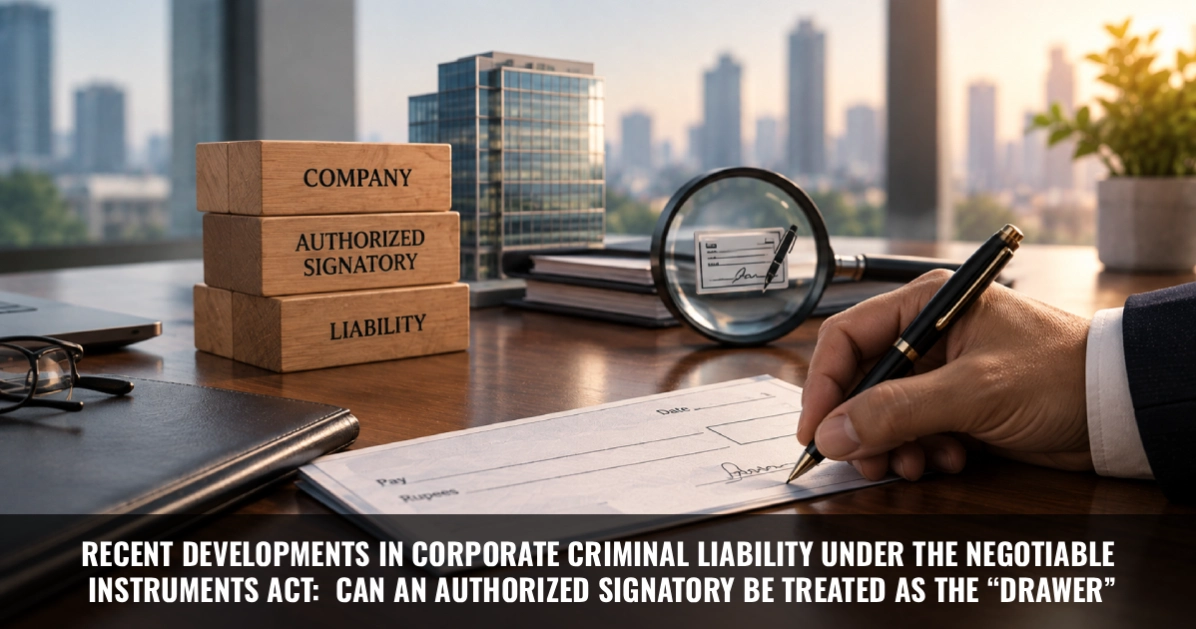
The evolving legal conundrum around Negotiable Instruments act especially sec 138[1] has tried to balance commercial efficiency with principles of quasi – criminal liability, and while the ingredients of the offence under sec 138 are well settled and clear, the ambiguity often lies in the debate surrounding the liability of authorized signatories and directors who often act on behalf of the company in cheque bouncing case and are dealt with situations of criminal liability even if the drawer is the company, that is what the preposition under section 141[2] of the Negotiable Instruments act talks about. Whether the vicarious liability of an authorized signatory can be wiped out simply on the basis of designation or does it have to do more with the responsibilities that the directors carry in managing the day-to-day affairs of the company. The recent Supreme court judgement ‘K Ranganaykulu vs State of Telangana”[3] prompted this renewed discussion.
2. Shifting Accountability amidst responsibility
In the present case, Appellant had signed the cheque on behalf of an organization i.e an NGO and later refused to pay compensation when the cheque got dishonored, stating that the debt solely belonged to the NGO and appellant being an authorized signatory is merely responsible for day to day business and management of the NGO and should not be dragged in this case an accused. It is interesting to note that while the appellant was just an treasurer of the NGO, the Hon’ble court still held that the appellant is liable since there was an MOU that was signed between the NGO i.e TIMES with the treasurer making him solely responsible for all the transactions under the Negotiable Instruments Act, casting no liability on the chairman or any other functionary of the NGO. The treasurer in this manner became the front face of the NGO and was entering into
all sorts of transactions and was responsible for remitting payments thereby giving the treasurer an de – facto control over the organization. While holding the appellant liable the court held that, looking at the work and responsibilities that are entrusted to the treasurer it can be concluded that he can be considered as a ‘drawer’ of the cheque even when the cheque was signed on behalf of the organization. Usually, the criminal liability of an director, authorized signatory or any other officers is not found under the definition of sec 138 of the NI Act, it is found under sec 141, where sec 138 gives you the substance of an offence, the liability arises under sec 141 both the sections are usually read together
The distinction between sec 138 and sec 141 is significant, in in that consequence the liability of the corporate debtors becomes derivative instead of being independent, this principle has becomes a precedent and is used over time by various courts in determining the liability of people associated with an company, with the case of ‘Aneeta Hada vs Godfather Travels & Tours Ltd.” [4]Where the court held that the vicarious liability cannot exist in a vacuum and you need to have a principal offender i.e the Company and unless the company is arraigned as an accused the liability would not exist, this position has subsequently been affirmed by various courts in ‘Harihara Krishnan v. J. Thoma’[5] and ‘Himanshu v. B. Shivamurthy’[6] thereby establishing the principle that impleading an company is the requisite for any further prosecutions involving corporate cheques.
3. Analysis
Against this settled principle, the Supreme court’s recent decision in K. Ranganayakulu v. State of Telangana is of significance, the appellant arguing being in a representative capacity it could not be considered as an drawer especially for the purpose of section 138, however the court refuse to accept that argument since the appellant had effectively answered the description of the drawer and could not really evade liability merely by describing himself as the authorized signatory.
The case of K. Ranganayakulu certainly adds an interesting dimension to the discourse on corporate criminal liability, but the precedential scope of the case needs to be understood carefully. The judgment does not go into details of Section 141 nor does it take note of the Constitution Bench judgment in Aneeta Hada. It does not attempt to establish a general proposition that authorised signatories may be routinely prosecuted independently of the company. Rather, the determination appears to turn on the exceptional factual matrix, in particular the exclusive contractual authority and responsibility vested in the appellant by the governing agreement. In case of dishonoured corporate cheques, the company is the main offender. So, the law remains the same. In general, directors and authorised signatories are liable under Section 141.
However, K. Ranganayakulu shows that in appropriate factual situations courts can go into the actual role and contractual obligations of an authorised signatory while deciding on criminal liability. Whether future decisions will expand this reasoning or limit it to its unique facts remains to be seen. Until then, the governing authority shall continue to be represented by Aneeta Hada on the issue of arraigning the company in prosecutions under Section 138 and 141 of the NI Act.
[1] Negotiable Instruments Act, 1881, s. 138.
[2] Negotiable Instruments Act, 1881, s. 138.
[3] K. Ranganayakulu v. State of Telangana, 2026 INSC 555
[4] Aneeta Hada v. Godfather Travels & Tours (P) Ltd., (2012) 5 SCC 661.
[5] Harihara Krishnan v. J. Thomas, (2018) 13 SCC 663.
[6] Himanshu v. B. Shivamurthy, (2019) 3 SCC 797.