
Written By: Apoorv Agarwal, Preyoshi Bhattacharjee
Introduction
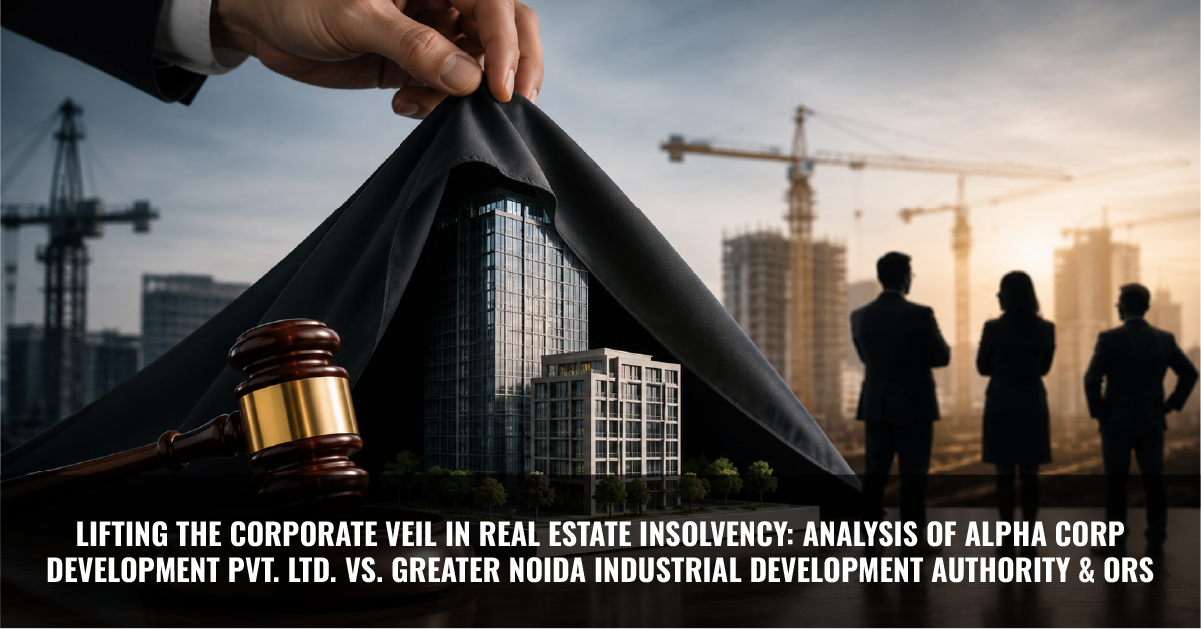
The judgment of the Supreme Court in Alpha Corp Development Private Limited vs. Greater Noida Industrial Development Authority& Ors.[1] marks a significant development in India’s evolving insolvency jurisprudence, particularly in the context of stalled real estate projects, and the interplay between the Insolvency and Bankruptcy Code, 2016 (“IBC”), the treatment of development authorities such as Greater Noida Industrial Development Authority (“GNIDA”) and the doctrine of lifting of the corporate veil.This decision examines the extent to which courts may look beyond the formal legal identity of subsidiary companies and Special Purpose Vehicles (“SPV”) in order to address commercial realities arising in large real estate insolvencies. At the same time, the judgment highlights the competing interests of statutory development authorities, resolution applicants, creditors, and thousands of homebuyers affected by stalled projects due to the pending insolvency processes.
The dispute arose out of the Corporate Insolvency Resolution Process (“CIRP”) initiated against Earth Infrastructures Limited (“EIL”), a real estate developer engaged in several housing and commercial projects in Greater Noida and Gurugram. Although the lands relating to some projects were formally leased to its SPVs, the actual development, marketing, construction, and financial control of the projects rested substantially with EIL. This raised a crucial question before the Court: Whether the assets and leasehold rights held by subsidiaries could be dealt with during the insolvency proceedings of the parent company by lifting the corporate veil?
Background of the dispute
The projects involved in the dispute included Earth Towne, Earth TechOne, Earth Sapphire Court, and Earth Copia. Three of these projects stood on lands leased by GNIDA to subsidiaries or SPVs associated with EIL, whereas Earth Copia was situated on freehold land in Gurugram and had no connection with GNIDA. GNIDA had originally allotted these parcels of land under a builder scheme through leases. The scheme specifically required consortium bidders to create SPVs for execution of the projects. Pursuant to this requirement, Earth Towne Infrastructures Pvt. Ltd. (“ETIPL”) was incorporated as a SPV with EIL as the dominant shareholder and lead member. Although the leasehold rights formally vested in these subsidiaries or SPVs, the actual development and construction activities were carried out by EIL itself. Thousands of homebuyers invested substantial amounts in these projects, many of which eventually stalled around 2016.
The insolvency proceedings commenced after an application under Section 7 of the IBC was filed by a financial creditor against EIL before the National Company Law Tribunal (“NCLT”). During the CIRP, project-wise resolution plans were invited. Roma Unicon’s plan was approved for the Earth Towne project, while Alpha Corp’s resolution plan covered Earth TechOne, Earth Sapphire Court, and Earth Copia. The Supreme Court took note of the growing judicial recognition of project-specific insolvency resolution in real estate matters and referred to someearlier decisions such as Indiabulls Asset Reconstruction Company Limited v. Ram Kishore Arora[2] and Mansi Brar Fernandes v. Shubha Sharma[3]. These judgments recognized that real estate insolvency should ordinarily proceed on a project-specific basis in order to protect viable projects and prevent solvent companies from being adversely affected due to the distress of unrelated ventures.
Findings of the NCLAT
The National Company Law Appellate Tribunal (“NCLAT”) adopted a restrictive approach while dealing with the appeals filed by GNIDA. It held that the assets of subsidiary companies could not be treated as assets of the corporate debtor and that the leasehold lands belonging to GNIDA could not be transferred without its prior consent. The NCLAT further observed that GNIDA ought to have been impleaded and heard during the CIRP proceedings before any resolution plans involving its leased lands were approved. It also faulted the Resolution Professional for not adequately involving GNIDA and consequently set aside the approved resolution plans, directing fresh invitations for plans after settlement of GNIDA’s dues and directed waiver of penal interest and penal charges claimed by GNIDA.
Protection of interests of homebuyers
While setting aside the judgment passed by the NCLAT, the Apex Court recognized that thousands of innocent buyers had invested their life savings into these projects and had waited for years without receiving possession of their homes. The judgment underscored that statutory authorities cannot act mechanically or ignore their public obligations while housing projects remain stalled indefinitely. Referring to the broader principles underlying the “public trust doctrine,” the Court stressed that public authorities must exercise their powers responsibly and in larger public interest.
The question of the Corporate Veil
The principal controversy before the Court concerned whether the assets and leasehold rights vested in the subsidiaries or SPVs could be dealt with during the insolvency proceedings of EIL. The NCLAT adopted a strict corporate law approach and held that the assets of subsidiary companies could not be treated as assets of the Corporate Debtor merely because EIL exercised control over them. According to the NCLAT, the separate legal identity of the subsidiaries had to be respected, and GNIDA’s consent was necessary before any transfer or resolution involving leasehold rights could take place.
The Supreme Court, however, adopted a more realistic approach. While not disregarding the separate legal identity of the subsidiaries, the Supreme Court emphasized the practical realities of the projects and acknowledged that EIL was effectively the true developer behind them. The Court recognized that the SPVs had been created largely to comply with the builder scheme of GNIDA and that the economic substance of the projects could not be ignored merely because the leasehold rights formally vested in separate corporate entities.
The Supreme Court referred to the landmark decision in Life Insurance Corporation of India v. Escorts Ltd.[4], where it had observed that courts may lift the corporate veil where the corporate personality is opposed to justice, convenience, or public interest. Applying this principle in ArcelorMittal India Private Limited vs. Satish Kumar Gupta& Ors.[5], the Supreme Court affirmed that where protection of public interest is of paramount importance or where a company has been formed to evade obligations enforced by law and by the Courts, the Court could disregard the corporate veil. It was further observed that this principle would be applied even to group companies so that one is able to look at the economic entity of the group as a whole.
By relying upon these authorities, the Supreme Court in Alpha Corp(supra) reaffirmed that the doctrine of corporate veil is not confined to cases of fraud alone. Rather, the doctrine may also be invoked where rigid adherence to separate corporate identity would defeat commercial justice, frustrate statutory objectives, or harm public interest.
Dissenting homebuyers and majority rule
Another important aspect of the judgment relates to dissenting homebuyers. Certain groups of buyers opposed Alpha Corp’s resolution plan despite its approval by an overwhelming majority in the Committee of Creditors (“CoC”). Relying upon Section 25A(3A) of theIBC and its earlier decision in Jaypee Kensington Boulevard Apartments Welfare Association v. NBCC (India) Limited[6], the Court reiterated that homebuyers vote as a class and that once the authorised representative casts a vote according to the majority decision, individual dissenters cannot separately obstruct the resolution process. The Court held that minority dissent cannot override the collective commercial wisdom of the CoC.
Conclusion
This judgment is significant for several reasons as it illustrates how insolvency law increasingly prioritizes economic substance over technical corporate form, particularly in the real estate sector where multiple SPVs and subsidiaries are often used for project structuring. By recognizing EIL as the effective developer despite the existence of separate corporate entities, the Supreme Court adopted a pragmatic approach consistent with the broader objectives of the Code. Ultimately, the decision reinforces the principle that insolvency resolution must serve commercial practicality, economic revival, and protection of stakeholders rather than become constrained by rigid adherence to corporate formalism.It reinforces the principle of project-specific insolvency resolution in real estate matters and strengthens the protection available to homebuyers under the insolvency framework
[1]2026 INSC 449.
[2]AIR 2023 SC 2273.
[3]2025 SCC OnLine SC 1972.
[4](1986) 1 SCC 264.
[5](2019) 2 SCC 1.
[6](2022) 1 SCC 401.