
Written By: Apoorv Agarwal, Rishabh Bafna, Suvangana Agarwal
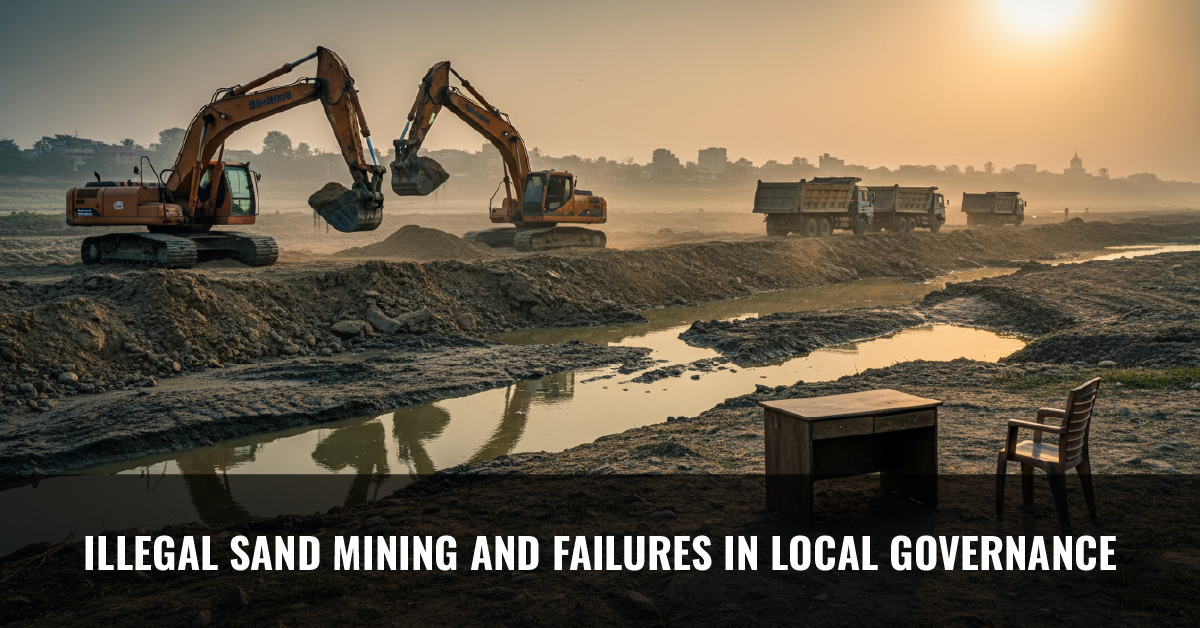
Sand and gravel have long been used as aggregate for construction of roads and building. Today, the demand for these materials continues to rise. In India, the main sources of sand are river flood plain, coastal sand and sand from agricultural fields. Illegal sand mining has emerged as one of the most pervasive forms of environmental crime in India, causing irreversible ecological damage while exposing serious failures in local governance. River sand mining is a common practice as habitation concentrates along the rivers and the mining locations are preferred near the markets or along the transportation route, for reducing the transportation cost. River sand mining can damage private and public properties as well as aquatic habitats. Excessive removal of sand may significantly distort the natural equilibrium of a stream channel.
In State of UP v. Gaurav Kumar[1], Supreme Court has declared that a valid and subsisting District Survey Report is mandatory for grant of environmental clearance for sand mining.The purpose and objective of preparing such District Survey Report is to scientifically locate the place for sand mining after calculation of annual rate of replenishment for allowing mining in the area.Just as forest conservation requires assessment of tree growth rate before permitting timber harvesting to ensure that felling of trees does not exceed tree growth, a replenishment study enables to take an informed decision as to whether sand mining can be permitted without degrading the rivers’ natural balance.
The significance of mining for economic development, particularly in relation to industries involved in infrastructure development, energy, cement etc. has long been recognised. In exercise of its legislative competence, Parliament enacted the Mines and Minerals (Development and Regulation) Act, 1957, for development and regulation of mines and minerals in the country. This legislation is, however, not concerned with safeguarding environmental interests. For that purpose, we have the Water (Prevention and Control of Pollution) Act, 1974, the Air (Prevention and Control of Pollution) Act, 1981, and the Environment(Protection) Act, 1986, as well as policy measures such as the National Mineral Policies of 2008 and 2019.Under Sections 3 and 5 of theEnvironment (Protection) Act, the Central Government is empowered to take all such measures as may be necessary for the purpose of preventing, controlling and abating environmental pollution. Despite the existence of a legal and Policy framework, illegal sand mining persists largely due to failures in local governance.
Judicial intervention became necessary to address persisting regulatory lapses, particularly in the context of sand mining. A seminal instance of such intervention is found in Deepak Kumar v. State of Haryana[2], wherein the Supreme Court examined the legality of mining leases granted in the State of Haryana without prior environmental appraisal. Supreme Court deprecated the practice of issuing auction notices for minor mineral extraction without first conducting scientific studies to assess the environmental impact.Emphasising the need for a precautionary approach, the Court underscored that no mining activity, however minor, could be permitted without an environmental clearance based on a proper replenishment study and sustainable extraction limits. This decision reaffirmed the necessity of grounding regulatory approvals in scientific analysis, and has since served as a judicial benchmark in ensuring that mining activities are aligned with environmental safeguards. The Supreme Court of India, in Deepak Kumar v. State of Haryana (Supra), categorically recognised sand mining as a major contributor to environmental degradation and biodiversity loss. The Court observed that:
“8…………. Sand mining on either side of the rivers, upstream and in-stream, is one of the causes for environmental degradation and also a threat to the biodiversity. Over the years, India’s rivers and riparian ecology have been badly affected by the alarming rate of unrestricted sand mining which damage the ecosystem of rivers and the safety of bridges, weakening of riverbeds, destruction of natural habitats of organisms living on the riverbeds, affects fish breeding and migration, spells disaster for the conservation of many bird species, increases saline water in the rivers, etc.
9. Extraction of alluvial material from within or near a streambed has a direct impact on the stream’s physical habitat characteristics. These characteristics include bed elevation, substrate composition and stability, in-stream roughness elements, depth, velocity, turbidity, sediment transport, stream discharge and temperature. Altering these habitat characteristics can have deleterious impacts on both in-streambiota and the associated riparian habitat. The demand for sand continues to increase day by day as building and construction of new infrastructures and expansion of existing ones is continuous thereby placing immense pressure on the supply of the sand resource and hence mining activities are going on legally and illegally without any restrictions. Lack of proper planning and sand management cause disturbance of marine ecosystem and also upset the ability of natural marine processes to replenish the sand.’
25. Quarrying of river sand, it is true, is an important economic activity in the country with river sand forming a crucial raw material for the infrastructural development and for the construction industry but excessive in-stream sand and gravel mining causes the degradation of rivers. In-stream mining lowers the stream bottom of rivers which may lead to bank erosion. Depletion of sand in the streambed and along coastal areas causes the deepening of rivers which may result in destructionof aquatic and riparian habitats as well. Extraction of alluvial material as already mentioned from within or near a streambed has a direct impact on the stream’s physical habitat characteristics.
26. We are of the considered view that it is highly necessary to have an effective framework of mining plan which will take care of all environmental issues and also evolve a long-term rational and sustainable use of natural resource base and also the bio-assessment protocol. Sand mining, it may be noted, may have an adverse effect on biodiversity as loss of habitat caused by sand mining will affect various species, flora and fauna and it may also destabilise the soil structure of river banks and often leaves isolated islands. We find that, taking note of those technical, scientific and environmental matters, MoEF, Government of India, issued various recommendations in March 2010 followed by the Model Rules, 2010 framed by the Ministry of Mines which have to be given effect to, inculcating the spirit of Article 48-A and Article 51-A(g) read with Article 21 of the Constitution.” (emphasis supplied)
The observations made by Supreme Court in Deepak Kumar (supra) laid down the jurisprudential foundation for requiring scientific scrutiny, particularly through District Survey Reports (DSRs) before permitting sand mining even at the local level. Recognising the ecological fragility of riverbeds and the unchecked nature of minor mineral extraction, the Central Government, in response to the said judgment, amended the EIA Notification of 2006 on 15.01.2016, to introduce a distinct regulatory framework for riverbed and sand mining. These amendments introduced specific procedures for cluster-based assessments and made replenishment studies integral to the clearance process.
Reference must also be made to the Sustainable Sand Mining Management Guidelines 2016 and Enforcement and Monitoring Guidelines for Sand Mining 2020. They constitute binding directives for regulatory authorities, and their due observance is indispensable for safeguarding ecology and public interest.
Demand for construction-grade sand is growing at a tremendous rate and it is said that the world is expected to run out of this resource by 2050. Construction-grade sand, can be found in aquatic environments, such as rivers and in a provisioning ecosystem service. Even under controlled circumstances, the practice of extracting sand from the riverbed and banks impacts the environment. In the physical environment, the primary effects are riverbed widening and lowering. In the biological environment, the overarching effect is a reduced biodiversity and stretches from the aquatic and shoreline flora and fauna to the whole floodplain area. Due to easy access, river sand and gravel have been used extensively in construction projects. Depending on the mining operation method as well as morphologic and hydraulic characteristics of the river, sand mining may cause bed and bank erosion or other negative consequences for the river eco-system.
Unregulated sand mining is unsustainable and must be controlled. Compliance with existing and future laws is mandatory rather than optional. Environmental protection and public well-being must be prioritized, ensuring that natural resources are utilized responsibly to contribute positively and sustainably to the economy. The prime objective of the said guidelines is to ensure that sand mining is done in an environmentally sustainable and socially responsible manner.
Sustainable Development is built on three pillars – environmental, social and economic. Sustainable development cannot be achieved if the environment is protected but poverty is prevalent in a significant part of the population. Similarly, sustainable development cannot be achieved through inappropriate economic growth, if it undermines the environment in which people and businesses exists.
Despite repeated judicial interventions, comprehensive statutory frameworks, and detailed executive guidelines, illegal and unscientific sand extraction continues unabated across riverbeds, floodplains, and coastal zones. The problem is not merely environmental; it reflects systemic governance deficits, regulatory capture, and weak institutional accountability at the district and local levels.Local regulatory bodies frequently suffer from lack of technical expertise, insufficient manpower, and political interference. In several regions, enforcement agencies either lack the will or the autonomy to act against powerful mining interests. Weak monitoring mechanisms, poor inter-departmental coordination, and absence of real-time tracking of mined material further enable illegal operations.
While court judgments and guidelines are clear, their impact on the ground remains limited. The critical gap lies between what the law requires and how local authorities implement it. District administrations are legally responsible for preparing DSRs, enforcing mining conditions, preventing illegal extraction, and coordinating between mining, revenue, police, and environmental departments. In practice, however, responsibility at the local level is often diffused. No single authority is held clearly accountable when illegal mining continues, allowing blame to shift between departments.
District administrations often treat DSRs as a procedural formality rather than a scientific baseline for decision-making. Replenishment studies are either outdated, inadequately conducted, or ignored altogether, leading to over-extraction beyond the river’s natural regenerative capacity.
Corruption at the local level exacerbate the problem. Illegal mining often flourishes with tacit approval from local officials, undermining the rule of law and eroding public trust in governance institutions. The resulting environmental damage disproportionately affects local communities, particularly those dependent on rivers for agriculture, drinking water, and livelihoods.
Effective governance of sand mining requires strict enforcement of scientific assessments, transparency in grant of leases, and meaningful public participation at the local level. Use of technology for monitoring, such as GPS tracking of transport vehicles and satellite surveillance of riverbeds, must be institutionalised. Capacity-building of district authorities and insulation of enforcement agencies from political pressure are equally crucial.
Illegal sand mining is not merely an environmental issue but a governance crisis. Judicial pronouncements, statutory amendments, and policy guidelines have provided a comprehensive framework for sustainable sand mining. However, persistent failures in local governance marked by weak enforcement, lack of scientific rigor, and institutional complacency have rendered these safeguards ineffective. Addressing illegal sand mining therefore demands not only legal compliance but also structural reforms in local governance to ensure accountability, transparency, and ecological stewardship for future generations.
The story of illegal sand mining in India reveals the limits of regulation in practice. Courts have spoken clearly, laws are in place, and detailed guidelines exist. Yet, environmental degradation continues because regulation, by itself, cannot succeed without accountable and empowered local governance.
What these laws and judgments ultimately tell us is that sustainable development cannot be achieved through legal formalism alone. Effective enforcement, scientific rigor, and institutional accountability at the local level are indispensable. Until district authorities treat environmental safeguards as substantive obligations rather than procedural hurdles, illegal sand mining will remain a governance crisis rather than a solved legal problem.
–By:RishabhBafna
Associate A1
ASV Legal LLP
[1]2025 SCC OnLine SC 1069
[2](2012) 4 SCC 629