
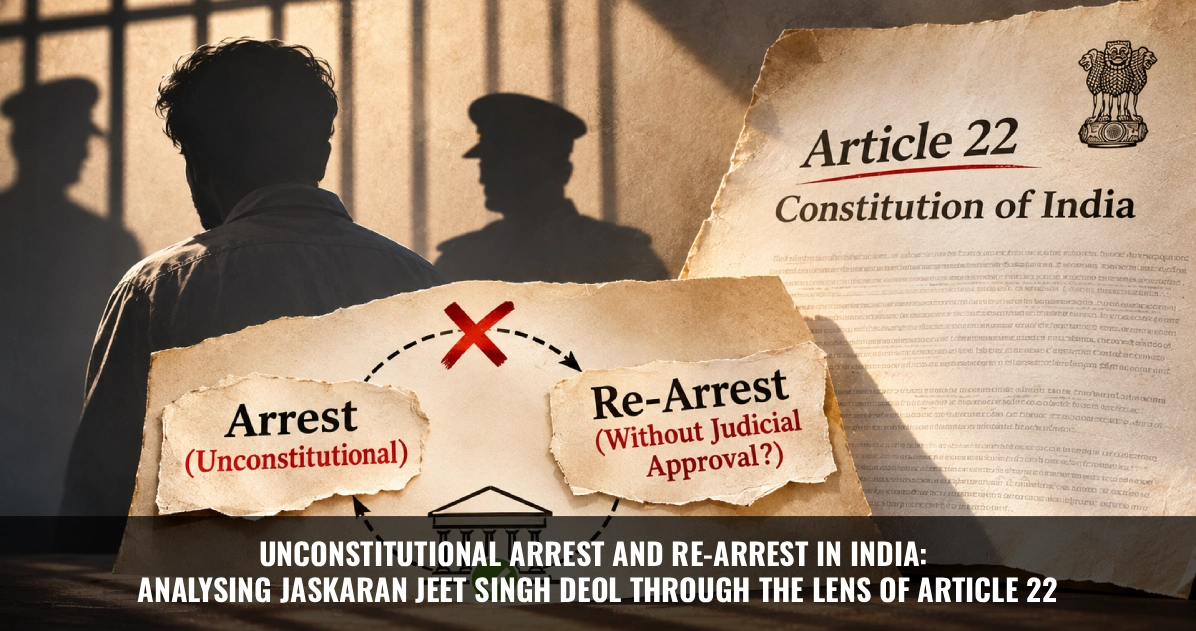
Indian constitutional law has long said that arrest is a serious intrusion on liberty. Yet the safeguards in Article 22 were often treated as a checklist that could be corrected later: a charge sheet, a remand order or a belated explanation could cure a defect in the original arrest. A line of Supreme Court decisions since 2023 has steadily closed that door. The latest is Jaskaran Jeet Singh Deol v. State of Punjab (2026 INSC 1022), decided on 21 September 2026, which asks a question the earlier cases left open: what happens after an unconstitutional arrest is set aside? Can the police simply arrest the person again?
The police must obtain a magistrate’s approval before re-arresting a person who was released because of an Article 22 violation. This article sets out the constitutional background, the facts and holding of the case, and what the ruling means for the balance between investigative power and personal liberty.
Article 22 sits in the chapter on fundamental rights, beside Article 21. Its first two clauses speak to every person arrested under ordinary law. Clause (1) gives an arrested person the right to be informed, as soon as may be, of the grounds of arrest, and the right to consult and be defended by a lawyer of their choice. Clause (2) requires production before the nearest Magistrate within twenty-four hours, excluding the time needed for the journey, and bars detention beyond that period without the Magistrate’s authority. Clause (3) carves out enemy aliens and preventive detention, which is not in issue here.
Statute gives these guarantees concrete form. The criminal procedure codes require the person making an arrest to communicate the grounds, and the Bharatiya Nagarik Suraksha Sanhita, 2023 carries these duties forward (Section 47 on grounds of arrest). The constitutional text, however, does not depend on the statute. A breach is a breach of a fundamental right, and Article 21 is its companion: a deprivation of liberty must follow a procedure that is fair, just and reasonable.
Earlier cases had already stressed this. Joginder Kumar v. State of U.P. (1994) and D.K. Basu v. State of West Bengal (1997) insisted that arrest is not routine and that arrested persons must know why they are held and be able to tell someone. Arnesh Kumar v. State of Bihar (2014) added that arrest must be justified by necessity and not made mechanically. What was missing was a clear statement of the consequences when the police ignored these requirements.
The Supreme Court supplied that statement in stages. In Pankaj Bansal v. Union of India (2023), the Court held that grounds of arrest under the Prevention of Money Laundering Act must be communicated in writing. Prabir Purkayastha v. State (NCT of Delhi) (2024) applied the same protection to arrests under the Unlawful Activities (Prevention) Act. Vihaan Kumar v. State of Haryana (2025) held that failure to communicate the grounds meaningfully violates Articles 21 and 22(1), making the arrest unconstitutional, and that a later charge sheet or order taking cognisance cannot cure it.
Mihir Rajesh Shah v. State of Maharashtra (2025) turned these principles into a working rule. Written grounds must ordinarily be given at the time of arrest. Where that is truly impractical, the grounds may be conveyed orally at first, but must be supplied in writing within a reasonable time and at least two hours before the accused is produced before the Magistrate. The consequence was plain, but only for the first arrest. The cases did not say what the police may do once the arrest has been declared illegal and the accused released.
In the case the FIR was registered against Jaskaran Jeet Singh Deol under Sections 64, 65(1) and 351 of the Bharatiya Nyaya Sanhita, 2023, read with Section 6 of the POCSO Act, on allegations of sexual abuse of a minor. He was arrested on 17 May 2026 from his residence in Ludhiana and was produced before the Magistrate the next day, more than twenty-four hours later. The Magistrate held that the failure to furnish grounds of arrest violated Article 22(1), ordered his immediate release, and rejected the investigating officer’s application for custody. The Magistrate had relied on Mihir Rajesh Shah and had clarified that the agency could take him into custody again only after complying with the constitutional and statutory requirements. When the police later sought custody, the court found that the grounds had still not been furnished.
Deol then approached the Punjab and Haryana High Court. He sought a blanket restraint on re-arrest, custody or any warrant, arguing that having suffered breaches of both Article 22(1) and 22(2) he had an indefeasible right against future arrest in the same case. The High Court dismissed the petition, holding that the agency could seek an arrest warrant, re-arrest him or seek custody by following the procedure established by law. The Supreme Court, in an appeal by Deol, partly agreed and partly disagreed with each side. It rejected the claim to immunity, but it also set aside the High Court’s order.
The Bench of Justices Ujjal Bhuyan and A.S. Chandurkar proceeded in four steps. First, the arrest was illegal- The Court reiterated that Article 22(1) is not a procedural formality but a mandatory safeguard rooted in Article 21. Failure to furnish written grounds makes the arrest illegal, whatever the offence. The Court rejected any dilution on account of gravity, relying on the three-judge decision in Prabhu Dayal Deorah v. District Magistrate, Kamrup (1973) for the proposition that constitutional protections do not depend on the seriousness of the accusation. That the allegations here concerned a minor did not alter the analysis, and the Court expressed no view on the merits of the case against Deol.
Second, release is not bail- A release for violation of Article 22(1) is not a grant of bail but a release from illegal and unconstitutional detention, and the original arrest is treated as null and void. That distinction matters. The Court separated this from default bail, which arises because the agency failed to file its report in time, whereas release after an Article 22 violation flows from the illegality of the arrest itself. The line of authority on re-arrest after default bail therefore does not govern.
Third, re-arrest needs a judge- The Court held that once an accused is released for a breach of Article 22(1) or 22(2), the power to re-arrest cannot rest with the same police authority that committed the violation, and requires prior judicial imprimatur. The procedure the Court prescribed is concrete. If the agency considers custodial interrogation necessary, it must first furnish the written grounds of arrest to the accused. It must then approach the jurisdictional Magistrate, explaining why re-arrest and custody are necessary and why the grounds were not supplied the first time. The application must carry the endorsement of the investigating officer’s immediate superior, and the Magistrate must decide it in accordance with natural justice,
preferably within a week.
Fourth, the breach has consequences- The superior authority considering the application must transfer the investigation to another officer and direct a departmental inquiry into the earlier violation, with an entry in the service book of the officer concerned if the inquiry goes against them. In Deol itself, the investigating officer had been suspended and the Station House Officer transferred to the Police Lines. The Court extended the same procedure to breaches of Article 22(2), and noted that a High Court may, depending on the facts, award compensation as a public law remedy for violation of that clause. The judgment was ordered to be circulated to the Directors General of Police of all States and Union Territories, the Registrars General of the High Courts and the State judicial academies.
The most important feature of Deol is not the rule that grounds must be in writing. That was already settled. It is the choice of decision-maker. The Court reasoned that an agency that has breached Article 22 cannot be trusted to judge for itself whether to take the person back into custody. The discretion moves to the Magistrate. This is consistent with a theme running through Article 22 itself: the Magistrate, not the police, is the constitutional check on custody.
One commentator reads the judgment as allowing re-arrest only where the original lapse is shown to have been bona fide and custody is genuinely necessary, and describes this as a fault-based standard. That reading is persuasive in light of the requirement that the police explain why the grounds were not supplied first time. If the failure is attributable to carelessness or to a deliberate shortcut, the police are poorly placed to ask for the benefit of a second attempt. The wording of the operative directions, as reported, does not spell out a formal test, so the content of “bona fide” will be worked out in the Magistrates’ courts. Expect early litigation over whether an honest mistake about the rules in force, or a reasonable but mistaken belief that oral communication sufficed, can qualify.
Deol’s argument for a permanent bar on re-arrest deserves a serious answer, and the Court gave one. A rule that any Article 22 breach permanently ends the power to arrest in that case would hand a windfall to the accused in grave matters and would punish the complainant for the police’s error. It would also encourage deliberate evasion by accused persons who might exploit procedural lapses. The Court’s approach avoids both problems. It keeps the investigation alive but makes the police earn the right to custody a second time, before a judge, and at some cost to the officers responsible. In effect, the Court treats the violation as a reason for stricter supervision and not as a reason to end the case.
The direction to transfer the investigation and open departmental proceedings is unusual. Earlier decisions largely stopped at declaring the arrest illegal. Attaching a personal consequence for the officer, and changing the officer who will continue the investigation, addresses a structural problem: an officer who has already been found to have acted unconstitutionally has an obvious interest in vindicating the first arrest. The direction also gives the superior officer a real role. The endorsement requirement means a senior officer must take responsibility for the request to re-arrest, which creates a record that can be examined later.
The extension to Article 22(2) closes a gap. Production before a Magistrate is the point at which a judicial mind first meets the fact of custody. A delay of even a few hours, as in Deol, deprives the arrested person of that review. By applying the same re-arrest procedure to both clauses,
the Court avoids creating a hierarchy among safeguards. The reference to compensation as a public law remedy also signals that a High Court need not wait for a civil suit to mark the violation.
Three issues remain. First, the Court suggested a decision within about a week; whether busy Magistrates can keep to that, and what happens when they cannot, is untested. Second, the judgment is concerned with the investigating agency’s second attempt to arrest. It leaves for another day how it interacts with applications for remand under the BNSS after a lawful arrest, and with anticipatory bail sought by a person who fears re-arrest. Third, the Court did not need to say whether a pre-arrest cure is possible, for example by furnishing detailed written grounds and then arresting afresh with full compliance. The procedure it laid down suggests that even this must go through the Magistrate if the first arrest was already declared illegal, but the point may need further clarification
For defence counsel, the first hour matters: check whether written grounds were given, in a language the person understands, and when. Note the times of arrest and production, because Mihir Rajesh Shah attaches importance to the two-hour margin before production. Where a
release order is obtained, the question to ask is no longer only whether the arrest can be repeated, but whether the police followed the Deol procedure before attempting it. For prosecutors and police, the lesson is operational: written grounds, in a comprehensible language, handed over at the time of arrest, and a documented record of that fact. After a release, any attempt at custody should go to the Magistrate with the superior officer’s endorsement.
Deol completes a sequence. Pankaj Bansal and its successors established that the grounds of arrest must be communicated in writing. Deol establishes what follows when that did not happen. The arrest is void, the release is not a favour, the police cannot cure the error by acting
alone, and the officers responsible face consequences. At the same time, the Court has refused to treat the violation as a free pass for a serious accusation. That middle path is the strength of the decision. It keeps faith with Article 22 by putting a judge between the police and the person’s liberty at the moment where the police have already shown they cannot be left to police themselves, while leaving the investigation and the victim’s claim to justice intact.