
Written By: Apoorv Agarwal, Preyoshi Bhattacharjee
Introduction
A free press is one of the indispensable foundations of a constitutional democracy. The ability of the press to investigate, criticise, question and disseminate information enables citizens to participate meaningfully in public affairs and ensures that governmental power remains subject to public scrutiny. In India, freedom of the press is not expressly guaranteed as an independent fundamental right under the Constitution of India. Nevertheless, the Hon’ble Supreme Court has consistently recognised that the freedom of the press forms an integral part of the freedom of speech and expression guaranteed under Article 19(1)(a) of the Constitution of India. At the same time, Article 19(2) permits the State to impose reasonable restrictions upon such freedom on specified constitutional grounds.
In an increasingly digital society, restrictions upon expression may take the form of internet shutdowns, blocking orders, intermediary directions, platform restrictions, surveillance, licensing requirements, regulatory action and other technologically mediated forms of governmental control. The changing nature of communication has consequently transformed the manner in which censorship can operate. The constitutional question is therefore no longer confined to whether the State has expressly prohibited publication. It extends to whether governmental power, directly or indirectly, has created conditions in which legitimate journalistic expression is suppressed. The Indian judiciary has historically played an important role in protecting freedom of expression, beginning with decisions such as Romesh Thappar vs. State of Madras[1] and Brij Bhushan vs. State of Delhi[2], and continuing through Bennett Coleman & Co. vs. Union of India[3], Indian Express Newspapers vs. Union of India[4], Shreya Singhal vs. Union of India[5] and Anuradha Bhasin v. Union of India[6]. These decisions collectively demonstrate an evolving judicial understanding that governmental regulation cannot be permitted to become a disguised mechanism for suppressing dissent.
From Direct Censorship to Indirect Control
One of the most significant developments in the law relating to press freedom has been the recognition that censorship does not necessarily operate through an express prohibition. Governmental power may affect press freedom indirectly by regulating the economic, institutional or technological conditions in which journalism takes place.
This principle received significant attention in Bennett Coleman & Co. vs. Union of India (supra), where the Hon’ble Supreme Court considered the constitutional implications of the Government’s newsprint policy. The Hon’ble Supreme Court recognised that restrictions which appear to regulate an economic aspect of newspaper operations may nevertheless indirectly affect the freedom of the press. The constitutional protection therefore cannot be circumvented merely by describing a measure as an economic, administrative or regulatory policy. A newspaper or digital publication may not be formally prohibited from criticising the Government, yet its ability to function may be affected through repeated regulatory proceedings, restrictions upon access, financial investigations, licensing requirements, withdrawal of governmental advertising or other administrative measures. Each of these actions may, in isolation, possess a legitimate governmental justification. However, where regulatory power is selectively or disproportionately exercised against critical journalism, the constitutional implications cannot be ignored.
Restriction on Freedom of Press- Article 19(2) of The Constitution of India
Freedom of speech and expression is not absolute, Article 19(2) of the Constitution of India permits reasonable restrictions in the interests of specified constitutional objectives. However, Article 19(2) of the Constitution of India does not confer an unrestricted power upon the executive. A restriction upon speech must have a constitutionally recognised basis and must satisfy the requirement of reasonableness. Judicial review therefore, requires courts to examine the relationship between the governmental objective and the restriction imposed. The question is not simply whether the State has identified a legitimate interest, but whether the particular restriction is legally authorised, rationally connected to that interest and proportionate to the harm sought to be prevented. Indian constitutional jurisprudence has progressively moved from a narrow understanding of reasonableness towards a more structured proportionality analysis, particularly in cases involving fundamental rights. The doctrine of proportionality requires the State to demonstrate that an interference with a protected right pursues a legitimate objective and that the means adopted bear an appropriate relationship to that objective.
The contemporary crisis manifests through India’s fall to 157th position in the 2026 World Press Freedom Index, a steady decline driven by concentrated media ownership, the weaponization of criminal law against journalists, and the press’s growing economic dependence on state advertising. Reporters Without Borders has characterized the current environment as approaching an “unofficial state of emergency” for journalists, with sedition, terrorism, and defamation provisions being strategically deployed to silence critical reportage.
This regulatory tightening has accelerated through recent legislative measures. The Digital Personal Data Protection Act, 2023 treats journalists as ordinary data fiduciaries, compelling them to obtain consent for processing personal information and mandating disclosure to regulatory boards, with penalties reaching Rs. 250 crores for non-compliance.
Digital Speech and The Changing Nature of Censorship
The transformation of the media landscape has fundamentally altered the relationship between journalism and technology. Newspapers and television remain important, but contemporary public discourse increasingly occurs through websites, digital publications and social-media platforms. The constitutional protection of speech must therefore operate across these different mediums.
The Supreme Court’s judgment in Shreya Singhal (supra) represents a landmark in this development. The Court struck down Section 66A of the Information Technology Act, 2000, recognising the constitutional importance of protecting legitimate online expression. The judgment reaffirmed that the internet is not a constitutional exception to freedom of speech.
The importance of Shreya Singhal (supra) extends beyond the particular statutory provision that was challenged. It demonstrates a broader constitutional proposition: the medium through which expression occurs cannot determine whether the expression receives constitutional protection. A journalist does not surrender Article 19(1)(a) of the Constitution of India protection merely because an article is published online rather than in print.
Internet Shutdowns and The Right to Communicate
The decision of the Hon’ble Supreme Court in Anuradha Bhasin vs. Union of India (supra) is particularly significant in understanding the constitutional implications of digital restrictions. The case arose from restrictions imposed in Jammu and Kashmir, including internet shutdown. The Hon’ble Court considered the relationship between internet access and the exercise of constitutionally protected freedoms and subjected restrictions to constitutional scrutiny, including the principle of proportionality. Modern journalism depends upon digital connectivity for the collection, verification and dissemination of information. Journalists use the internet to communicate with sources, access public documents, transmit reports and reach audiences. Consequently, an internet shutdown can substantially impair the practical ability of the press to function even if no formal prohibition has been imposed upon publication.
Privacy, Surveillance and Journalistic Freedom
The digital transformation of journalism has also created an important intersection between freedom of expression and the right to privacy. Investigative journalism may involve confidential communications, sensitive sources and large volumes of digital information. At the same time, journalists themselves may become vulnerable to surveillance and data collection. The Supreme Court’s decision in Justice K.S. Puttaswamy (Retd.) vs. Union of India[7]recognised privacy as a constitutionally protected right emerging from liberty, dignity and autonomy under Article 21 of the Constitution of India. The judgment fundamentally altered the constitutional framework within which State collection and use of personal information must be assessed.
The implications for journalism are significant. The protection of confidential sources, journalistic communications and personal data increasingly forms part of the broader constitutional environment necessary for independent journalism.
The State may possess legitimate investigative or security interests, but those interests must coexist with constitutional guarantees of privacy and expression. The two sets of rights cannot be treated as mutually exclusive.
The Role of Judicial Review
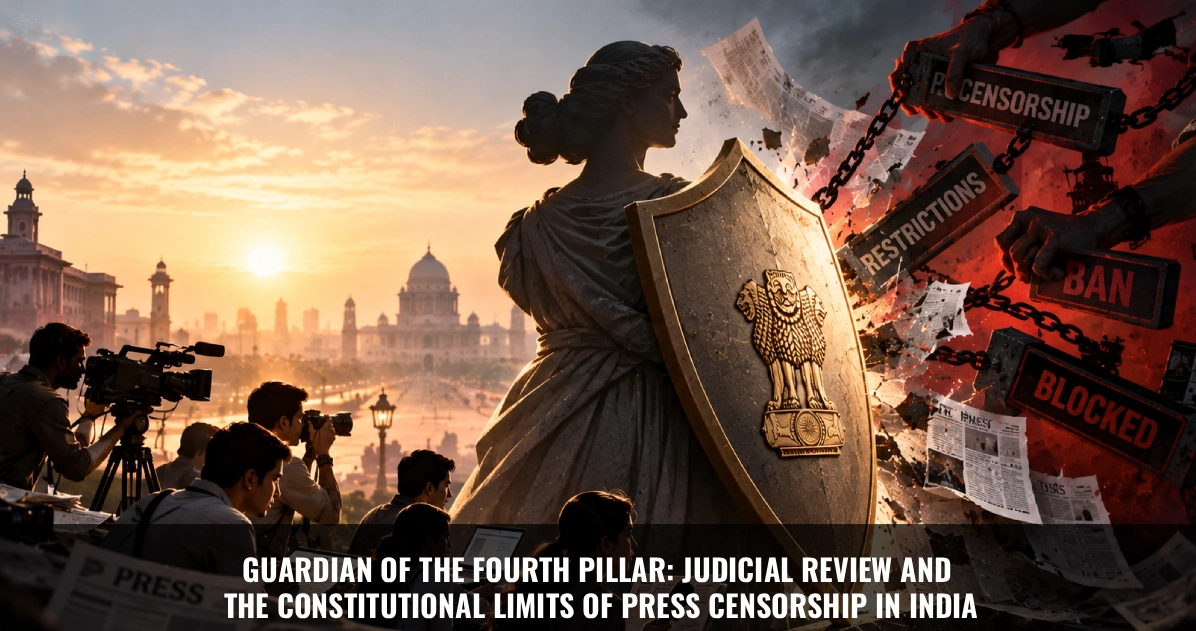
Judicial review remains the principal constitutional safeguard against arbitrary governmental restrictions upon the press. The judicial function is instead to examine whether the State has exercised its power within constitutional and statutory limits. Courts may therefore inquire whether the authority possessed jurisdiction, whether the restriction was authorised by law, whether it falls within Article 19(2), whether relevant considerations were taken into account, whether irrelevant considerations influenced the decision, whether procedural safeguards were followed and whether the restriction is proportionate to the governmental objective.
This distinction is critical to maintaining institutional balance. Judicial protection of press freedom does not require courts to determine the content of journalism. It requires courts to protect the constitutional conditions within which journalism can exist. The future of press freedom litigation in India will increasingly involve procedural questions. Where governmental authorities restrict journalistic expression, there must be meaningful mechanisms through which affected parties can challenge those restrictions. The State cannot be permitted to avoid constitutional accountability by transferring decision-making from a traditional administrative office to a digital platform. Nor can the technological complexity of a system become a justification for withholding all meaningful information concerning how a decision affecting fundamental rights was reached the constitutional principle must remain that public power remains reviewable irrespective of the technological mechanism through which it is exercised.
Conclusion
Modern censorship may operate through digital blocking, internet shutdowns, intermediary regulation, surveillance, administrative pressure or a combination of apparently neutral regulatory measures. This makes judicial review more important, rather than less. The constitutional protection of the press must therefore evolve alongside the technologies through which journalism is practised. Courts must remain attentive not merely to the form of governmental action but to its actual effect upon the freedom to gather, publish, circulate and receive information. At the same time, judicial review must respect the constitutional separation of powers. Courts are not editors, policymakers or security administrators. Their role is to ensure that governmental power remains bounded by law and fundamental rights. When the press is silenced, the public loses an important mechanism through which governmental accountability operates. The constitutional responsibility of the judiciary is therefore not to ensure that the press is free from all regulation. It is to ensure that regulation does not become a disguised instrument of suppression.
In an age where censorship can occur not only through a prohibition on publication but through the blocking of an account, the shutting down of a network or the removal of information from the digital public sphere, the central constitutional principle remains unchanged: the State may regulate speech only within the limits prescribed by the Constitution, and the power to regulate cannot become the power to silence. The enduring strength of Indian democracy will depend, in significant measure, upon whether its constitutional institutions continue to preserve that distinction.
[1] AIR 1950 SC 124.
[2] AIR 1950 SC 129
[3] (1972) 2 SCC 788.
[4] 1985 SCR (2) 287.
[5] (2015) 5 SCC 1.
[6] (2020) 3 SCC 637.
[7] AIR 2017 SC 4161.