
Written By: Apoorv Agarwal
I. The Facts and the Legal Question
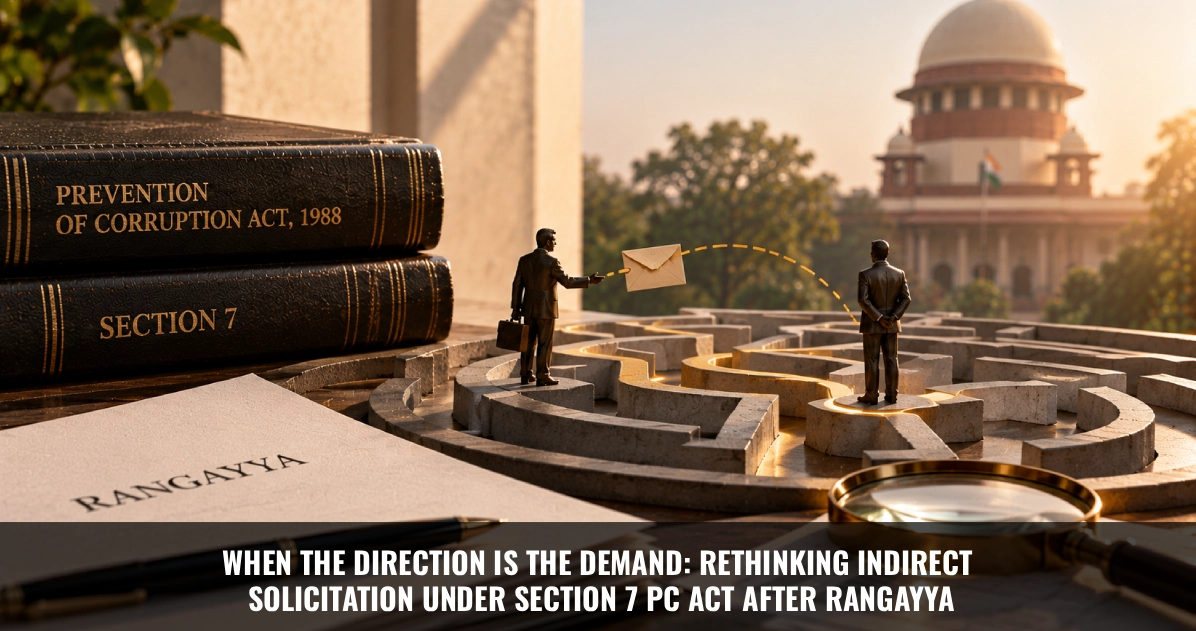
On 28 May 2023, a police sub-inspector named Rangayya told a complainant standing in a police station: “you have not done anything to me, please do something to these boys and go.”[1] He did not name a figure. He made no demand for himself. He walked away. Minutes later, Constable Kashinath demanded Rs. 5,000 on his instructions, later negotiated down to Rs. 3,000 plus a penalty of Rs. 500.
The complainant had been visiting the station for over two months seeking return of a seized two-wheeler and mobile phone. When he finally filed a complaint before the Karnataka Lokayuktha Police, an FIR was registered against Rangayya under Section 7(a) of the Prevention of Corruption Act, 1988.[2]
The Karnataka High Court quashed the FIR.[3] Its reasoning was that neither direct demand nor personal acceptance by Rangayya was made out on the face of the allegations, and these were essential ingredients of Section 7. The Supreme Court reversed this on 26 May 2026, holding that the statement “do something for these boys” constituted a prima facie attempt to obtain an undue advantage for another person within the meaning of Section 7(a) read with Explanation 2.[4]
The decision is factually modest and legally concise. Its significance lies in what it settles about the relationship between Explanation 2 and the proof framework at the FIR stage in cases of indirect solicitation.
II. Explanation 2 and the Expansion of Indirect Solicitation
Section 7(a) of the PC Act punishes a public servant who “obtains or accepts or attempts to obtain from any person, an undue advantage” with the intention to perform or cause performance of a public duty improperly or dishonestly.[5] On its face, the provision is personal: the accused must himself obtain, accept, or attempt to obtain.
The 2018 Amendment added Explanation 2, which operates on two dimensions. Explanation 2(i) extends the class of persons for whose benefit the act may be committed: the expressions “obtains,” “accepts,” and “attempts to obtain” cover cases where the public servant acts for “another person” (not restricted to a public servant), whether through abuse of position, personal influence over another public servant, or any other corrupt or illegal means.[6] Explanation 2(ii) removes the directness requirement, it is immaterial whether the advantage is sought directly or through a third party.[7]
The critical point, which the draft decision in Rangayya makes explicit for the first time in this context, is what Explanation 2 does and does not alter. It does not create a new offence or redefine “attempt.” It clarifies that the attempt may be for another person’s benefit and may be executed through an intermediary. The conduct requirement, meaning an attempt to obtain an undue advantage, remains. What changes is the range of factual configurations that can satisfy it.
This matters because of how courts had historically read Section 7. Working with the un-amended provision, the Supreme Court developed a rigorous proof standard: both demand and acceptance were required for conviction. The Constitution Bench in Neeraj Dutta v. State (NCT of Delhi) restated this standard comprehensively, though it was construing the pre-2018 text.[8] What Rangayya does is not displace that standard but confine it to its proper domain: the standard for conviction at trial. At the FIR stage, the inquiry is different.
III. The Court’s Analysis: From Direction to Solicitation
The Court’s reasoning unfolds in two stages. The first concerns the meaning of Section 7(a) read with Explanation 2 on these facts.[9] The second concerns the High Court’s methodological error.
Firstly, the Court reads the provision’s elements in sequence. Section 7(a) requires an attempt to obtain an undue advantage. Explanation 2(i) confirms that the advantage may be for another person and may be pursued through personal influence over a subordinate public servant. Explanation 2(ii) removes any requirement that the accused himself be the direct conduit. Applying this to the FIR allegations, the Court holds that Rangayya’s instruction to the complainant to “do something for these boys” constituted, at the prima facie level, an attempt to obtain an advantage for his subordinates.[10]
The Court relies on the subsequent demand by Constable Kashinath as corroborating the causal link between the direction and the solicitation.[11] A reader may ask whether the earlier statement would be sufficient on its own. The Court’s analysis suggests otherwise. What brings the facts within Section 7(a) is not the statement viewed in isolation, but the combination of the veiled instruction, the immediate monetary demand made by a named subordinate, and the recorded telephone conversations demonstrating coordination. It is the convergence of these facts that brings the conduct within the scope of an attempt to obtain under Explanation 2(i), rather than leaving it as an ambiguous supervisory remark.
Second, the Court relies on Devinder Kumar Bansal v. State of Punjab for the proposition that solicitation may be made “as effectually in implicit or in explicit terms” and that actual exchange of a bribe is not required for liability under Section 7.[12] The Court acknowledges that these observations were made in the context of an anticipatory bail application and are therefore obiter, but treats them as accurately reflecting the legislative policy of the PC Act.[13] The implicit-versus-ambiguous distinction matters here because every vague instruction constitutes implicit solicitation. What makes Rangayya’s words solicitation rather than ambiguity is the factual specificity of the surrounding circumstances: the context of a prolonged grievance, the instruction to “take care of these boys,” and the immediate monetary demand that followed.
The High Court’s error was in conducting what the Supreme Court describes as a mini-trial.[14] By relying on the outcomes of two trap proceedings (both of which Rangayya avoided), the phenolphthalein test results, and the findings of a departmental enquiry, the High Court engaged in an evaluation of the evidentiary record rather than an examination of the FIR allegations. At the quashing stage, the relevant inquiry is whether the allegations, taken at face value, disclose a cognizable offence, not whether the evidence is sufficient to sustain a conviction. The High Court’s approach therefore amounted to a premature assessment of the merits, precisely the kind of mini-trial that the Supreme Court cautioned against.
IV. Three Consequences for PC Act Practice
Before identifying what Rangayya settles, it is worth being precise about what it does not. A reader could plausibly interpret the decision as fact-specific: the Supreme Court held merely that where a superior officer’s statement is immediately followed by a subordinate’s monetary demand, the allegations warrant investigation rather than pre-trial foreclosure. On that narrower reading, the Court did not redefine solicitation, alter the meaning of “attempt,” or make any general pronouncement about the scope of Explanation 2.
That reading is available. But it does not fully account for what the Court actually does in the judgment. At paragraphs 20-22, the Court systematically works through the elements of Section 7(a) read with Explanation 2, concludes that the provision covers attempts to obtain for another person executed through a subordinate, and then applies that reading to the facts. This is doctrinal analysis, not factual application alone. The three consequences that follow are grounded in that analysis, not merely in the outcome of this specific appeal.
First, the Court establishes a clear separation between the FIR-stage and conviction-stage inquiries in indirect solicitation cases. The lower threshold at the former stage derives from the structure of the amended provision, rather than from the ordinarily limited scope of quashing jurisdiction. The three post-trial decisions on which Rangayya relied in the High Court – Shanthamma, Soundarajan, and Jagtar Singh – all held that demand and acceptance must be proved for conviction.[15] The Supreme Court holds that these standards cannot be transplanted to the quashing stage.[16] A court reading an FIR against Section 7(a) as amended must ask whether the allegations disclose an attempt to obtain an advantage for the accused or for another person, directly or through intermediaries. Personal receipt by the accused is not a threshold requirement.
Second, courts applying Bhajan Lal’s first category to PC Act FIRs after the 2018 amendment must assess the allegations against the amended text, not against the pre-2018 judicial glosses that the amendment was enacted to supplement.[17] A quashing court that applies the sine qua non of direct demand and personal acceptance without reference to Explanation 2 is testing the FIR against a provision that no longer exists in that form.
Third, the decision confirms that implicit communication can satisfy the conduct requirement under Section 7(a) read with Explanation 2, provided that the surrounding circumstances are sufficiently determinate to distinguish solicitation from ambiguity. The surrounding circumstances in Rangayya include not merely the words themselves but the recorded telephonic coordination with Accused No. 3, the immediate demand from Constable Kashinath, and the prolonged pattern of avoidance by police officials. The words were the signal; the other facts established what they were signalling.
V. The Limiting Principle
The Court is careful to confine its observations to the prima facie stage.[18] The trial-stage standard from Neeraj Dutta is not touched. Whether Rangayya’s conduct amounted to demand and attempt to obtain an undue advantage within the meaning of Section 7(a) “is a matter entirely within the domain of the trial court, to be determined upon evidence duly led.” The judgment restores the FIR without expressing any view on the accused’s guilt. Rangayya raises the threshold for quashing, not the threshold for conviction.
The over-extension risk deserves attention. Explanation 2(i)’s third mode covers “any other corrupt or illegal means.” That formulation is open-ended. A departmental officer who instructs a junior to “handle” a pending file is not necessarily soliciting a bribe. The distinguishing factor in Rangayya is the presence of a specific, immediately consequent monetary demand from a named subordinate, corroborated by recorded communications. Courts applying the Rangayya standard to quashing petitions will need to ask whether those elements are present.[19] The decision does not make every supervisory communication a potential Section 7(a) allegation. It makes those communications relevant where the surrounding circumstances establish the corrupt character of the direction.
VI. Conclusion
The 2018 Amendment rewrote Section 7 to capture hierarchical corruption: the senior official who sets the extraction in motion while keeping himself away from the transaction. Explanation 2 is the mechanism. What it lacked before Rangayya was a Supreme Court decision applying it to facts of this kind at the threshold stage.
Courts handling quashing petitions in PC Act cases now have a clear direction: the amended provision requires them to ask whether the allegations, taken as true, disclose an attempt to obtain an advantage for the accused or for another person, by the accused or through a subordinate. The factual configurations that can satisfy this are wider than what the un-amended Act required. Whether the prosecution can ultimately prove any given configuration is a different question entirely.
What Rangayya does not answer is whether, at trial, courts will be willing to infer coordinated solicitation from sequences of conduct without a direct, express demand by the accused. The decision pointedly reserves that question.[20] The answer will determine how much practical difference the 2018 amendment makes to prosecutions of this kind. For now, the investigation gets its chance.
[1] The State by Lokayuktha Police v. Sri K. Rangayya & Anr., 2026 INSC 574 (May 26, 2026) (Sanjay Karol and N.K. Singh, JJ.) [hereinafter Rangayya]. The facts as summarised here are drawn from paras. 3-8 of the judgment.
[2] Prevention of Corruption Act, 1988 (India) (as amended by Act 16 of 2018) [hereinafter “PC Act”], s. 7(a).
[3] Rangayya, para. 12 (reciting the Karnataka High Court’s order dated January 23, 2024 in Writ Petition No. 104236 of 2023).
[5] PC Act, s. 7(a).
[6] PC Act, Explanation 2(i) to s. 7.
[7] PC Act, Explanation 2(ii) to s. 7.
[8] Neeraj Dutta v. State (NCT of Delhi), (2023) 4 SCC 731 (Constitution Bench). The Constitution Bench was construing the un-amended Section 7 and held that proof of demand and acceptance were both required for conviction. The Court in Rangayya distinguishes this and related decisions on the ground that they arose after completed trials, at which the prosecution must establish the offence beyond reasonable doubt.
[9] Rangayya, para. 20 (reading s. 7(a) together with Explanation 2(i)).
[10] Rangayya, para. 23.
[11] Rangayya, para. 23. The Court describes the causal sequence as going to corroboration of the nexus between Rangayya’s direction and the subsequent demand, not as independently constituting the offence.
[12] Devinder Kumar Bansal v. State of Punjab, (2025) 4 SCC 493, paras. 12-13, quoted in Rangayya, para. 26. The Court in Bansal was addressing an anticipatory bail application; the observations on the scope of “attempt” are therefore obiter. The Court in Rangayya itself acknowledges this at para. 27, before treating the observations as accurately reflecting the legislative policy of the PC Act.
[13] Rangayya, paras. 27, 34.
[14] Rangayya, para. 17.
[15] K. Shanthamma v. State of Telangana, (2022) 4 SCC 574; Soundarajan v. State, (2023) 16 SCC 141; Jagtar Singh v. State of Punjab, (2023) 19 SCC 498.
[16] Rangayya, paras. 28-29.
[17] State of Haryana v. Bhajan Lal, 1992 Supp (1) SCC 335, Category 1 (allegations on the face of the FIR do not disclose commission of any offence).
[18] Rangayya, para. 37 (expressly stating that the findings “cannot influence in any manner the final or conclusive determination of the guilt or innocence of Respondent No. 1, which has to be determined at the conclusion of the trial based on the evidence that may be adduced during the trial”).
[19] Rangayya, paras. 31-32 (treating the departmental enquiry findings and the mala fide contention as matters for trial, not for the quashing court).