
Written By: Apoorv Agarwal
Introduction
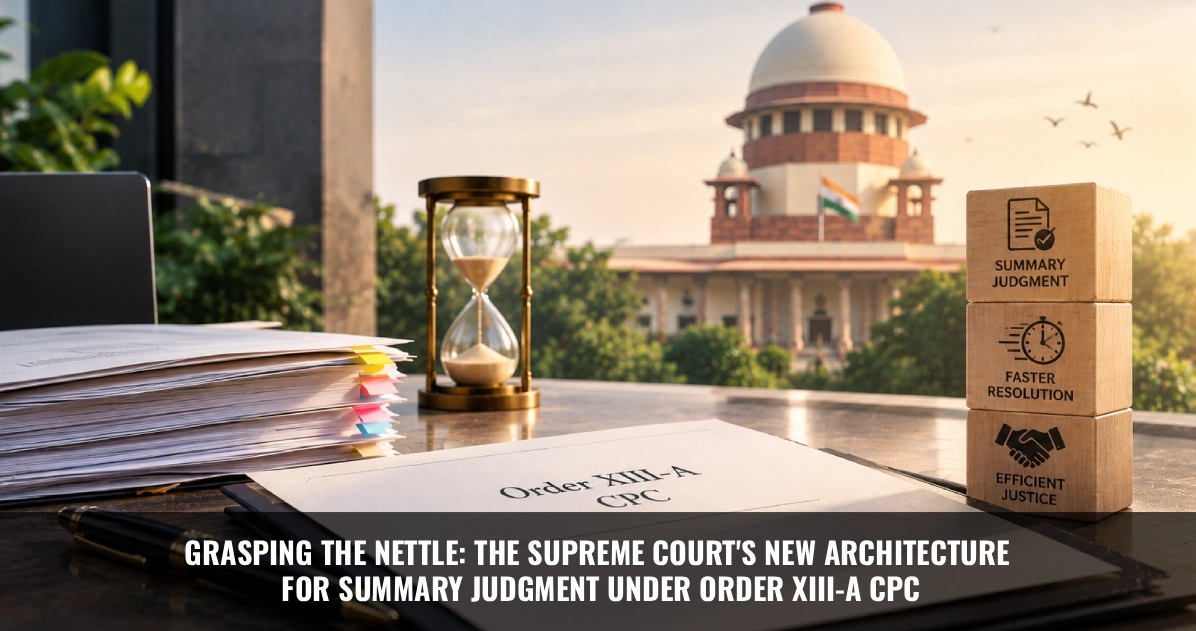
For nearly a decade, Order XIII-A of the Code of Civil Procedure, 1908 (“CPC”) remained one of the least utilised innovations introduced by the Commercial Courts Act, 2015. Conceived to incorporate a common law-style summary judgment mechanism into Indian commercial litigation, the provision sought to enable courts to dispose of claims or defences that disclosed no real prospect of success, thereby avoiding unnecessary trials.[1] In practice, however, commercial courts exercised this jurisdiction sparingly. Concerned that summary disposal might be perceived as curtailing a litigant’s right to a full trial, courts generally treated Order XIII-A as an exceptional remedy rather than an effective case-management tool.
The position has now undergone a significant transformation. In Reliance Eminent Trading and Commercial Private Limited v. Delhi Development Authority, 2026 INSC 436, a Bench comprising Justices J.K. Maheshwari and Atul S. Chandurkar delivered the Supreme Court’s first comprehensive exposition of Order XIII-A. The judgment formulates a structured nine-principle framework governing the exercise of summary judgment jurisdiction and substantially clarifies both the scope and purpose of the provision. In doing so, the Court has provided commercial courts with a coherent doctrinal foundation that is likely to shape summary judgment jurisprudence for years to come.
Factual Background: When Defective Title Surfaces Years After a Sale
The dispute illustrates how deficiencies in public law can unravel transactions long after they appear complete. In 2007, the Delhi Development Authority (“DDA”) auctioned a commercial plot situated at Jasola, New Delhi. Reliance Eminent Trading and Commercial Private Limited emerged as the successful bidder and paid approximately ₹164.91 crore towards the purchase consideration. A conveyance deed was subsequently executed in 2008, apparently concluding the transaction.
The difficulty lay not in the sale itself but in the DDA’s own title. The Authority claimed title through land acquisition proceedings that were subsequently held to have lapsed under Section 24(2) of the Right to Fair Compensation and Transparency in Land Acquisition, Rehabilitation and Resettlement Act, 2013.[2] The statutory lapse occurred because compensation had neither been paid to the original landowners nor had possession been lawfully taken within the prescribed period. Although the Supreme Court, in earlier proceedings, granted the DDA an opportunity to re-acquire the land, the Authority failed to do so.
Consequently, the DDA had purported to convey a title that it did not possess. The conveyance deed executed in favour of Reliance Eminent rested upon an acquisition that stood extinguished in law.
Reliance Eminent therefore instituted a commercial suit seeking recovery of the purchase consideration together with interest. Simultaneously, it invoked Order XIII-A CPC, contending that the material facts were either admitted or had already been conclusively determined in prior proceedings, leaving no triable issue requiring oral evidence.
The Delhi High Court declined to grant summary judgment, holding that the matter ought to proceed to trial. The correctness of that decision reached the Supreme Court.
The Supreme Court’s Decision
Allowing the appeal, the Supreme Court concluded that the defence raised by the DDA did not disclose any real prospect of success.
The Court observed that the lapse of acquisition proceedings and the Authority’s failure to undertake fresh acquisition had already attained judicial finality. Against this background, the DDA’s objections regarding possession, limitation and non-joinder of parties were characterised as merely “fanciful” defences incapable of altering the ultimate legal consequence. Since no genuine factual controversy survived, insisting upon a full-fledged trial would merely prolong litigation without advancing the adjudicatory process.
Invoking its powers under Article 142 of the Constitution, the Court set aside the conveyance deed executed in 2008 and directed refund of ₹164.91 crore together with interest at 7.5% per annum from July 2007. Appropriate directions were also issued regarding adjustment of amounts already deposited before the Court and payment of the remaining balance.
While the relief granted was significant, the lasting importance of the judgment lies in its doctrinal treatment of Order XIII-A.
The Nine-Principle Framework Under Order XIII-A
Drawing upon the legislative objective of the Commercial Courts Act, 2015, its earlier observations in Ambalal Sarabhai Enterprises Ltd. v. K.S. Infraspace LLP, (2020) 15 SCC 585, and English authorities including Swain v. Hillman [2001] 1 All ER 91, the Supreme Court articulated a structured framework governing summary judgment applications.
The Court emphasised that:
- the procedural requirements contained in Order XIII-A must be strictly complied with;
- the court must determine whether either the claim or the defence lacks any real, as distinguished from fanciful, prospect of success;
- even where the claim appears weak, the court must consider whether there exists any other compelling reason requiring the matter to proceed to trial;
- pleadings are not to be accepted uncritically merely because they have been pleaded, although the court must avoid converting the exercise into a mini-trial;
- courts should “grasp the nettle” by deciding short and determinative legal questions wherever appropriate rather than postponing them unnecessarily;
- the assessment should extend to evidence reasonably expected to become available at trial and not be confined exclusively to the material presently before the court;
- summary judgment remains an exceptional procedural mechanism designed for cases in which oral evidence is genuinely unnecessary;
- the court must evaluate whether witness credibility, disputed factual inferences or cross-examination are essential to a just determination; and
- ultimately, the interests of justice remain the controlling consideration in deciding whether the dispute should proceed to trial.
Collectively, these principles represent the first authoritative judicial roadmap for the application of Order XIII-A.
The Productive Tension Within the Framework
Despite its clarity, the framework is characterised by an inherent tension.
On one hand, courts are instructed not to accept pleaded facts at face value, requiring them to engage critically with the evidentiary record. On the other, they are cautioned against conducting a “mini-trial.” Distinguishing between legitimate judicial scrutiny and impermissible evaluation of contested evidence will often prove difficult in practice.
Similarly, the Court’s exhortation that judges should “grasp the nettle” encourages robust judicial intervention at an early stage, while its simultaneous description of summary judgment as an exceptional remedy counsels restraint. These directions, although individually sensible, inevitably pull in opposite directions.
The instruction requiring courts to consider evidence “reasonably expected” to emerge during trial introduces an additional layer of complexity. Such an exercise necessarily involves a degree of predictive assessment, asking courts to evaluate evidence that has not yet been formally led.
Compounding these interpretive challenges is the Court’s express observation that the nine principles are non-exhaustive. While this preserves judicial flexibility, it also affords considerable discretion. Courts inclined towards aggressive case management may rely upon the “grasp the nettle” principle to dispose of borderline cases, whereas more cautious courts may invoke the prohibition against mini-trials to justify sending most disputes to trial. Both approaches can plausibly be reconciled with the judgment.
It is therefore likely that the precise contours of Order XIII-A will continue to evolve through future High Court decisions.
Comparative Borrowing and Its Practical Limits
An important feature of the judgment is its reliance upon English summary judgment jurisprudence.
The Supreme Court drew extensively from Swain v. Hillman (supra), which established the “real prospect of success” test under the Civil Procedure Rules of England and Wales. Although Indian courts have referred to English authorities previously, Reliance Eminent (supra) is the first decision to integrate those principles into a structured Indian framework.
The transplantation, however, raises legitimate institutional questions.
English civil procedure operates within a highly developed case-management culture characterised by active judicial supervision, mandatory case management conferences, rigorous disclosure obligations and costs budgeting. Summary judgment functions within that broader procedural ecosystem.
Indian commercial courts possess analogous powers under Order XV-A CPC following the Commercial Courts Act, 2015. Yet significant differences remain in judicial infrastructure, docket congestion and listing practices. Consequently, the “real prospect” standard may not operate identically within Indian procedural conditions.
There exists a genuine risk that commercial courts facing substantial docket pressure may deploy summary judgment more aggressively than intended. Equally, concerns regarding appellate scrutiny may encourage excessive caution, perpetuating the very reluctance that Order XIII-A sought to eliminate.
The judgment also leaves unresolved an important procedural interaction between Order XIII-A and Order XV-A. A pending summary judgment application inevitably affects case management timelines, since framing issues and fixing trial schedules while simultaneously considering whether no trial is necessary presents an obvious procedural incongruity. The judgment offers little guidance regarding how these provisions should be sequenced, leaving commercial courts to develop practical solutions incrementally.
Conclusion
Reliance Eminent Trading and Commercial Private Limited v. Delhi Development Authority marks the maturation of Order XIII-A from an underutilised procedural innovation into a meaningful instrument of commercial case management.
Its principal contribution lies not in the particular relief granted, but in providing Indian courts with a coherent vocabulary for determining when commercial disputes genuinely require a trial and when they do not. The decision recognises that procedural fairness does not invariably demand oral evidence, while simultaneously cautioning against the premature disposal of disputes involving genuine factual controversy.
The judgment’s enduring significance will ultimately depend upon its application in more difficult cases—those lying between plainly frivolous defences and clearly triable disputes. It is in those intermediate cases that the distinction between a “fanciful” defence and one possessing a “real prospect of success” will assume practical importance. Whether the Supreme Court’s invitation to “grasp the nettle” comes to represent principled judicial efficiency or an over-expansive summary jurisdiction will be determined by the jurisprudence that now follows.
[1] Statement of Objects and Reasons, Commercial Courts, Commercial Division and Commercial Appellate Division of High Courts Bill, 2015
[2] Right to Fair Compensation and Transparency in Land Acquisition, Rehabilitation and Resettlement Act, No. 30 of 2013