
Written By: Apoorv Agarwal, Manvi Jain
One of the defining features of the Insolvency and Bankruptcy Code, 2016 (“IBC”) is its attempt to provide a single forum for resolving any and all disputes arising from the insolvency of the corporate debtor. The intent behind the same is that when a company is undergoing insolvency, stakeholders should not have to run from one court to another to resolve the interconnected issues.
The National Company Law Tribunal (“NCLT”), being the Adjudicating Authority under the IBC, is entrusted with significant powers to ensure that the insolvency process remains swift, effective, efficient and commercially viable. At the heart of this framework lies Section 60(5) of the IBC which states:
“(5) Notwithstanding anything to the contrary contained in any other law for the time being in force, the National Company Law Tribunal shall have jurisdiction to entertain or dispose of-
- Any application or proceeding by or against the corporate debtor or corporate person;
- Any claim made by or against the corporate debtor or corporate person, including claims by or against any of its subsidiaries situated in India; and
- Any question of priorities or any question of law or facts, arising out of or in relation to the insolvency resolution or liquidation proceedings of the corporate debtor or corporate person under this Code.”
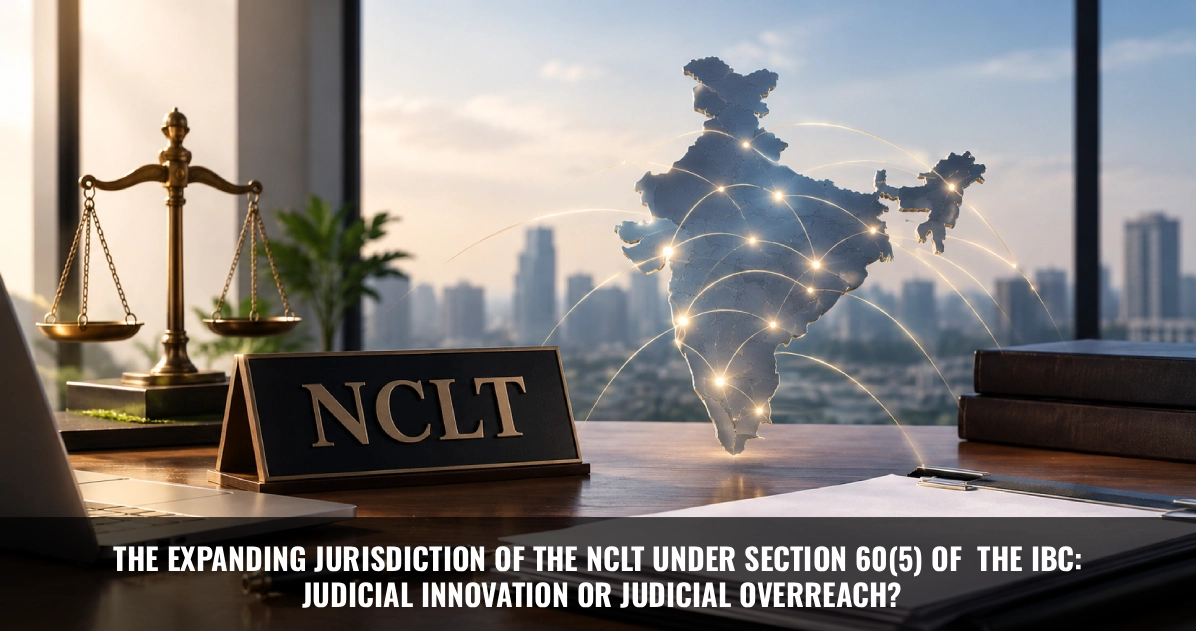
Due to the broad language of the said provision, the usage of Section 60(5) of the IBC has generated considerable debate over the years as it has enabled the NCLT to adjudicate a wide range of disputes connected with insolvency proceedings. At the same time, it has also raised an important question: Has the judiciary interpreted Section 60(5) in a manner that furthers the objectives of the IBC, or has the jurisdiction of the NCLT gradually expanded beyond what was intended?
Why Section 60(5) Matters?
As the wording suggests, Section 60(5) of the IBC empowers the NCLT to entertain or dispose of any question of law or fact arising out of or in relation to the insolvency resolution of a corporate debtor.
Interestingly, a corporate insolvency rarely involves a single dispute. A resolution professional may face issues relating to contracts, statutory authorities, creditors, government departments, employees, or even third parties claiming rights over the assets of the corporate debtor and vice versa. If each of these disputes were to be litigated before different forums, the insolvency process would quickly lose the speed and certainty that the IBC seeks to achieve.
Section 60(5) was therefore intended to avoid fragmentation of proceedings and enable the NCLT to decide issues that are intrinsically connected with the insolvency process. However, the intention was never to transform the NCLT into a civil court exercising unlimited jurisdiction over every dispute involving a company undergoing CIRP.
The Evolution of Judicial Interpretation
As the insolvency jurisprudence has evolved over the years, so has the interpretation of Section 60(5) of the IBC. Faced with increasingly complex insolvency proceedings, courts have often adopted a pragmatic approach. Every day, multiple applications are filed before the NCLT to decide disputes relating to the implementation of approved resolution plans, claims by statutory authorities, rights and obligations of successful resolution applicants, and issues affecting the conduct of the Corporate Insolvency Resolution Process (“CIRP”) of a corporate debtor.
This practical approach has undoubtedly contributed to the success of the IBC. By allowing insolvency related disputes to be resolved within the insolvency framework, courts have reduced parallel litigation, minimised conflicting decisions, and provided greater certainty to stakeholders. However, every expansion of jurisdiction brings with it the question of where the line ought to be drawn.
The Supreme Court’s Cautious Approach
Recognising the wide scope of Section 60(5), the Supreme Court has consistently emphasised that the said provision is not without limits. Perhaps the clearest reminder came in the decision of Embassy Property Developments Pvt. Ltd. v. State of Karnataka[1]. The Court observed that the NCLT is not a substitute for constitutional courts and cannot exercise powers of judicial review that particularly belong to the High Courts under Article 226 of the Constitution of India. Merely because a dispute arises during CIRP does not automatically bring it within the NCLT’s jurisdiction.
A similar approach was adopted in Gujarat Urja Vikas Nigam Limited v. Amit Gupta[2], wherein the Supreme Court, while recognising that Section 60(5) confers wide powers, clarified that such jurisdiction extends only to disputes that arise solely from or have a direct nexus with the insolvency process. Ordinary contractual disputes or issues that can be effectively decided elsewhere cannot be brought before the NCLT simply because one of the parties happens to be undergoing insolvency.
These decisions by the Supreme Court reflect a careful balancing exercise and emphasize that the objective is not to restrict the effectiveness of NCLT, but to ensure that it remains a specialised insolvency forum rather than a court of general civil jurisdiction.
When Does Expansion Become Overreach?
The distinction may appear straightforward in principle, but in practice, it is often far less clear. Presently, Section 60(5) of the IBC is increasingly invoked in matters that have only a remote connection with insolvency proceedings. Parties frequently seek to bring contractual disputes, employment claims, recovery proceedings and other civil disputes before the NCLT on the ground that the corporate debtor is under CIRP.
While such attempts are understandable from a litigation strategy perspective, they also raise legitimate concerns.
An overly expansive interpretation of the provision risks overburdening the NCLT with disputes that fall outside its core mandate. This, in turn, affects the timelines prescribed under the IBC and undermines one of its most significant strengths, i.e. speedy resolution. It also often blurs the distinction between specialised tribunals and ordinary civil courts, something the legislature never intended.
Striking the Right Balance
The debate surrounding Section 60(5) is not one of choosing between a broad or narrow interpretation. The real challenge lies in identifying the point at which a dispute becomes sufficiently connected to the insolvency process to justify the intervention by NCLT.
The Supreme Court’s “direct nexus” test offers a sensible way forward. If deciding a dispute is necessary for conducting, completing or implementing the insolvency resolution process, the NCLT should undoubtedly exercise jurisdiction. On the other hand, where the connection is merely incidental, parties should ordinarily pursue their remedies before the appropriate forum. This approach preserves both the efficiency of the insolvency framework and the institutional boundaries that underpin India’s judicial system.
Conclusion
Section 60(5) has undoubtedly played a crucial role in making the IBC an effective insolvency legislation. Its broad wording has enabled the NCLT to deal with a variety of issues that would otherwise have stalled insolvency proceedings and diluted the objective of timely resolution.
Yet, with broad powers comes the need for judicial restraint. The effectiveness of the IBC does not depend upon the NCLT deciding every dispute involving a corporate debtor, rather, it depends upon the NCLT deciding only those disputes that are essential to the insolvency process, while allowing other forums to exercise the jurisdiction vested in them.
As the insolvency jurisprudence continues to evolve, the debate on the use of Section 60(5) is unlikely to end but perhaps that is the strength of the said provision. It is flexible enough to meet the practical realities of insolvency, while continually inviting courts to define and redefine the delicate balance between judicial innovation and judicial overreach.
[1] Civil Appeal No. 9170 of 2019
[2] Civil Appeal No. 9241 of 2019