
Written By: Apoorv Agarwal, Manini Shah
INTRODUCTION
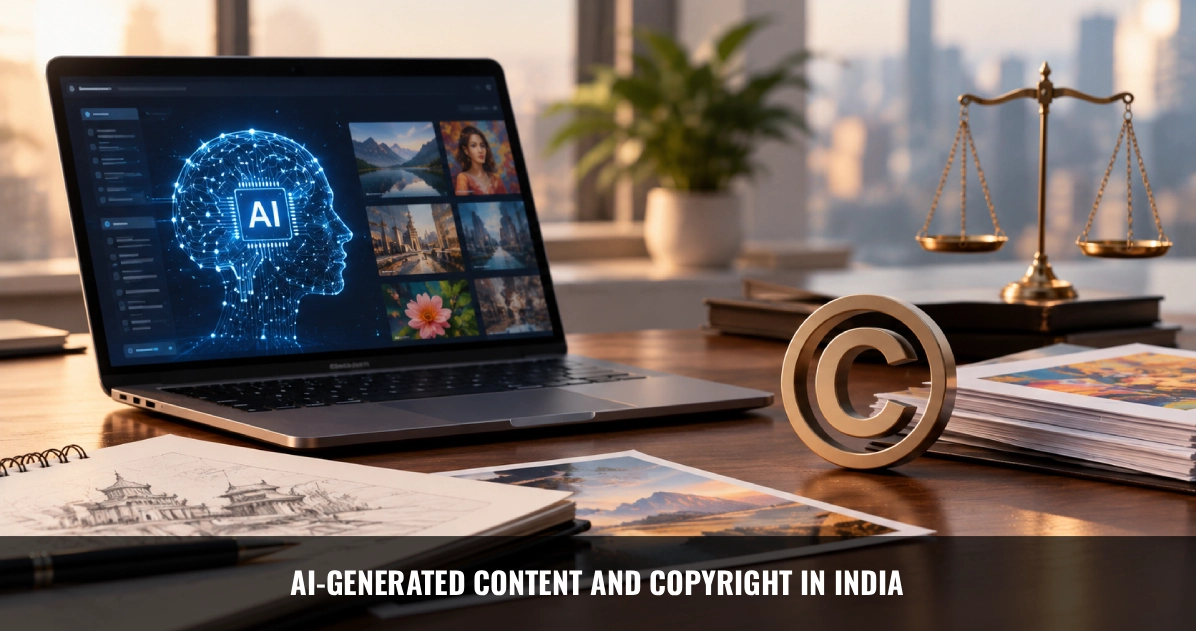
In today’s fast‑moving world, Generative Artificial Intelligence is no longer confined to research labs, it can be found everywhere, from large AI models that make content like image, music, and video. It can be said that AI tools shape creative industries and machines are now active participants in domains once thought to be exclusively human. But here’s the catch: these systems are trained on massive amounts of text, visuals, audio, and video, often pulled from the internet or licensed datasets, many of which include copyrighted works. This raises a foundational question for Indian copyright law, if a machine “creates” a work, can copyright subsist, and if so, in whose favour?
The copyright framework was formulated in a time where creative expression was understood to originate exclusively from human authors and to be disseminated through traditional intermediaries. Consequently, the Copyright Act, 1957 does not expressly address the legal implications of generative artificial intelligence or the large-scale use of copyrighted works for training AI models. This legislative gap has created significant legal uncertainty, leaving creators, AI developers, users, and policymakers without clear guidance on questions of authorship, ownership, and infringement.
INDIAN COPYRIGHT FRAMEWORK AND ORIGINALITY
The Copyright Act, 1957 (Act) protects “original literary, dramatic, musical and artistic works”, cinematograph films and sound recordings.[1] “Literary work” expressly includes computer programmes and databases, showing that Parliament contemplated digital subject matter.[2]
The identity of the “author”[3] varies according to the nature of the work, in the case of literary works, the author is the person who creates the work whereas for cinematograph films and sound recordings, the producer is recognised as the author. As a general rule, Section 17 of the Act vests the first ownership of copyright in the author, subject to well-established exceptions relating to works created in the course of employment, commissioned works, and other statutory arrangements.
The term “original” is not defined under the Act, further, in Eastern Book Company vs. D.B. Modak[4], the Hon’ble Supreme Court rejected a pure “sweat of the brow” standard and adopted a “skill and judgement” test, requiring some minimal creativity beyond mechanical labour. On that basis, the Hon’ble Court held that raw Supreme Court judgments are not protected, but original headnotes and sophisticated editorial inputs can be. This jurisprudence makes human intellectual contribution central, originality requires that the work “owes its origin” to human skill and judgement, not merely to investment or mechanical processing.
CAN AI BE AN AUTHOR UNDER INDIAN LAW?
The scheme of the Act is premised on the assumption that authorship originates from either natural persons or, in specified circumstances, recognised juristic entities such as producers, government bodies, or other organisations. The statutory framework does not envisage artificial intelligence systems as authors or holders of copyright. This position is further reinforced by Section 57 of the Act, which confers moral rights upon authors to protect their honour and reputation, concepts that are inherently tied to humans and are incapable of meaningful application to non-sentient artificial intelligence.
From a theoretical perspective, the very purpose of copyright law suggests that AI should not be treated as an author. The economic or incentive-based justification for copyright seeks to encourage human creativity by rewarding authors for their intellectual labour, while the personality theory views a creative work as an extension of the author’s identity, thereby warranting protection of the personal bond between the creator and his work. Therefore, conferring authorship upon artificial intelligence would undermine both of these normative foundations by attributing legal rights to an entity that neither possesses consciousness nor requires incentives to create. Such an approach would also be inconsistent with the broader structure and purpose of the Copyright Act. Accordingly, under the existing legal framework in India, artificial intelligence cannot be regarded as either an author or a copyright owner.[5]
WHO SHOULD OWN AI-GENERATED OUTPUTS?
Assuming that certain AI-generated outputs satisfy the threshold of originality owing to meaningful human involvement, multiple models of copyright ownership may be contemplated. One approach is to vest ownership in the user or the person who inserted the prompt however, this model becomes difficult to justify where the user’s contribution is limited to generic prompts and the AI system performs the substantial expressive functions.[6]
Alternatively, ownership could be attributed to the developer or platform responsible for creating and maintaining the AI model, thereby rewarding the considerable investment in technological innovation. Yet, such an approach risks concentrating copyright ownership in the hands of a few technology companies while undervaluing the creative contributions of users who employ sophisticated prompting techniques.[7]
A joint authorship model may appear to recognise the collaborative nature of AI-assisted creation, but it sits uneasily with the doctrinal requirements of collaboration and common design under copyright law and presents significant practical challenges in the exercise and enforcement of rights. Another possibility is to treat purely machine-generated outputs as falling within the public domain or as being ineligible for copyright protection altogether, thereby avoiding conceptual difficulties surrounding machine authorship and preventing excessive monopolisation of AI-generated content. However, this approach may reduce commercial incentives for businesses whose operations depend upon the creation and exploitation of such works. The Copyright Act, 1957 presently adopts none of these models, leaving the issue unresolved.[8]
CONCLUSION
Under current Indian law, AI cannot be an author, and many fully automated outputs may not be “original works” at all.
The primary function of copyright is to protect human creativity and investment, not to create proprietary rights in machine behaviour detached from human emotional intelligence. AI‑assisted works should remain protectable where humans exercise skill and judgement, purely AI generated content should either fall into the public domain. The absence of such reform and gap between doctrine and technological reality is widening over time, leaving courts, creators and AI developers to navigate uncertainty.
[1] Section 13 of the Copyright Act, 1957
[2] Section 2(o) of the Copyright Act, 1957
[3] Section 2(d) of the Copyright Act, 1957
[4] [2007] 13 (Addl.) S.C.R.
[5] https://www.khuranaandkhurana.com/ownership-of-ai-generated-content-a-deep-dive-into-copyright-law-in-india (Last Accessed On: 04.07.2026)
[6] https://astraea.law/insights/generative-ai-copyright-ownership-guide-2025 (Last Accessed On: 04.07.2026)
[7] https://astraea.law/insights/generative-ai-copyright-ownership-guide-2025 (Last Accessed On: 04.07.2026)
[8] https://eur-lex.europa.eu/legal-content/EN/TXT/?uri=CELEX%3A32024R1689 (Last Accessed On: 04.07.2026)