

Written By: Apoorv Agarwal, Raghwendra Pratap Rao
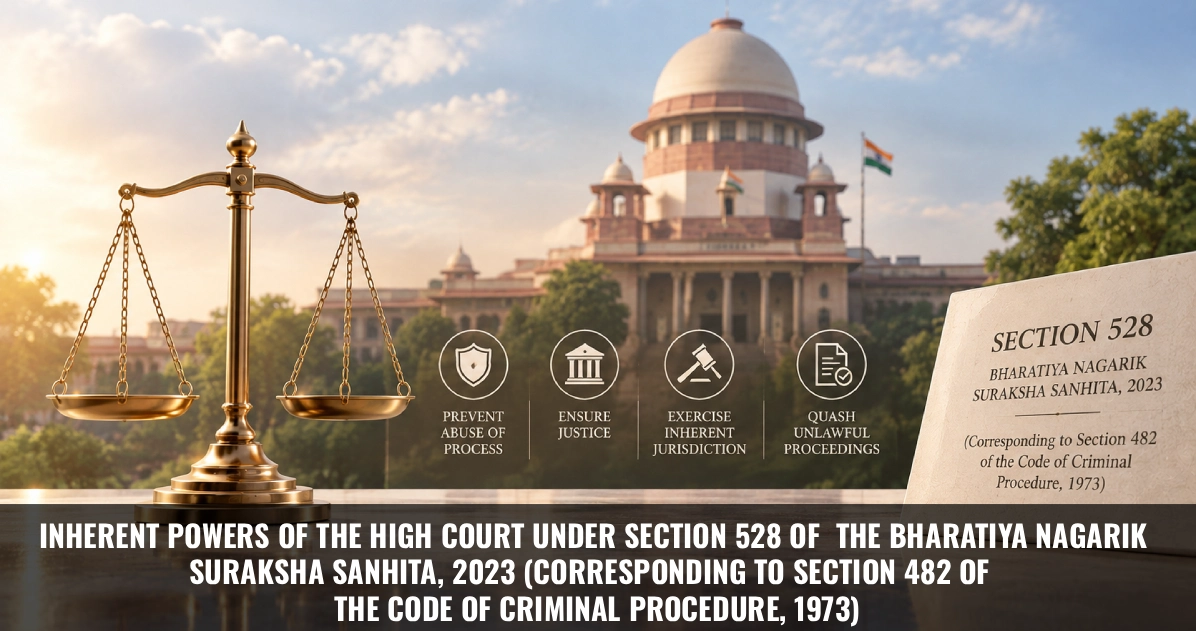
Under the Bharatiya Nagarik Suraksha Sanhita, 2023 (hereinafter referred to as the “BNSS”), Chapter XXXIX deals with miscellaneous provisions, wherein Section 528 (corresponding to Section 482 of the Code of Criminal Procedure, 1973) preserves the inherent powers of the High Court. Section 528 of the BNSS reads as follows:
“Saving of inherent powers of High Court.—Nothing in this Sanhita shall be deemed to limit or affect the inherent powers of the High Court to make such orders as may be necessary to give effect to any order under this Sanhita, or to prevent abuse of the process of any Court or otherwise to secure the ends of justice.”
The provision preserves the inherent powers of the High Court to pass such orders as may be necessary to secure the ends of justice, prevent abuse of the process of any Court, or give effect to any order passed under the BNSS. The High Court is, therefore, empowered to quash complaints, First Information Reports (FIRs), investigations, or criminal proceedings wherever the circumstances so warrant. The term “quash”, as defined in Black’s Law Dictionary, means “to overthrow, annul, vacate or make void.” Accordingly, the quashing of criminal proceedings refers to the termination of criminal proceedings initiated through the filing of a complaint or registration of an FIR.
Historically, the inherent powers of the High Court were recognised under Section 561-A of the Code of Criminal Procedure, 1898, which, after the enactment of the Code of Criminal Procedure, 1973, found place under Section 482. With the coming into force of the Bharatiya Nagarik Suraksha Sanhita, 2023, the corresponding provision is now Section 528 BNSS, which substantially retains the same legislative intent and scope.
Inherent Powers of the High Court
The inherent powers preserved under Section 528 of the BNSS (formerly Section 482 CrPC) empower the High Court to:
- Quash an FIR;
- Quash an investigation;
- Quash criminal proceedings pending before any subordinate court; and
- Pass such other orders as may be necessary to prevent abuse of the process of the Court or to secure the ends of justice.
The object of Section 528 BNSS is to ensure that justice is served and that the judicial process is not misused. It is a well-settled principle that the inherent jurisdiction of the High Court is extraordinary in nature and is ordinarily exercised only where no equally efficacious statutory remedy is available to the aggrieved party.
Ingredients of Section 528 BNSS (Section 482 CrPC)
The inherent powers of the High Court under Section 528 BNSS may be exercised for the following purposes:
- To give effect to any order passed under the BNSS;
- To prevent abuse of the process of any Court; and
- To otherwise secure the ends of justice.
In State of Karnataka v. L. Muniswamy, the Supreme Court held that the inherent jurisdiction of the High Court may be exercised in the three situations expressly recognised by the provision.
Need for Section 528 of the Bharatiya Nagarik Suraksha Sanhita, 2023 (Section 482 CrPC)
The inherent jurisdiction of the High Court is an indispensable feature of the criminal justice system and exists to ensure the proper administration of justice. Such jurisdiction is discretionary and is to be exercised sparingly, carefully, and with great caution. The High Court may decline to exercise its inherent powers where the applicant has an effective alternative remedy or where the applicant has approached the Court without clean hands.
Although Section 528 BNSS preserves the inherent powers of the High Court, it does not enumerate the precise circumstances in which such powers may be exercised. Consequently, the contours of the provision have been developed primarily through judicial precedents. Over the years, the Supreme Court and various High Courts have laid down settled principles governing the exercise of inherent jurisdiction, particularly in matters concerning the quashing of criminal proceedings.
Thus, while the source of the inherent power now stands embodied in Section 528 of the Bharatiya Nagarik Suraksha Sanhita, 2023 (formerly Section 482 of the Code of Criminal Procedure, 1973), the well-established principles evolved through judicial interpretation under Section 482 CrPC continue to guide the exercise of such jurisdiction under the BNSS, unless inconsistent with the provisions of the new enactment. The following are the cases:
1. Prashant Bharti v. State of NCT of Delhi
The following concerns were presented before the High Court to ascertain the validity of pleading for quashing a criminal case brought forth by the accused in compliance with Section 482 of the CrPC. The Court held that the Tribunal should quash the trial, exercising its authority pursuant to Section 482 of CrPC, if the response to any of the following questions is positive;
- Is it sound, fair and unquestionable that the material on which the accused relies, i.e. is really the material of exemplary and perfect quality?
- Is the evidence on which the accused relies adequate to refute and reverse the factual claims in the lawsuit, namely that the material is the one that will convince a rational person to reject the claim as false and denounce it as factual?
- The prosecution has not refuted whether the material on which the defendants relies, and/or that is not such that the prosecution cannot reasonably refute the material?
- Will it not serve the function of justice if prosecutions lead to a misuse of the court’s procedure?
2. Parbatbhai Ahir v. State of Gujarat
This case was referred by the Supreme Court in separate precedents and summed up the following rules to limit the High Court’s power in compliance with Article 482 of the CrPC;
- Section 482 retains the High Court’s intrinsic power to stop another court’s violation or to guarantee that the judiciary’s aims are fulfilled. No new powers are provided in the clause. It acknowledges and retains only competences found in the High Court.
- The invoking of the High Court’s authority to quash a FIR or a judicial proceeding on the basis of an arrangement between the accused and the victim is not the same as a jurisdiction invocation over a more complex offence. The jurisdiction of the court is limited in compliance with Section 320 of the Code of Criminal Practice 1973, in the case of compounding of an offence. Even where the violation is inconsistent, the ability to drain Section 482 is attracted.
- The High Court shall determine, in the exercise of its competence under Section 482, the exercise of the intrinsic powers that would justify the ends of justice by stating it whether a criminal proceeding or lawsuit ought to be quashed.
- The inherent power of the court is to secure:
- Justice; and
- stop manipulation at every court’s proceedings.
- It will finally turn to the evidence and the circumstances of the particular cases to determine if a lawsuit or the FIR can be quashed on grounds that the accused and victims have settled the conflict. It cannot be formulated in details.
- In exercising the crime filed under Section 482 and in arguing that the conflict is settled, the high court must adequately take into consideration the nature and severity of the offence. Heinous and extreme crimes, such as homicide, violation and dacoity, including mental depravity or offences cannot be properly ignored even if the victim or his kin has resolved the conflict. These crimes are, in effect, not private, but have a direct influence on society. In such cases, the decision to continue the prosecution is based on the predominant concern of public interest in sentencing people for violent offences.
- Criminal cases which have the significant or dominant aspect of a civil conflict may be differentiated from violent offences. They have a strong basis in terms of exercising the intrinsic power to quash.
- In suitable circumstances where parties have settled the conflict, criminal lawsuits involving the crimes arising from corporate, financial, contractual, relationship or other related transactions, with a substantial civil flavor can be liable to quashing.
The theory laid down in suggestions. Economic crimes affecting the state’s financial and economic well-being have repercussions beyond the sphere of a single conflict between private disputants. In cases where the delinquent participates in practices such as financial, or economic frauds or misdemeanors, the High Court will refuse to quash.