
Written By: Apoorv Agarwal, Manya Jaiswal, Divya Verma
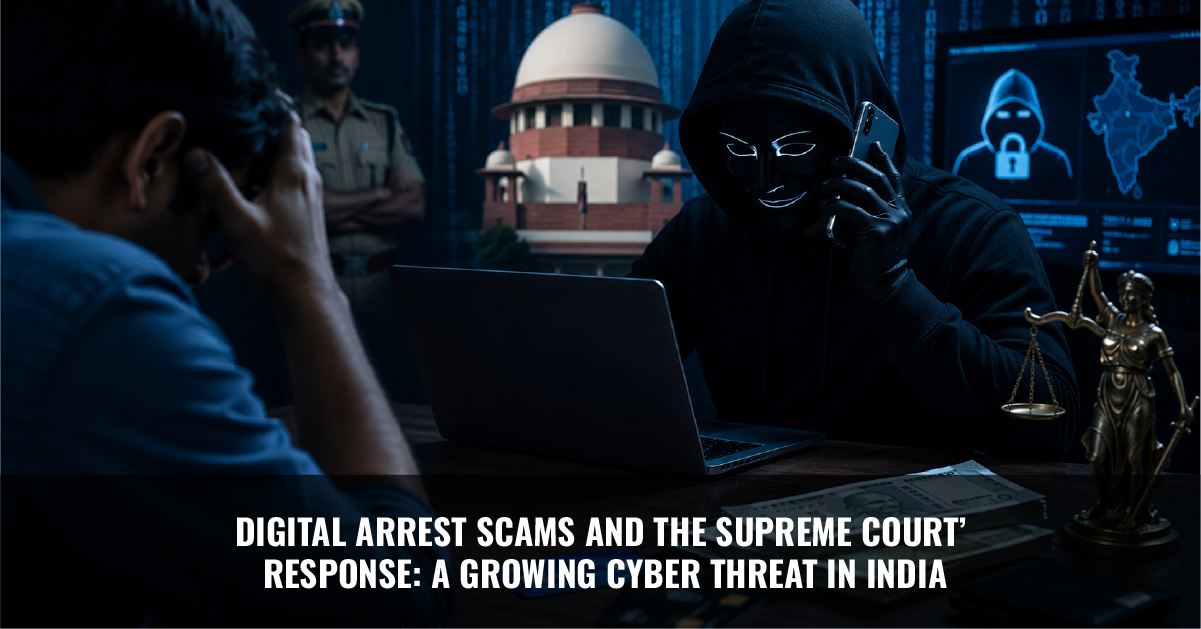
The rapid expansion of digital communication technologies and online financial systems in India has simultaneously resulted in the emergence of sophisticated forms of cybercrime. One such growing phenomenon is the “digital arrest” scam, wherein fraudsters impersonate law enforcement agencies, investigative authorities, or judicial institutions and falsely claim that an individual is under investigation or liable to be arrested in connection with serious criminal offences. Though popularly referred to as “digital arrest,” no such concept presently exists in Indian law.
Typically, perpetrators of such frauds contact individuals through telephone calls, video conferencing platforms, WhatsApp calls, or other digital communication channels while impersonating officials of agencies such as the Central Bureau of Investigation (CBI), Enforcement Directorate (ED), Narcotics Control Bureau (NCB), Mumbai Police, Telecom Regulatory Authority of India (TRAI), or even officers purportedly attached to the Supreme Court or High Courts. Victims are falsely informed that they are implicated in offences involving money laundering, narcotics trafficking, financial fraud, or terrorism-related activities. Thereafter, forged notices, fabricated warrants, and counterfeit official documents are circulated electronically to create an atmosphere of coercion and fear.
In several cases, victims are directed to remain continuously connected through video calls and are told that they are under “digital surveillance” or “digital custody.” Under psychological pressure and fear of criminal prosecution, individuals are induced to transfer substantial sums of money into designated bank accounts on the pretext of “verification,” “safe custody,” or “clearance” of funds. Such acts constitute organized cyber fraud and are punishable under various provisions of criminal and cyber law.
Legally, the expression “digital arrest” has no recognition under the Bharatiya Nyaya Sanhita, 2023 (“BNS”), or any other criminal statute in force in India. Arrest and detention are strictly regulated by statutory procedure and constitutional safeguards under Articles 21 and 22 of the Constitution of India. No investigating agency or police authority is legally empowered to place an individual under arrest through a video call, online conference, or digital communication platform. Any such representation made by fraudsters is entirely fraudulent and contrary to law.The offences involved in such scams may attract provisions relating to cheating by personation, criminal intimidation, forgery, extortion, impersonation of public servants, conspiracy, and electronic fraud under the BNS, as well as offences under the Information Technology Act, 2000 (“IT Act”). Depending upon the nature and extent of the transactions involved, offences relating to money laundering and organized criminal activity may also be attracted.
The menace of digital arrest scams also raises serious concerns relating to the constitutional right to privacy and personal liberty guaranteed under Article 21 of the Constitution of India. Fraudsters, while impersonating police officers, investigative agencies, or judicial authorities, often compel victims to remain under continuous video surveillance, disclose confidential financial information, reveal personal identification details, and restrict their communication with family members or outsiders under the guise of “official investigation.” Such acts amount to a grave intrusion into an individual’s informational privacy, decisional autonomy, and dignity. The constitutional recognition of privacy as a fundamental right by the Hon’ble Supreme Court in Justice K.S. Puttaswamy (Retd.) v. Union of India[1], is therefore, of direct relevance. In the said judgment, the Supreme Court unequivocally held that the right to privacy is intrinsic to life and personal liberty under Article 21 and includes protection of personal autonomy, informational control, and freedom from unwarranted intrusion. The Court observed that privacy encompasses the preservation of personal intimacies, sanctity of family life, and protection of individual autonomy against arbitrary interference. Digital arrest scams fundamentally violate these constitutional protections by subjecting individuals to coercive digital surveillance, psychological intimidation, and unauthorized extraction of personal and financial information through fraudulent means. The principles laid down in Puttaswamy therefore reinforce the State’s obligation to ensure robust cyber protection mechanisms and effective legal safeguards against technologically enabled invasions of privacy and personal liberty.
The issue has recently received significant judicial attention from the Hon’ble Supreme Court of India in the case of In Re: Victims of Digital Arrest Related to Forged Documents[2]initiated in October 2025, in light of the alarming increase in cyber fraud cases involving impersonation of public authorities. The Supreme Court expressed serious concern over the scale and sophistication of such scams and observed that even educated individuals were falling prey to these fraudulent activities. The Court noted that cybercriminals were exploiting fear of criminal prosecution and misuse of institutional authority to deceive citizens and illegally obtain money.Recognizing the interstate and organized nature of these offences, the Hon’ble Supreme Court considered the necessity of coordinated investigation mechanisms rather than fragmented state-level inquiries. The Apex Court observed that such cyber-enabled offences involve complex digital trails, multiple bank accounts, telecom networks, and technologically sophisticated methods of operation, thereby requiring centralized investigative coordination and advanced cyber forensic capabilities.The Hon’ble Supreme Court also examined the role of financial institutions and regulatory authorities in preventing cyber fraud. Questions were raised regarding the adequacy of existing safeguards within the banking system, particularly concerning the operation of mule accounts and suspicious financial transactions used for siphoning fraud proceeds and emphasized the importance of prompt detection systems, technological monitoring mechanisms, and inter-agency coordination for the prevention of large-scale cyber fraud.
Another significant concern noted was the misuse of forged judicial documents and false representations of court proceedings by fraudsters. Instances were brought to light where fabricated Court notices, fake arrest warrants, and simulated virtual hearings were used to intimidate victims. Such acts not only amount to criminal offences but also undermine public confidence in judicial institutions and the administration of justice.The Hon’ble Supreme Court’s intervention reflects a broader judicial recognition of cybercrime as a serious threat to public order, financial security, and institutional credibility. The observations of the Court underscore the necessity for stronger cybercrime infrastructure, enhanced digital forensic capabilities, public awareness initiatives, and coordinated regulatory oversight in the digital era.Importantly, the judiciary has reiterated that criminal investigations and arrests in India can only take place in accordance with procedure established by law. Any demand for transfer of money through digital means for avoiding arrest, securing bail, or preventing investigation is patently illegal and indicative of cyber fraud. Citizens are therefore required to exercise caution and verify the authenticity of communications purportedly originating from investigative or judicial authorities.
The phenomenon of digital arrest scams illustrates the evolving nature of cyber-enabled criminality in India. As technological advancements continue to reshape communication and financial systems, the legal framework and enforcement mechanisms must evolve simultaneously to ensure effective protection of constitutional rights, institutional integrity, and public confidence in the justice delivery system.
-Manya Jaiswal& Divya Verma
[1]Justice K.S. Puttaswamy (Retd.) v. Union of India, (2017) 10 SCC 1
[2]In Re: Victims of Digital Arrest Related to Forged Documents, Suo Motu Writ Petition (Criminal) No. 3/2025