
Written By: Apoorv Agarwal
Introduction: Parallel Regimes, Competing Objectives
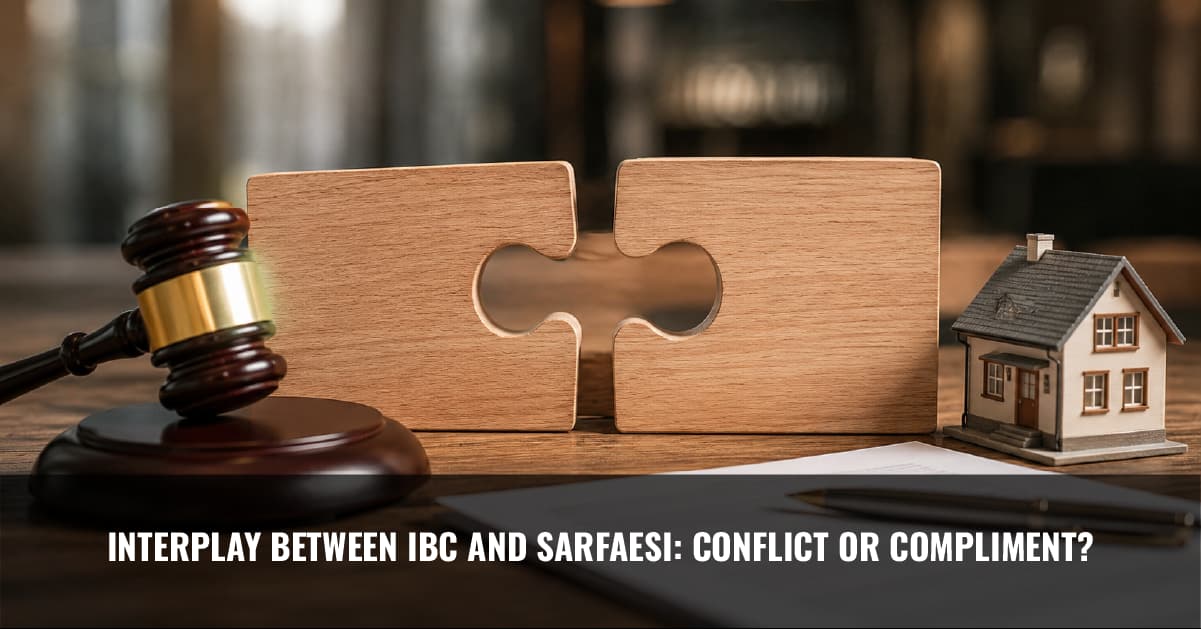
The Insolvency and Bankruptcy Code, 2016 was introduced as a unified code to consolidate insolvency‑related laws and to provide a time‑bound resolution mechanism for corporate debtors. By contrast, Securitisation and Reconstruction of Financial Assets and Enforcement of Security Interest Act, 2002 serves as a creditor‑centric, enforcement‑oriented statute, enabling banks and financial institutions to take possession of and sell secured assets. The co-existence of these regimes has produced a grey area where the same assets may be simultaneously targeted under both statutes, raising questions of supremacy, priority, and the permissibility of parallel proceedings.
Moratorium under IBC vs. Enforcement Rights under SARFAESI
Secured creditors are directly impacted by the moratorium under Section 14 of the Insolvency and Bankruptcy Code, 2016, which prohibits any legal and collection measures against the debtor, including enforcement under SARFAESI. This pause frequently results in a delay in recovery for creditors who would otherwise be able to enforce their security, even though it is intended to allow the debtor some breathing room and guarantee an orderly resolution procedure. When the secured assets are perishable or lose value over time, this becomes particularly troublesome because creditors are left with little control over the decline in their security. In Kiran Gupta v. State Bank of India, the Delhi High Court made it clear that the IBC moratorium supersedes SARFAESI litigation, even if doing so puts creditors in a difficult situation.In practice, this creates a difficult situation where secured creditors, despite having strong rights, are forced to wait through lengthy insolvency proceedings, often resulting in reduced recovery and increased uncertainty.[1]
Secured Creditors’ Autonomy under SARFAESI and Liquidation Framework under IBC
TheIndia’s legal system for secured creditors strikes a delicate balance between formal recovery procedures and individual enforcement rights. Secured creditors in liquidation have an important option under Section 52 of the Insolvency and Bankruptcy Code, 2016: they can either realize their security individually, as under the SARFAESI Act, or give up their security interest and take part in the distribution waterfall. In addition, Sections 13(4) and 14 of the SARFAESI Act, 2002 strengthen creditor autonomy outside of insolvency by enabling secured creditors to enforce their security without the need for court intervention and to request assistance from the District Magistrate or Chief Metropolitan Magistrate in order to take possession of secured assets.[2]
Rights of Secured Creditors under IBC.
Section 52 of the IBC protects the rights of secured creditors and, similar to the SARFAESI Act, gives secured creditors in liquidation the choice to either realize their security independently outside of liquidation or give up their security interest to the liquidation estate and receive proceeds in accordance with the distribution waterfall.
First, secured creditors are able to pursue security interests without the need for court action thanks to Section 13(4) of the SARFAESI Act, 2002. Second, secured creditors may ask the Chief Metropolitan Magistrate or District Magistrate for help in seizing secured assets under Section 14 of the SARFAESI Act, 2002. Furthermore, the Supreme Court ruled in India Resurgence Arc Private Limited v. M/s Amit Metaliks Limited &Anr. that a dissident secured creditor cannot assert priority over other creditors on the basis of their security interest. A secured creditor’s entitlement is restricted to their proportionate share, the court stressed, and the distribution of the resolution plan should be fair and equitable to all creditors.
However, The Supreme Court further clarified in DBS Bank Limited Singapore v. Ruchi Soya Industries Limited and Anr, that dissenting secured creditors are entitled to the liquidation value of their security interest, ensuring fair treatment and protecting their rights. [3]
Non – Obstante clause Under Code
The Insolvency and Bankruptcy Code’s Section 238 emphasizes the Code’s non obstante nature and grants it precedence over other laws in situations when they conflict. The clause itself states that the Code’s provisions will take effect regardless of any inconsistencies found in any other legislation that was in place at the time or in any document that derived its authority from one of those laws.
The NCLAT ruled in Encore Asset Reconstruction Company Pvt. Ltd v. Ms. Charu Sandeep Desai that when a financial institution asserts rights over property under SARFAESI, it does so “as if” it is the owner; nonetheless, the phrase “as if” only denotes presumed ownership, not real possession of the property. The Tribunal also noted that the Interim Resolution Professional is legally required to take control of such property during the CIRP in accordance with section 18 of the Code.The NCLAT also pointed out that the earlier ruling in Transcore v. Union of India, which the bank had relied upon, was rendered long before the IBC went into effect and, as a result, cannot be upheld in light of the Code’s non obstante clause, which grants the IBC precedence over the SARFAESI Act in cases where the two conflict. In Mardia Chemicals Ltd. v. Union of India, the Hon’ble Supreme Court decided that the SARFAESI Act, 2002 provides a special means of enforcing security interests that can take precedence over other laws.[4]
Can SARFAESI Survive During CIRP? A Doctrinal Inquiry
In Indian Overseas Bank v. M/S Rcm Infrastructure Ltd., the Honorable Supreme Court issued a decision on May 18, 2022. Another noted that once the Corporate Insolvency Resolution Process (CIRP) is started and a moratorium is issued under the Insolvency and Bankruptcy Code, 2016, the Securitization and Reconstruction of Financial Assets and Enforcement of Security Interest Act, 2002 (SARFAESI Act) cannot be continued. The Apex Court further noted that any action under the SARFAESI Act of 2002, as well as any action to foreclose, reclaim, or enforce any security interest established by the Corporate Debtor with regard to its property, is forbidden in such circumstances.[5]
Recovery Certificates and Post-CIRP Scenarios
The execution of recovery certificates issued before the start of CIRP is another situation in which Debt Recovery Tribunals are still relevant. The outcome of the insolvency procedure determines their destiny after CIRP, even though execution processes are halted during the moratorium.
When a resolution plan is accepted, independent execution through DRTs is prohibited and claims are extinguished to the extent specified in the plan. Individual recovery proceedings are superseded in liquidation by the waterfall procedure under Section 53 of the IBC. However, DRT actions resurrect and acquire enforceability in situations where CIRP is withdrawn under Section 12A or dismissed at the admission stage.This shows that the jurisdiction of DRTs is not eliminated but rendered contingent upon the status and outcome of insolvency proceedings.[6]
DRTs have not been rendered obsolete, as evidenced by their continued jurisdiction in cases involving personal guarantors, SARFAESI enforcement outside of CIRP, and recovery processes in non-insolvency circumstances. Rather, they have been rearranged within a hierarchical framework that prioritizes the resolution of insolvency while maintaining recovery options where necessary.As demonstrated by their continued authority in cases involving personal guarantors, SARFAESI enforcement outside of CIRP, and recovery procedures in non-insolvency situations, DRTs have not been rendered useless. Instead, they have been reorganized into a hierarchical structure that gives priority to resolving insolvency while preserving recovery alternatives as needed.[7]
Practical Implications for Creditors and Borrowers
From an institutional standpoint, DRTs’ continued existence is also a reflection of practical necessity. Although the IBC has made insolvency resolution easier, recovery procedures for all types of debtors are not meant to be replaced by it. DRTs remain the main venue for recovery against corporate, business, and individual debtors who fall below the insolvency threshold.
Additionally, there are capacity issues with the NCLT infrastructure itself. In this situation, DRTs offer a different enforcement arena in which insolvency is neither triggered nor economically feasible.[8]
The Way Forward: Clarifying Boundaries Between the Regimes
Both frameworks must be in balance. When it comes to speedy recovery, SARFAESI must remain the preferred option for secured creditors; however, the Insolvency Code needs to be significantly simplified to accommodate the concerns of the creditors, especially with regard to the duration of the moratorium. The architecture of the Insolvency Code must include safeguards that permit secured creditors to pursue enforcement proceedings at certain stages of the resolution process, especially when assets are at risk of devaluation or dissipation. Lastly, a more harmonic combination of the Insolvency Code and SARFAESI would guarantee that creditors may effectively collect their debts without compromising the more general objectives of corporate rehabilitation and restructuring. In the long term, all parties involved will gain from this balance since it will result in a more equitable and efficient insolvency resolution procedure.[9]
[1]Jaya Tayal, SARFAESI vs. IBC: Analyzing the Intersection of Secured Creditors’ Rights and the Moratorium, 8 Int’l J.L. Mgmt. & Human. 657 (2025).
[2]Overlap Between IBC and SARFAESI, MANUPATRA ARTICLES (last visited Mar. 28, 2026),https://articles.manupatra.com/article-details/Overlap-Between-IBC-and-SARFAESI.
[3]Damaraju Pradeep Kumar, Secured Creditors Enforcement of Security Interests in Insolvency Proceedings: Challenges and Opportunities, 7 IJFMR Issue 5 (Sept. – Oct. 2025).
[4]Overlap Between IBC and SARFAESI, MANUPATRA ARTICLES (last visited Mar. 28, 2026), https://articles.manupatra.com/article-details/Overlap-Between-IBC-and-SARFAESI.
[5]Fox Mandal & Associates, IBC Overrides SARFAESI, Lexology (May 28, 2021),https://www.lexology.com/library/detail.aspx?g=19930ecf-87ed-40a5-9e98-a2698f58352a.
[6]Saloni Choudhary, Role of Debt Recovery Tribunals in a Post-IBC Regime: Redundancy or Continued Relevance?, IBCLaw.in (Dec. 19, 2025), https://ibclaw.in/role-of-debt-recovery-tribunals-in-a-post-ibc-regime-redundancy-or-continued-relevance-by-saloni-choudhary/
[7]Saloni Choudhary, Role of Debt Recovery Tribunals in a Post-IBC Regime: Redundancy or Continued Relevance?, IBCLaw.in (Dec. 19, 2025), https://ibclaw.in/role-of-debt-recovery-tribunals-in-a-post-ibc-regime-redundancy-or-continued-relevance-by-saloni-choudhary/
[8]Saloni Choudhary, Role of Debt Recovery Tribunals in a Post-IBC Regime: Redundancy or Continued Relevance?, IBCLaw.in (Dec. 19, 2025), https://ibclaw.in/role-of-debt-recovery-tribunals-in-a-post-ibc-regime-redundancy-or-continued-relevance-by-saloni-choudhary/
[9]Int’l J.L. Mgmt. & Human., Vol. 8, Issue 1 (2025).