
Written By: Apoorv Agarwal
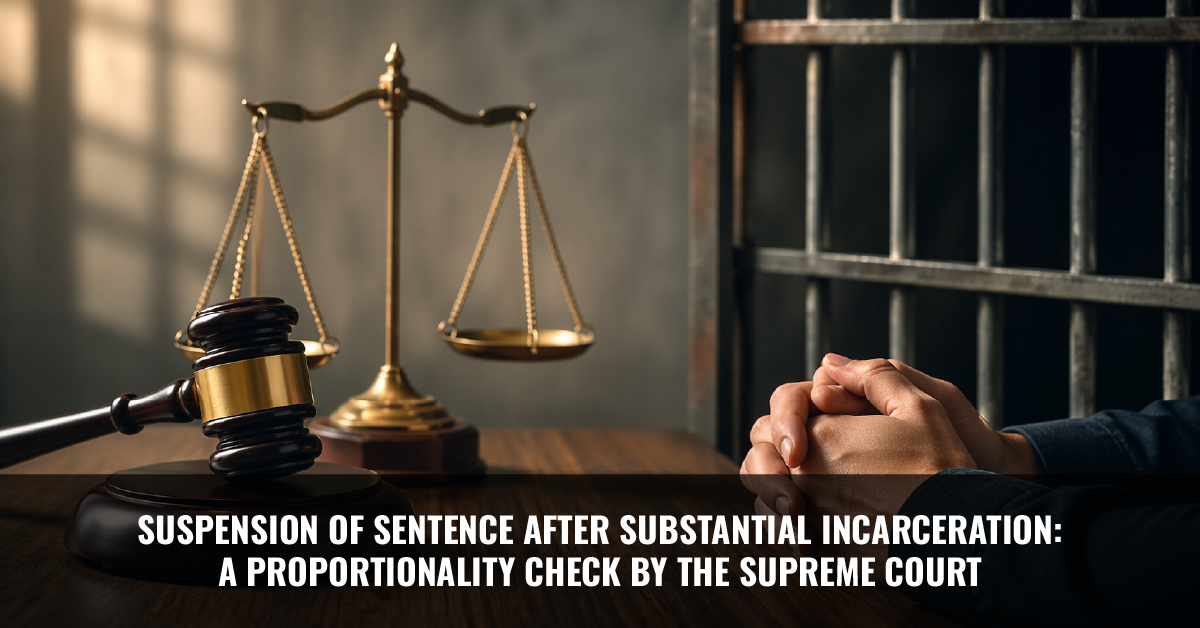
In Umesh Kumar alias Sonu v. State of Uttar Pradesh, the Supreme Court of India was called upon to examine whether continued incarceration of a convict—who had already undergone a significant portion of his sentence—was justified pending appeal. The decision reaffirms the judiciary’s commitment to proportionality in sentencing and the necessity of intervention where detention risks becoming excessive.
Factual Background
The petitioner had been convicted by the Sessions Court in January 2020 for offences under Sections 498A and 304-B of the erstwhile Indian Penal Code, and sentenced to ten years of rigorous imprisonment. By the time the matter reached the Supreme Court, he had undergone approximately seven years and two months of incarceration—amounting to over 70% of the imposed sentence—without remission.
Despite this substantial period already served, the Allahabad High Court declined to grant suspension of sentence in September 2024. Aggrieved, the petitioner approached the Supreme Court by way of a Special Leave Petition under Article 136 of the Constitution of India.
Legal Framework
The Supreme Court’s jurisdiction under Article 136 is discretionary and wide-ranging, enabling it to correct errors and prevent miscarriage of justice. In the context of suspension of sentence pending appeal, courts traditionally weigh multiple considerations, including:
- the duration of the sentence already undergone;
- the likelihood of delay in disposal of the appeal;
- the proportionality of continued detention; and
- broader interests of justice.
It is a well-settled principle that where a substantial part of the sentence has been served without remission, continued incarceration may warrant judicial reconsideration, particularly in the absence of compelling countervailing factors.
Analysis and Findings
The Supreme Court found the factual matrix to be compelling. The petitioner had already undergone more than two-thirds of his sentence, and there was no indication that the appeal would be heard in the immediate future. In such circumstances, the Court observed that further detention would be difficult to justify.
Implicit in the Court’s reasoning is a recognition that the criminal justice process must not result in punitive excess merely due to procedural delays. Continued incarceration, when a major portion of the sentence has already been served, risks undermining the principle of proportionality and fairness embedded in sentencing jurisprudence.
Decision
Setting aside the High Court’s order, the Supreme Court directed suspension of the sentence and ordered the petitioner’s release on bail, subject to conditions to be imposed by the trial court.
Significance
This decision reinforces an important doctrinal position: punishment must remain proportionate not only at the stage of sentencing but throughout the appellate process. Where prolonged detention ceases to serve a legitimate purpose—particularly in cases involving significant time already undergone—the courts are duty-bound to intervene.
The ruling thus serves as a pertinent reminder that the right to appeal must remain meaningful, and not be rendered illusory by extended incarceration pending adjudication.