
Written By: Apoorv Agarwal
When the process itself becomes the controversy
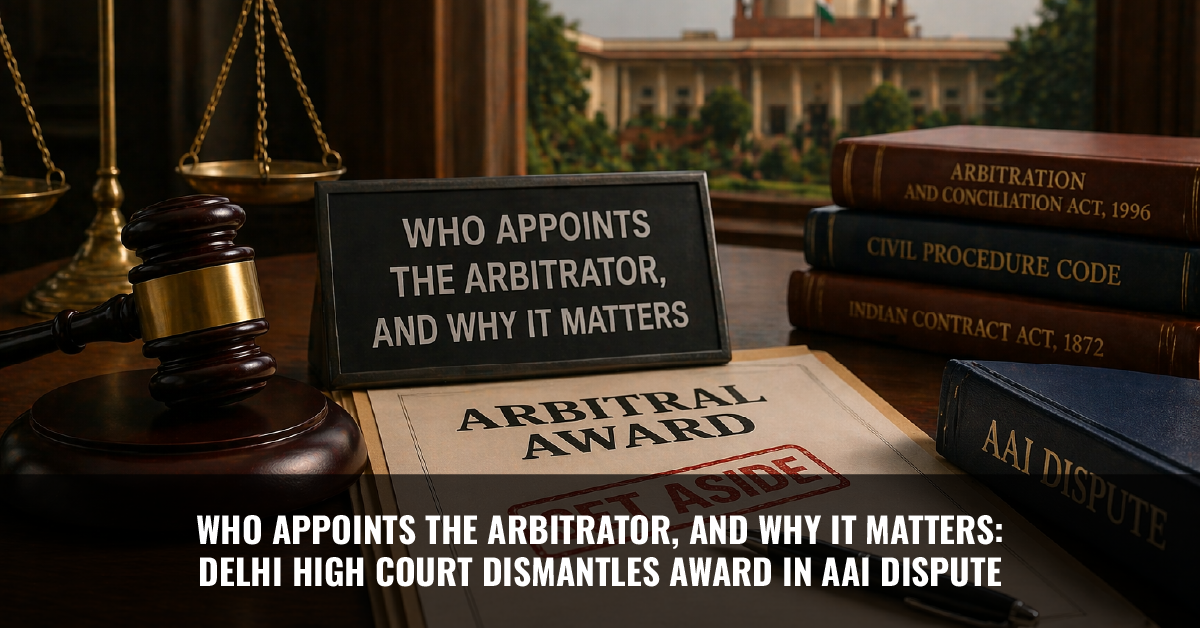
There are disputes in which the law is tested on the facts, and others in which it is tested on structure. The Delhi High Court’s decision dated 08 August 2025 in MS Era Infra Engineering Limited v. Airport Authority of India belongs firmly to the latter. The Court was not concerned with whether the arbitral tribunal had reached the correct conclusion on the claims before it. Instead, it was asked to consider whether the award could stand at all when the very process through which it was rendered was structurally compromised.
At the centre of the challenge lay a single, sharply defined question: can a party to a dispute unilaterally appoint a sole arbitrator and still claim that the resulting adjudication satisfies the requirement of neutrality?
The Court answered that question in clear and unambiguous terms. It held that such an appointment is legally unsustainable, and that an award rendered pursuant to it cannot be allowed to stand. What is striking about the decision is its refusal to engage with the merits. The Court does not examine whether the tribunal’s conclusions were right or wrong. It proceeds on a more fundamental footing, where the process itself is flawed at inception, the outcome cannot be salvaged.
The dispute: familiar facts, decisive flaw
The factual background is well known. The dispute originated from a construction contract for the New Integrated Terminal Building at Port Blair. The petitioner was the successful bidder, following which a Letter of Award was issued on 01 September 2014, and a formal agreement was executed shortly thereafter.
As is common in infrastructure contracts, disagreements arose during execution. These were first referred to the Dispute Resolution Committee, as stipulated in the contractual framework. The Committee rejected the petitioner’s claims. Arbitration subsequently ensued.
It was at this juncture that a critical element came into focus. The respondent proceeded to appoint a sole arbitrator, specifically, a retired engineer previously associated with the respondent organisation. The appointment was transparent and not procedurally irregular in a narrow contractual sense. However, it raised a structural concern that ultimately proved decisive.
The arbitral tribunal issued an award on 25 February 2022, dismissing the petitioner’s claims and upholding the respondent’s counterclaims. The petitioner then sought intervention under Section 34 of the Arbitration and Conciliation Act, 1996, challenging solely the validity of the tribunal’s appointment.
The earlier challengeand its limits
Prior to the rendering of the award, the petitioner sought to challenge the appointment of the arbitrator under Section 14 of the Act. That challenge was unsuccessful. The Court, at that juncture, noted that the issue could be raised before the tribunal in accordance with the procedure outlined in Section 13.
What is significant, however, is not the failure of the earlier challenge but the reasons behind it. The Court did not examine the question of impartiality on the merits; it merely indicated the appropriate procedural pathway. The issue itself remained unresolved. This distinction proved to be crucial in subsequent proceedings. It enabled the Court, at the Section 34 stage, to engage comprehensively with the question of neutrality, unburdened by the earlier order.
From Actual Bias to Structural Bias
The Court’s reasoning is grounded in a principle that has, in recent years, become a defining feature of Indian arbitration law. It references the decisions of the Hon’ble Supreme Court in TRF Ltd. v. Energo Engineering Projects Ltd. and Perkins Eastman Architects DPC v. HSCC (India) Ltd., which have clarified that a party with a vested interest in the outcome of a dispute cannot unilaterally appoint a sole arbitrator.
What is particularly noteworthy is the manner in which the Court articulates this principle. It does not focus on whether the arbitrator in fact exhibited bias. Instead, it addresses what may be termed structural bias. The central question is not the arbitrator’sconduct, but the manner of the arbitrator’sappointment.
When one party holds exclusive control over the tribunal’scomposition, the process inherently involves asymmetry. The Court asserts that such asymmetry is sufficient to generate a reasonable apprehension of bias. Demonstrating actual prejudice is not necessary. The flaw resides in the structural setup itself.
In the present matter, the appointment made by an official of the respondent authority directly falls within this principle. The Court found little difficulty in concluding that such an appointment is impermissible.
The argument of waiverand its rejection
The respondent attempted to counter this conclusion by invoking the doctrine of waiver. It was argued that the petitioner, having participated in the arbitral proceedings and having sought an extension of the arbitrator’s mandate pursuant to Section 29A, had effectively acquiesced to the appointment.
The Court unequivocally rejected this argument. It was held that waiver, as stipulated under Section 12(5) of the Act, must be made explicitly and in writing. It cannot be inferred from participation, conduct, or procedural necessity. Participation in arbitration does not remediate a defect in the constitution of the tribunal.
This aspect of the judgment is noteworthy. It prevents the deterioration of statutory safeguards through implication. If participation were deemed sufficient to constitute waiver, parties would be compelled to abandon proceedings entirely to preserve their objections—an outcome that the law does not contemplate.
Why did the earlier proceedings not bar the challenge
The respondent’s reliance on the earlier Section 14 proceedings was also carefully considered. The Court noted that the earlier order predated the decision in Perkins Eastman, which authoritatively settled the law on unilateral appointments. More importantly, it observed that the issue of impartiality had not been adjudicated at that.
In these circumstances, the Court held that the petitioner was not precluded from raising the challenge at the Section 34 stage. The reasoning reflects a pragmatic approach. Where a foundational issue has not been decided, and where the law has subsequently been clarified, procedural history cannot be used to foreclose a substantive challenge.
Neutrality as the foundation of arbitration
The judgment ultimately rests on a straightforward yet profound principle: arbitration, although based on consent, cannot operate beyond the confines of fairness. The autonomy granted to parties to organise the process does not extend to creating a mechanism that jeopardises neutrality.
The Court articulated this principle with clarity. Any individual or authority with an interest in the dispute, or connected to one of the parties, must not be vested with the sole authority to appoint an arbitrator. Such exclusivity, as the Court observed, fundamentally diminishes the fairness and credibility of the arbitral process.
This statement extends beyond the specifics of the case, affirming a broader doctrinethat adjudication must not only be conducted fairly but also be perceived as fair.
Setting aside the award and restoring the process
Having determined the invalidity of the appointment, the Court annulled the arbitral award in its entirety. The defect, being structural in nature, was deemed incurable. Regardless of the reasoning provided, the award could not be upheld.
Concurrently, the Court ensured that the dispute itself remained unresolved. With the parties’ consent, it appointed a new sole arbitrator under the auspices of the Delhi International Arbitration Centre. All rights and claims were preserved for resolution in the new arbitration.
This approach demonstrates both prudence and deliberation. It delineates the flawed process from the substantive dispute, rejecting the former whilst safeguarding the integrity of the latter.
Conclusion
The significance of the decision resides not in any novelty of doctrine but in the clarity with which it applies established principles. It reaffirms that arbitration cannot be reduced to a matter of contractual convenience. The process must contain within it the assurance of neutrality.
By setting aside the award solely on the ground of unilateral appointment, the Court has established a definitive boundary. Party autonomy, however broad, does not extend to structuring a tribunal in a manner that undermines impartiality. When the process itself is flawed, the outcome cannot be upheld.