
Written By: Apoorv Agarwal, Amrita Sony, Manav Goyal
Introduction
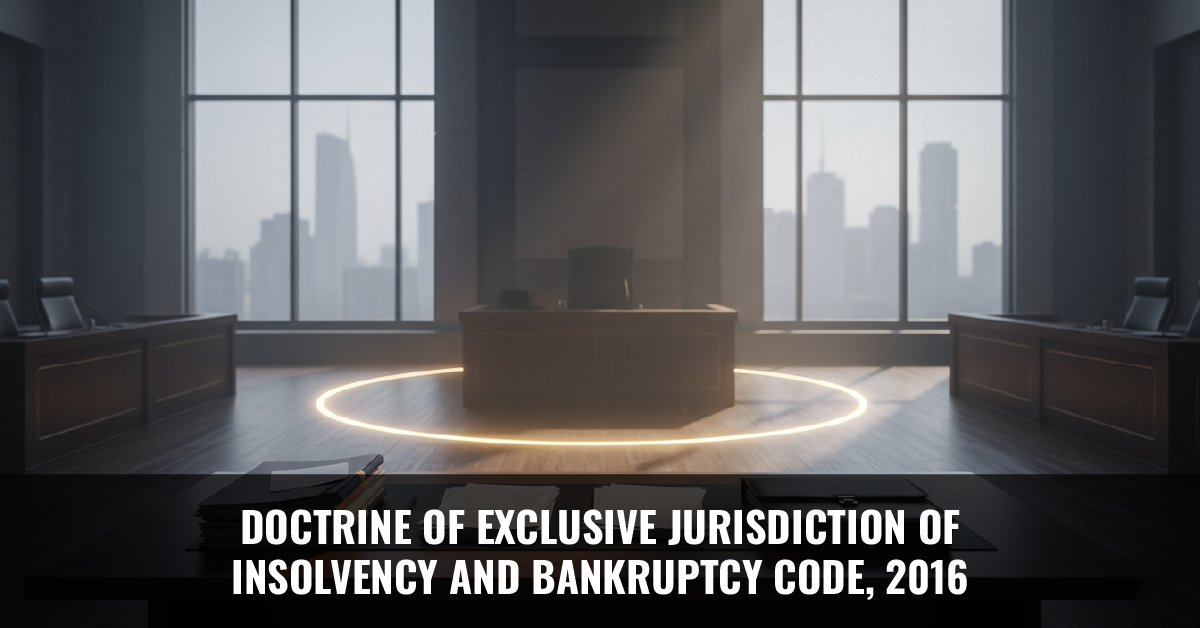
The Insolvency and Bankruptcy Code, 2016 (“IBC”) was enacted with a clear legislative mandate: to consolidate and amend the laws relating to reorganisation and insolvency resolution of corporate persons, partnership firms, and individuals in a time-bound, creditor-driven, and market-oriented manner. A key feature of this framework is the exclusive jurisdiction of specialised insolvency fora, under which disputes arising from insolvency proceedings are required to be adjudicated by the National Company Law Tribunal (“NCLT”) and the National Company Law Appellate Tribunal (“NCLAT”).
Despite this clear statutory procedure, insolvency proceedings in India have frequently faced parallel challenges before High Courts, invoking writ jurisdiction under Article 226 of the Constitution. Such interventions have the potential to derail Corporate Insolvency Resolution Processes (“CIRP”), disrupt statutory timelines, and undermine commercial certainty. In response, Indian courts, particularly the Supreme Court, have gradually evolved the Doctrine of Exclusive IBC Jurisdiction, reinforcing the position that once the IBC is triggered, recourse must ordinarily be confined to the remedies provided within the Code itself.
Through a consistent line of decisions, the Supreme Court has articulated what may now be described as a doctrine of exclusive IBC jurisdiction, requiring constitutional courts to exercise marked restraint once the insolvency framework is set in motion.
IBC as a Self-Contained Insolvency Regime
IBC is regarded as a complete code because it is designed to comprehensively deal with insolvency and bankruptcy issues within a single, unified framework. It vests jurisdiction in the National Company Law Tribunal (“NCLT”) for the initiation, conduct, and conclusion of insolvency proceedings, and provides a structured appellate hierarchy culminating in the Supreme Court. Importantly, it expressly bars the jurisdiction of civil courts[1], thereby ensuring that insolvency disputes are confined to the specialized fora created under the Code. This design prevents fragmentation of proceedings and promotes certainty, efficiency, and uniformity in insolvency resolution.
Further, Section 238 of the IBC explicitly states that its provisions shall have effect notwithstanding anything inconsistent contained in any other law. This means that once insolvency proceedings are initiated under the IBC, other forums such as civil courts, company law tribunals, or debt recovery tribunals cannot interfere or run parallel proceedings on the same subject matter. The rationale is to ensure speed, certainty, and uniformity in insolvency resolution, preventing multiplicity of litigation and conflicting decisions that could undermine the objective of timely resolution and maximisation of asset value.
Emergence of the Doctrine through Judicial Interpretation
While the IBC does not explicitly use the phrase “exclusive jurisdiction”, Indian courts have progressively articulated this doctrine through judicial interpretation.
In Duncans Industries Ltd. v. A.J. Agrochem[2]the Supreme Court laid the early and foundational basis for treating the IBC as a complete and overriding insolvency framework. The dispute arose from an alleged conflict between the IBC and the Tea Act, 1953, under which prior consent of the Central Government was argued to be a prerequisite for initiating insolvency proceedings. Rejecting this contention, the Court held that the IBC is a self-contained code, enacted to comprehensively govern insolvency resolution in a time-bound manner, and cannot be subjected to additional conditions drawn from earlier sector-specific legislations. Relying expressly on Section 238 of the IBC, the Court held that the IBC, being a later and special legislation, would prevail over inconsistent requirements under the Tea Act. The Court further clarified that the corporate insolvency resolution process cannot be equated with winding-up proceedings and that importing external statutory approvals would frustrate the core objectives of the IBC. This decision firmly established that once insolvency is governed by the IBC, its statutory scheme must operate exclusively and without dilution by parallel legislative regimes.
In Bharti Airtel Limited &Anr. v. Vijaykumar v. Iyer & Ors.[3] the Supreme Court authoritatively reaffirmed that the IBC is a complete and comprehensive code governing insolvency and bankruptcy in India. The Court observed that it was enacted to consolidate and amend the law relating to reorganisation and insolvency resolution of corporate persons, partnership firms and individuals in a time-bound manner, with the objectives of maximisation of asset value, promotion of entrepreneurship, availability of credit, and balancing the interests of all stakeholders. Emphasising the codified nature of the regime, the Court held that the IBC exhaustively occupies the field of insolvency law and is self-contained, except where it expressly permits the application of other statutes. The Court further noted that this legislative design is reinforced by Section 238 of the IBC, which accords the Code an overriding effect over all inconsistent laws. This recognition of the IBC as a complete code strengthens the doctrine that insolvency-related disputes must be addressed within the statutory framework of the IBC, leaving little scope for parallel or external remedies.
The Supreme Court further strengthened this position in Indian Overseas Bank v. RCM Infrastructure Ltd. &Anr.[4]where it reiterated that the IBC is a complete code whose provisions prevail over all inconsistent laws by virtue of Section 238. The dispute arose in the context of enforcement proceedings under the SARFAESI Act, and a sale conducted thereunder vis-à-vis the commencement of the CIRP. The Court held that it has been consistently recognised that once CIRP is initiated, the statutory scheme of the IBC assumes primacy, and any parallel action or consequence under other enactments inconsistent with the Code cannot be sustained. By affirming the overriding effect of the IBC over recovery mechanisms such as SARFAESI, the Court underscored that insolvency resolution is not merely another mode of debt recovery, but a comprehensive and exclusive process governed entirely by the IBC framework. This decision reinforces the doctrinal position that statutory remedies under the IBC cannot be diluted or bypassed by recourse to parallel proceedings under other laws.
In the most recent judgment of the Supreme Court in Mohammed Enterprises (Tanzania) Ltd. v. Farooq Ali Khan & Ors.[5]the Court held that the IBC is a complete code in itself, having sufficient checks and balances, remedial avenues and appeals, while deprecating High Court interference with CIRP under Article 226. The dispute arose in the backdrop of an ongoing CIRP against the corporate debtor, i.e., Associate Decor Ltd. which commenced on 26.10.2018 on a financial creditor’s Section 7 application; during CIRP the Resolution Professional issued an information memorandum, invited plans, and the plan of Mohammed Enterprises (Tanzania) Ltd. (“METL”) was considered in several CoC meetings and finally approved on 11.02.2020 with 100% CoC voting share, while a “resettlement proposal” of the suspended director (Respondent No. 1) was rejected. Parallelly, Swamitva, a disappointed applicant, litigated before NCLT and NCLAT; NCLAT’s order dated 19.09.2022 upholding the approval of METL’s plan was affirmed by the Supreme Court on 25.11.2022. Respondent No. 1 himself filed an interlocutory application before NCLT on 06.10.2022 seeking rejection of METL’s plan, but subsequently, on 04.01.2023 almost three years after the key CoC meeting of 11.02.2020 filed a writ petition before the Karnataka High Court under Article 226 challenging the CoC minutes, the declaration of METL as successful resolution applicant, and the rejection of his later Section 12A settlement proposal, and sought directions to accept his proposal instead. The High Court granted interim status quo, and by its final judgment dated 22.04.2024 set aside METL’s resolution plan primarily on the ground that only about 24 hours’ notice was given for the crucial 19th CoC meeting, which it treated as a violation of principles of natural justice.
On appeal, METL, the consortium banks and the Resolution Professional argued that the writ petition was grossly belated, that Respondent No. 1 had already invoked the statutory IBC remedy before NCLT on identical grounds, and that the High Court should not have interfered with CIRP given IBC’s self‑contained framework and the imperative of timely resolution. The Solicitor General supported this stance, relying on earlier orders such as CoC of KSK Mahanadi Power Co. Ltd. v. U.P. Power Corporation Ltd.[6] to contend that indiscriminate writ interference “breaches the discipline of law” under the IBC. Respondent no. 1, through senior counsel, maintained that Article 226 jurisdiction survives notwithstanding alternative remedies where natural justice is violated, citing Whirlpool Corporation v. Registrar of Trade Marks, Mumbai and Ors.[7]that his Section 12A settlement proposal was financially superior and to be tested under Regulation 19, and that the intervening Swamitva litigation explained the delay in approaching the High Court.
The Supreme Court allowed the appeals, holding that the writ petition suffered from serious delay and laches, since the cause of complaint (the 11.02.2020 CoC meeting) was nearly three years prior to the writ filing, and, in any event, Respondent No. 1 had already invoked the dedicated IBC remedy before NCLT, to which he should have been confined. The Court emphasised that the NCLT has wide jurisdiction under Section 60(5)(c) to deal with issues arising “out of or in relation to” insolvency resolution, as recognised in earlier decisions such as Committee of Creditors of Essar Steel India Ltd. v. Satish Kumar Gupta[8]and Gujarat Urja Vikas Nigam Limited v. Amit Gupta[9]and that CIRP had been pending since 2018 with METL’s plan approved in 2020, making expedition critical. In a key passage, the Court stated that the “Insolvency and Bankruptcy Code is a complete code in itself, having sufficient checks and balances, remedial avenues and appeals”, and that, although High Courts retain supervisory powers, their exercise in IBC matters demands rigorous restraint; on these facts, it was certainly not a case for the High Court to interdict CIRP. Accordingly, the Supreme Court set aside the Karnataka High Court’s judgment, restored the IBC process, and directed the NCLT to resume and complete the proceedings from the stage at which they had been halted, in the spirit of time‑bound resolution mandated by the Code.
Conclusion
The doctrine of exclusive IBC jurisdiction has emerged as a necessary judicial response to preserve the integrity, efficiency, and objectives of India’s insolvency framework. Through a consistent line of decisions, the Supreme Court has clarified that IBC is not merely one among several remedial statutes, but a comprehensive and self-contained code intended to govern insolvency resolution in its entirety. The recognition of the IBC’s overriding effect under Section 238, coupled with the express exclusion of parallel civil jurisdiction, reflects a clear legislative intent to centralise insolvency adjudication within specialised fora.
Judicial pronouncements from Duncans Industries to Mohammed Enterprises demonstrate a steady progression from resolving statutory conflicts with prior enactments, to subordinating parallel recovery mechanisms, and finally to circumscribing constitutional intervention during the pendency of CIRP. In Mohammed Enterprises, the Supreme Court decisively reinforced that the availability of adequate remedies, safeguards, and appellate avenues within the IBC framework warrants judicial restraint, even in the exercise of writ jurisdiction under Article 226. This marks an important doctrinal shift from tolerance of parallel proceedings to a principled insistence on exclusivity.
At the same time, the Court has been careful not to suggest an absolute bar on constitutional powers, instead emphasising that such jurisdiction must be exercised sparingly and only in exceptional circumstances. The doctrine of exclusive IBC jurisdiction thus represents a calibrated balance between constitutional oversight and legislative design, ensuring that insolvency resolution remains predictable, time-bound, and insulated from disruptive interference. As insolvency jurisprudence continues to evolve, this doctrine will remain central to maintaining confidence in India’s insolvency regime and achieving the economic objectives underlying the Code.
[1]Section 231 of The Insolvency and Bankruptcy Code, 2016
[2] Civil Appeal No. 5120 of 2019, [2019] 12 S.C.R. 830, 2019 INSC 1136
[3]Civil Appeal No. 3088 of 2020, [2024] 1 S.C.R. 140, 2024 INSC 15
[4] Civil Appeal No. 4750 of 2021, [2022] 7 S.C.R. 1090, 2022 INSC 584
[5] Civil Appeal No. 48 of 2025, [2025] 1 S.C.R. 177, 2025 INSC 25
[6] Civil Appeal No. 11086 of 2024, dated 14.10.2024
[7] [1998] Supp. 2 SCR 359
[8] [2019] 16 SCR 275 : (2020) 8 SCC 531
[9] [2021] 13 SCR 611 : (2021) 7 SCC 209